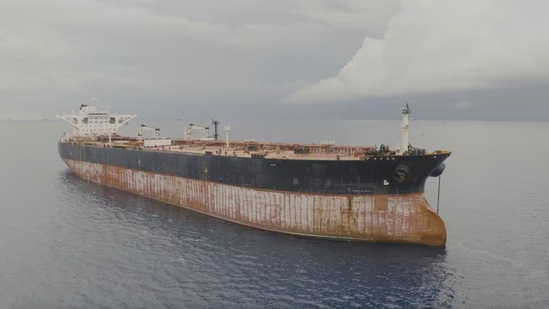
EASTERN OUTER PORT LIMITS—In this nautical no-man’s-land 45 miles off the coast of Malaysia, tankers laden with sanctioned Iranian oil sit low in the water, waiting to offload their cargo to vessels bound for Chinese refineries.
They lower tarps and other objects over the names on their hulls and use black paint to conceal identity numbers. They’re here to carry out an elaborate deception: offshore trysts known as ship-to-ship transfers, in which one vessel offloads sanctioned oil onto another to help obscure the oil’s origins before it is sent on to Iran’s biggest customer.
These clandestine oil transfers reveal a key strength of the Iranian regime and a major reason why it has been able to hold firm for so long against American pressure: Iran can still sell its oil. In negotiations, the U.S. has so far resisted lifting oil sanctions against Iran. But the regime’s workaround is still bringing in crucial hard currency.
The Wall Street Journal recently observed this up close. On a May 8 visit by boat, Wall Street Journal reporters watched as the Catalina 7, an aging vessel sanctioned by the U.S. for carrying Iranian crude, transferred oil through a thick hose with a ship whose name was covered by black paint.
The ships had lowered giant fenders between them to prevent the Catalina 7 from crushing the smaller ship as they rolled in the waves. Workers in orange vests and hard hats scurried around the Catalina 7’s deck during the transfer.
Old and rusting tankers like these form what maritime experts call the “shadow fleet,” a roving armada of hundreds of vessels that ferry oil for sanctioned regimes, including Iran and Russia. Iran relies on such tankers for nearly all of its oil exports.
The ships, sometimes uninsured, have hidden owners and sail under “flags of convenience” from countries that pay little scrutiny to what the vessels are doing. At sea, the ships use deceptive practices such as turning off their tracking devices to make it harder to follow them.
Washington’s failure to stop the fleet, which has mushroomed in size in recent years, helps explain why the Iranian regime has proved so resilient.
Despite U.S. efforts to suffocate the smuggling, Tehran reaped around $31 billion in oil revenue from China last year, according to the U.S.-China Economic and Security Review Commission, a Congressional group. That amounted to around 90% of the oil Iran sold abroad and accounted for about 45% of its government’s budget, the group said.
As Iran’s main lifeline, China helps ensure the shadow fleet for Iranian oil stays afloat. Many entities that act as the tankers’ legal owners are registered in Chinese cities, and many of the ships’ crews come from China. This month, China’s government explicitly ordered domestic firms not to comply with U.S. sanctions on five Chinese refineries, invoking for the first time a 2021 “blocking rule” designed to neutralize foreign laws it believes violate international norms or restrict trade.
Before the U.S. war in Iran began, China was getting around 1.4 million barrels a day from the country, or roughly 12% of its oil imports, at a discount to international prices.
The U.S. has dramatically escalated its fight against the trade recently. In addition to blockading Iranian ports, it has imposed a flurry of new sanctions against oil tankers and Chinese oil infrastructure. It recently dispatched U.S. Special Forces to rappel down from helicopters onto the decks of two shadow tankers in the Indian Ocean.
Last week, the U.S. seized a third Iran-linked oil tanker in the Indian Ocean after it had visited the coast off Malaysia. The ship was likely loaded with more than a million barrels of crude at Iran’s Kharg Island in February, the Journal reported, and appeared to be heading back to the Middle East when it was seized.
To truly rein in the fleet, though, the U.S. would likely need to maintain a warlike footing against the ships indefinitely, keeping its blockade on Iranian ports, using military assets to intercept shadow-fleet ships, and intensifying pressure on China. If it lets up, the oil would likely flow uninterrupted again, maritime experts say.
Energy analytics company Vortexa recently estimated there were some 90 million barrels of Iranian oil outside of the blockade, most or all of which left Iranian waters before the closure began. The oil is effectively in offshore storage, potentially providing billions of dollars in additional funds to the Iranian regime in the coming months.
It takes two to three months for Iranian oil to reach Chinese ports, and another two to three months for Iran to receive payment, so even if the Strait of Hormuz doesn’t reopen, Iran will likely be receiving money for its oil on the water until October, said Iman Nasseri, managing director of Middle East Research at energy analytics company FGE NexantECA in Dubai, who once worked in the research arm of Iran’s Ministry of Petroleum.
“Economic Fury was supposed to bring them to their knees,’ he said, referring to the U.S. economic campaign against Iran. But compared with other oil exporters in the region “Iran is suffering the least,” he said.
A U.S. Treasury Department spokeswoman said the department is pursuing shadow fleet targets, and that U.S. sanctions are depriving the Iranian regime of oil revenue to fund weapons programs and terrorism.
“Under President Trump’s strong leadership, Treasury will continue to stop the Iranian regime from plundering the country’s natural resources in the name of terrorism,” the spokeswoman said.
China’s Foreign Ministry has said it firmly opposes the U.S. clampdown, which it says involves “illegal and unreasonable unilateral sanctions,” and that it would do whatever is necessary to protect its energy security. The ministry didn’t respond to a request for comment on this article.
Officially, China hasn’t logged any imports of Iranian oil since 2022. Analysts say this likely reflects a desire by Beijing to avoid having more of its refineries, ports and banks sanctioned by Washington. Despite China’s open criticism of U.S. sanctions, having more of its economy cut off from the dollar financial system would cripple its export machine.
Sleuths are able to track the shipments, however, by following occasional pings from the shadow ships’ transponders, which are sometimes turned on for safety to navigate narrow straits. Researchers supplement that information with satellite images of the vessels making ship-to-ship transfers and then docking in Chinese ports, enabling them to trace the oil’s journey from Iran to China.
The shipments also show up in other ways: Customs data record that China imported 126 million barrels of oil from Malaysia and 102 million barrels from Indonesia in the first four months of the year. Those numbers exceeded the past production levels of the two countries, and are seen by analysts as proxies of China’s estimated crude oil imports from Iran.
The oil typically goes to private refineries, called teapot refineries, in the eastern Chinese province of Shandong and northeastern province of Liaoning. Because these operations rely mainly on Chinese banks and customers, and don’t interact with the U.S. financial system, they are beyond the reach of U.S. sanctions.
‘Epicenter of lawlessness
The Eastern Outer Port Limits, or EOPL, as the area is known in the shipping industry, has become a pivotal pit stop for the oil, serving as the location of choice for ship-to-ship transfers that Chinese buyers and Iranian sellers use to help dodge the sanctions.
Located midway between Chinese and Iranian waters, the roughly 500-square-mile area usually has calm waters and is within Malaysia’s exclusive economic zone, yet outside of its territorial waters. That makes it a legal gray area where there’s little urgency for anyone to claim responsibility.
In one common scenario, a shadow fleet ship picks up oil in Iran and sets sail for the EOPL. There, it transfers the oil to another vessel. Then, the second ship proceeds to China, where the oil is offloaded and sent to a refinery.
In addition to helping disguise the oil’s origin, the transfer often moves the crude from a sanctioned ship to an unsanctioned one, lowering risks for the Chinese port that receives it.
Maritime Vice Admiral Saiful Lizan bin Ibrahim, a senior official in Malaysia’s coast guard, acknowledged the shadow fleet’s presence near Malaysia. But he said it is hard to intervene because the ships often operate outside of Malaysia’s “direct enforcement jurisdiction,” and use evasive tactics, switching locations whenever law enforcement pressure rises.
He added that Malaysia maintains a neutral foreign policy and doesn’t automatically comply with unilateral sanctions. It also has limited resources for maritime surveillance. Even so, it has detained more than a dozen vessels for unauthorized anchoring this year, he said.
In early May, when the Journal chartered a supply boat to visit the area, it resembled a giant tanker parking lot, with dozens of ships.
Between 2023 and 2025, the number of observed ship-to-ship transfers in the EOPL more than doubled, from 280 to 679, according to United Against Nuclear Iran, or UANI, a U.S.-based advocacy group that uses satellite data to track them, which cited strong Chinese demand.
“This is a critical logistics node,” said Charlie Brown, a former U.S. naval officer based in Singapore who works for UANI. “China cannot get its oil from Iran without going through the EOPL.”
In all, some 1.4 million barrels of oil a day passed from Iran to China via the shadow fleet over the past year, according to TankerTrackers.com.
An entire offshore ecosystem has sprung up to service the ships, which can’t easily enter international ports because they’re sanctioned.
Bunker vessels hunker in the area for months or years, providing a steady supply of fuel. Support ships carrying supplies or repair crews are commissioned from the shore—at a hefty price, because of the remote location, and to compensate for the sanctions risks that come with servicing the shadow fleet.
Peddlers speed by in small boats known as sampans, offering crew members cigarettes and Indonesian Bintang beer. Bored sailors pass time by joking on the radio, meowing like cats and slinging random curses at passing ships.
It’s a “little epicenter of maritime lawlessness,” said Michelle Bockmann, a maritime intelligence analyst at Windward, saying ships used a “smorgasbord of deceptive shipping tactics” to stay off authorities’ radars.
Some, such as the Catalina 7, stay around for weeks as floating oil platforms. They fill up with Iranian and Russian oil from passing tankers and redistribute it to other ships.
The Catalina 7, built in 2007, is registered to a Hong Kong-based company called Canes Venatici, which means “hunting dogs” in Latin, and is sanctioned by the U.S. for its links to the Iranian oil trade.
It couldn’t be determined who owns Canes Venatici. No one was present when a Journal reporter visited its registered address, a secretarial service in an old building in Hong Kong’s Kwun Tong area. A neighbor said the office rarely had any staff, just an occasional visitor to collect mail.
On recruiting websites, a seafarer surnamed Wang posted that he was recently on the Catalina 7 between last May and this March, traveling between Southeast Asia and China. His employer, according to his post, is PrimCrew Global, a Shandong-based staffing company that didn’t reply to requests for comment.
Another Chinese crew member involved in ship-to-ship transfers off Malaysia’s coast told the Journal that transferring sanctioned oil had become routine. He said he saw nothing wrong with the maneuverer, because neither he, nor China’s government, recognizes the validity of U.S. sanctions.
Growing fleet
Iran tapped the shadow fleet to transport its oil after the Obama administration tightened sanctions in 2012, and increased its use after Trump ratcheted up pressure in 2018. The shadow fleet, which also transfers other sanctioned countries’ oil, grew rapidly to accommodate Russian oil after the 2022 invasion of Ukraine, and now numbers around 1,500 ships according to TankerTrackers.com.
Typically, the tankers’ ownership is hidden under layers of shell companies in Chinese cities or other places such as Dubai.
The ships also frequently switch their flags. Just as people have nationalities and passports, merchant vessels must be registered to individual countries, which are supposed to ensure proper labor practices and other standards are adhered to onboard.
Shadow-fleet shipowners avoid such scrutiny by securing flags from poor, developing countries such as Sierra Leone, which collect fees for registering the ships, but provide little oversight.
All of this makes fighting the proliferation of shadow fleet ships a game of whack-a-mole. After being sanctioned, they can change their names or the names of their ownership companies, along with the ship’s flag, and then return to business.
One 800-foot oil tanker built in 2004, known as Seasky, was sometimes chartered by Western oil companies before being sanctioned by the U.S. in 2025 for transporting Iranian oil on behalf of the National Iranian Oil Company.
The ship swiftly changed its flag from San Marino to Gabon, and its name from Seasky to Hanson. It then completed numerous roundtrips between the EOPL off Malaysia’s coast and the Chinese city of Dongying, a teapot-refinery hub, according to financial data provider LSEG.
Neither the ship’s registered owner, Seasky Marine Co. in Shanghai, nor its staffing agency Taihua Ship Management, replied to emails seeking comments.
China connections
In China, a cottage industry has sprung up to ensure the shadow fleet stays operational and delivers its oil to refineries.
Ship management companies openly advertise jobs on the tankers, even though such postings could put them at risk of violating U.S. sanctions.
“Short-haul transport of methanol from Iran to the rest of the Persian Gulf; crew change in Dubai,” said one advertisement posted this month by a ship management company in the city of Xi’an recruiting seafarers. The captain would get paid $26,000 a month, around twice as much as for more routine journeys.
Lower-level Chinese staff on shadow-fleet tankers typically get paid about $1,000 to $3,000 more per journey than they would on more standard routes, according to videos posted by Chinese crew members on social media.
Some of these Chinese sailors have been stuck in the Strait of Hormuz for nearly 90 days. In regular casual chats with a Journal reporter, many voiced their strong preference for Chinese chefs on board and lamented the lack of fresh water and the dominance of fish in their current diet.
The companies have to pay more because of the known risks of signing up for a shadow-fleet gig. In addition to being sanctioned, the ships are often past 15 years old, which is when parts start breaking down. There is also a greater risk of oil spills and crew injury.
In May 2023, the 26-year-old shadow tanker Pablo blew up off the coast of Malaysia, killing three crew members. The ship, which researchers had linked to Iranian oil transfers, had been sailing under a Gabonese flag. No owner ever claimed the vessel, which was later towed away and dismantled.
Tracking Nora
Sometimes, authorities do act. In January, Malaysia detained a U.S.-sanctioned vessel, the Nora, a 24-year-old ship registered in Shanghai which was carrying Iranian oil and conducting a ship-to-ship transfer in the region.
Malaysian authorities said they collected fines from an agent for the Nora totaling around $33,000, and then released the ship and its crews, saying the case showed “the significant economic implications” of syndicate operations.
Emails and calls to the ship’s Shanghai-based manager, Shanghai Tucson Roy Shp Mgmt, were unanswered.
The Nora wasted little time getting back in business, however.
Satellite tracking data showed the ship docked at Kharg Island, Iran’s main oil export hub, in early March. It then crossed the Strait of Hormuz, laden with oil, before the U.S. embargo blocked Iran-linked ships from leaving, and traveled back to off the coast of Malaysia.
In late April satellite data captured the Nora discharging oil onto another ship, the Luna Luster, which sped off to the waters of northern China, and is currently hanging around near Rizhao, a key port city for teapot refineries, waiting to discharge its oil, according to LSEG. On May 19, Washington sanctioned the Luna Luster, saying the Sierra-Leone flagged tanker has transported millions of barrels of Iranian oil since mid-2025.
A Journal reporter spotted the Nora from a passing boat off the coast of Malaysia this month. The ship had painted over its name and identity number, and turned off its tracking signal. But an incomplete paint job meant its name was still visible through binoculars.
It has declared a new nationality at least seven times over the past decade, and for a while was flagged as Iranian, but since last year it has flown a false Guyanese flag, according to public records.
After the Journal reporter saw the ship this month, satellite images captured the Nora in another ship-to-ship transfer. This time, it was on the receiving end, offloading oil from the Iran-flagged Derya, one of the last tankers to cross the Strait of Hormuz around the time the blockade began.
It was proof, yet again, said Brown, the researcher at UANI, that “sanctions alone don’t stop the ships.”
Write to Jon Emont at jonathan.emont@wsj.com and Rebecca Feng at rebecca.feng@wsj.com