THERE WERE many Marilyn Monroes. In the 1940s a young actress named Norma Jeane swapped her normal-sounding name for this more glamorous one; Marilyn, she felt, was “a veil” she could wear. Then came Hollywood Marilyn and, soon enough, sex-symbol Marilyn. Others emerged in gossip: there was girlish Marilyn who called her husband “Daddy”; political Marilyn who sang to (and probably slept with) the president; and even literary Marilyn, who read Dostoevsky and married Arthur Miller, a playwright. Later Marilyn became a tragic figure, dying from an overdose in 1962, aged 36.
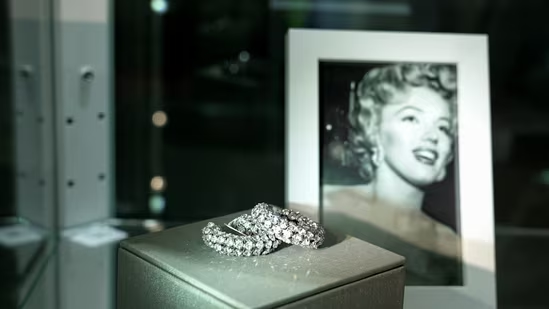
Memorabilia belonging to late model and movie star Marilyn Monroe is displayed alongside a photograph during a preview ahead of an upcoming auction in Los Angeles (REUTERS/FILE)
This year there are almost as many celebrations as there are versions of Marilyn: June 1st marks the centenary of her birth. There are exhibitions at the National Portrait Gallery in London and the Academy Museum of Motion Pictures in Los Angeles, as well as new books and film screenings. At commemorative auctions fans can bid on everything from Marilyn’s used lipstick to a tile from her bathroom. New products are also being released: you can sip Marilyn champagne, hold Marilyn china or wear jewel-encrusted Marilyn high heels. And if that’s not too many Marilyns, 500 or so will gather in Palm Springs on May 30th to try to break the world record for the largest gathering of Marilyn lookalikes.
The celebrations are not only fuelled by adoration. Much of the centenary was planned by the firm that owns the rights to Monroe’s estate and intellectual property (IP). Founded in 2010, Authentic Brands Group acquired Marilyn as its first celebrity estate; today its portfolio includes Elvis Presley and Muhammad Ali.
You can make a killing from the IP of bygone celebrities. Authentic claims to make $80m a year in sales from Monroe’s estate alone. (The company is the second-largest IP-licensing business by revenue in the world, after Disney, with a mix of celebrity estates and other brands expected to bring in more than $38bn this year.) Anyone who was anyone—from Albert Einstein to Rosa Parks—has an agent to license their IP.
The business of profiting from dead celebrities is legally complex. Estates own what Mark Roesler, head of CMG, the firm servicing both Einstein and Parks, calls “a portfolio of IP”. This includes copyrights, trademarks and “right of publicity”, which in some American states allows estates to control the commercial use of the celebrity’s likeness, name and voice. (Monroe had few relatives, so Authentic snapped up the whole estate.)
The market grew in the late 1970s and early 1980s, driven in part by Presley’s death and his estate’s efforts to stop others profiting from his likeness; post-mortem publicity rights expanded, says Jennifer Rothman, the author of a book on the subject. Celebrity identities came to be seen as something that could be inherited like other property. Estates saw an opportunity.
The dead-celebrity business is profitable for two other reasons. First, famous faces sell products. Einstein’s likeness has been used to plug reading glasses; Presley’s to sell red wine. (Some deals are turned down: CMG rejected a plan to make James Dean condoms, for example.) Brand deals help Monroe keep “pace” with modern culture, says Dana Carpenter, who oversees her estate at Authentic. Though her name is sometimes used to promote products she might have been baffled by, such as trendy LED face masks, the aim is to find a new generation of fans.
Second, celebrity IP can help tell longer stories. In theory anyone could make a biopic or documentary about Monroe or Einstein, but estates often have the rights to copyrighted materials that are useful to film-makers. Authentic licensed IP for the “Elvis” biopic; CMG, who works with Robert Oppenheimer’s estate, helped with the film “Oppenheimer”. In 2023 Authentic launched its own production studio, and co-produced the recent film “EPiC: Elvis Presley in Concert”, directed by Baz Luhrmann. As Jamie Salter, boss of Authentic, puts it, the most successful estates think not only about “preserving the past”, but also “participating in culture”.
They think about the future, too. In particular, firms are finding ways to use AI and holograms to bring back stars for live tours and fan experiences. In 2024 Authentic partnered with Soul Machines, an AI firm, to create a “digital Marilyn” who is “authentic and responsive”. The avatar wears Monroe’s signature red lipstick and says “darling” with alarming frequency.
Yet AI has also made it easier for others to use a celebrity’s likeness and voice. Now even a student in his bedroom can create a cartoon that looks or speaks like a star. It has become a bit like a game of “whack-a-mole” to get the “unauthorised” likenesses off the web, admits Mr Roesler. (Estates have long demanded payment for the right to use a star’s words or identity in films and adverts, and even on monuments.)
Celebrities who are still alive are also thinking about the future of their personal brands. Authentic has a roster of “living legends”, including Sir David Beckham, an ex-footballer. Unlike with Monroe’s estate, these stars are co-owners of their brand and actively collaborate on IP deals. Since partnering with Authentic in 2022, brand Beckham has plugged everything from beer to wireless headphones.
Monroe believed that she “belonged to the public and to the world”. Thanks to Authentic, people will know her for longer than she could have imagined—whether as a film star, a digital avatar or the beautiful face on a bottle of champagne.
For more on the latest books, films, TV shows, albums and controversies, sign up to Plot Twist, our weekly subscriber-only newsletter