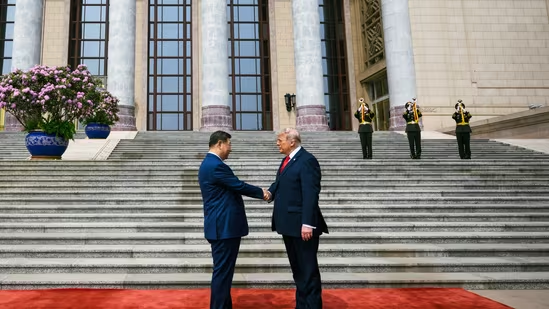
US President Donald Trump signaled China is willing to support negotiations with Iran, as he pushes for a diplomatic resolution to end the war and reopen the Strait of Hormuz, after a commercial vessel was apparently seized near the United Arab Emirates.
Trump, who is visiting Chinese President Xi Jinping in Beijing, said his counterpart offered to help, something China has not explicitly confirmed. In a readout of the meeting between Trump and Xi, a White House official said the two sides agreed that the Strait of Hormuz must be open to support the free flow of energy.
“He said he’s not going to give them military equipment,“ Trump said, according to a clip of an interview with Fox News. “President Xi would like to see a deal made. He would like to see a deal made. And he did offer, he said if I can be of any help at all I would like to be of help.”
China is the Islamic Republic’s largest oil buyer and a key diplomatic partner, granting it a degree of diplomatic sway over the Islamic Republic. It supplies Tehran with goods from consumer products to electronics.
Also Read: Xi’s subtle Taiwan warning, Trump’s eulogy of China-US ties: Who said what at key summit in Beijing
A commercial vessel was apparently seized by unauthorized personnel near the United Arab Emirates earlier on Thursday, adding to uncertainty over control of the critical Strait of Hormuz. The ship, whose identity wasn’t disclosed, was taken 38 nautical miles off the UAE coast, the UK Maritime Trade Operations said, adding the vessel was bound for the Islamic Republic.
The incident happened as there appears to be an uptick in vessels transiting the strait, which usually handles about a fifth of the world’s oil and liquefied natural gas supply. Its effective closure since the US and Israel began bombing Iran in late February has upended energy markets and led to global supply shortages.
Iran said Thursday a number of Chinese vessels will transit the strait following discussions with Beijing’s foreign ministry, the semi-official Fars news agency reported, citing a source it didn’t identify. Vessels will be allowed through according to “Iranian management protocols,” the agency added.
A separate report by Iranian state TV said over 30 ships have been allowed passage through the strait since Wednesday night, according to an official from the Islamic Revolutionary Guard Corps’ navy.
The US hasn’t commented on movements through the Persian Gulf’s chokepoint, where it’s refused to lift a blockade on Iranian ports. Yet, ten vessels carrying oil, fuel and gas have made it through since Sunday, an increase from recent weeks.
Oil prices held steady on Thursday, with Brent crude trading at about $105 a barrel after falling 2% in the previous session. They’ve risen by nearly 50% since the war began, and the International Monetary Fund has warned of a broad slowdown in global growth.
Also Read: Oil holds steady after Trump-Xi meeting signals hope for US-China cooperation
The US-Iran ceasefire that’s been in place since April 8 has broadly held, though negotiations have reached a deadlock. Iran continues to resist US demands to reopen Hormuz and says it will only do that if Washington ends its naval blockade. It’s also insisting that the US unfreezes billions of dollars of Iranian assets and lifts sanctions.
The US has destroyed more than 90% of Iran’s inventory of around 8,000 naval mines, the commander of US forces in the Middle East told lawmakers on Thursday, while downplaying Iran’s asymmetric capabilities — including drone attacks on ships and energy facilities in the region.
Despite weeks of heavy US-Israeli bombardment, Iran’s military still has plenty of firepower. US intelligence assessments show Iran has operational access to 30 of its 33 missile sites along the Hormuz strait and has retained roughly 70% of its prewar missile stockpile, according to a New York Times report, citing classified information.
India condemned an attack on one of its vessels in the Gulf of Oman, which sunk after it was set ablaze, calling the incident “unacceptable.” All 14 crew members were rescued by the Omani Coast Guard, an official in the country’s shipping ministry said.
The war is upending Middle Eastern geopolitics, with one significant shift being closer military and intelligence collaboration between the UAE and Israel. The two countries, which established diplomatic relations via the US-backed Abraham Accords during Trump’s first term, coordinated on airstrikes against Iran in early April, Bloomberg reported.
Israeli Prime Minister Benjamin Netanyahu’s office said on Wednesday that he made a secret visit to the UAE during the war, though the UAE denied the claim.