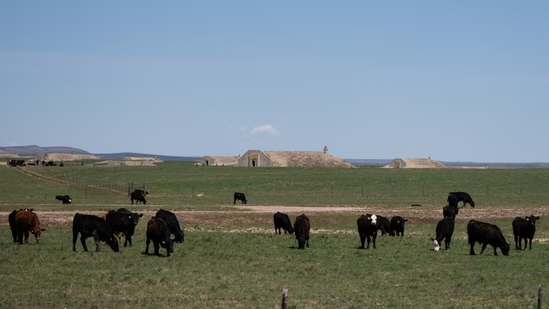
IGLOO, S. D.—Row upon row of concrete bunkers with steel blast doors peek up from the rolling grasslands—like hobbit holes for the apocalypse.
There are 575 of them, clustered on a former munitions depot near South Dakota’s Black Hills and billed as “The Largest Survival Community on Earth.” The pitch: Ride out nuclear war, the next pandemic, or societal collapse in relative comfort.
Yet for many residents, the dream has soured. The threat hasn’t come from Armageddon, but from friction that resembles a suburban homeowners’ association battle.
Lawsuits, countersuits and disputes are piling up over septic systems, property taxes, off-leash dogs and a growing list of community rules. The legal skirmishing has reached the state supreme court—twice. Promised amenities, including a restaurant bunker, a pool bunker and a horse-stable bunker, have yet to materialize. Guns have been drawn, and there have been offers to settle things with fists. The developer denies wrongdoing and says complaints come from a few malcontents.
“You get that many people with the same mentality in a small place like that, eventually they’re going to cross over each others’ lines and you’re going to have a conflict,” said Larry Harter, a retired locomotive engineer in nearby Edgemont, population 725. He was nursing a beer recently at the Victory Steakhouse & Lounge, where preppers from the compound sometimes turn up for dinner or a drink.
Edgemont Mayor Rheta Reagan said she was unsure whether being on the road to the complex was a boon for her city. “There’s a few that come into town, but for the most part they don’t,” she said. “They’re just doing their own thing, whatever their own thing is. Like I said, I would want no part of it.”
‘5-star survival luxury’

The doomsday enclave, known as Vivos xPoint, is the brainchild of Robert Vicino, a Los Angeles-based entrepreneur who had a vision in 1980: He needed to build a large underground structure to protect 1,000 people from a coming “life-extinction event,” according to the company’s website. He since has developed a global network of such communities.
In 2016, Vicino began working with local ranchers to convert the long-abandoned South Dakota property—far from “known nuclear targets” and “high-crime anarchy zones” (read: cities)—into a compound for “like-minded survivalists to ride out ‘the event,’” as Vivos puts it. Vicino later bought the property outright, according to his son, Dante, Vivos xPoint’s director of operations.
Vivos offers 99-year leases on the shelters, roomy at nearly 2,200 square feet. Occupants pay up to $55,000 upfront, plus annual ground rent and service fees. They can build out the raw space themselves or hire Vivos’s contractors. The company touts “5-Star Survival Luxury and Comfort” and residents live on roads with names like Bunker Way.


“My vision is to see xPoint become a thriving community of people who want safety in this increasingly crazy world we live in,” Dante Vicino said. He noted that about a third of the units were leased and a few dozen occupied full-time. “The lawsuits have been a real pain, but we’re not set back at all,” he said.
Philippe Briggs, a recently retired Los Angeles police detective and former Army reservist, said he paid $25,000 for the 99-year lease on his windowless bunker six or seven years ago. He lives in Las Vegas now and uses it as a vacation spot and potential emergency shelter. “You can do fishing over there, you can do hunting, you can do hiking,” he said. “And if I need to, yeah, I could use it as a bug out—if I can get there.”

He keeps a year’s supply of provisions inside. “Just like rice—basic foodstuff that you would fix at the end of the world,” he said, adding that he hasn’t had issues with management. “If I had an issue, I would just sell my place and be gone.”
Not everyone shares Briggs’s experience.
‘You ain’t never killed nobody, have you?’
David Streeter paid $55,000 for his unit in July 2023 and moved to the windswept prairie. His wife, daughter and her four children eventually all joined him.
He soon discovered his septic system didn’t work. When he inquired about filing a complaint, a Vivos employee warned him off, Streeter testified in court. The company would likely try to evict him—as it had done to others, he said the employee told him. Upon eviction, he would lose his lease payment and potentially the value of any improvements he had made, according to the terms of the lease.
Vivos has said that no such tactic exists.
Then came roughly five months of what Streeter described in court as harassment by Vivos contractors. It ended when one of them drove a front-end loader up to Streeter’s bunker and challenged him to a fistfight. Streeter drew his gun and told the man to leave.
“You ain’t never killed nobody, have you?” the man said, according to a video shot by Streeter’s daughter and entered into the court record.
“Oh, yeah,” replied Streeter, a former prison guard, EMT and Army veteran who served in Bosnia.
“I have, with these hands,” the man responded.
A few moments later, the camera goes out of frame. A shot can be heard.
Streeter testified that the man charged him and he fired once, striking him. Streeter rendered aid afterward and, with a friend, drove the man to meet an ambulance. The man survived. A grand jury declined to indict Streeter, and a judge later granted him immunity under South Dakota’s stand-your-ground law. The state supreme court later affirmed the decision.
Vivos moved to evict Streeter for the shooting and for an incident earlier in the day in which he shoved another contractor. Streeter is fighting the proceeding in court.
Bunker mentality
Residents who move in find that preparing for the end times is just one challenge. They receive a long list of rules—including a ban on talking about the compound or its owner to the media, with penalties that can include eviction—and Vivos can change the rules mid-lease. “Vivos has prided itself on the ability of members to coexist with each other and within the confines of the Rules and Regulations,” it said in an email to lessees.
It isn’t quite a zombie apocalypse, but life in litigation is its own kind of dystopia.

Daniel Sindorf, who worked for the government and has an M.B.A., paid $35,000 for his 99-year lease in July 2020 and put another $100,000 into improvements, according to legal filings. Two main things soured him: Vivos moved to raise monthly fees to cover property taxes, and a contractor’s dogs kept running loose, the filings show. He complained in a resident text group called xPoint Pioneers.
In July 2023, it came to a head. Sindorf—who had reported three days earlier that a dog charged his wife—said he drew a firearm to protect himself from the animals while riding on his motorcycle. The contractor’s girlfriend alleged he pointed the gun at her.
About six months later, Vivos sought to evict him, citing a rule against brandishing firearms—a rule added after he signed his lease. Sindorf acknowledged he had received notice of the change.
Sindorf left in May 2024 but padlocked the unit behind him, preventing Vivos from taking possession. He countersued and initially won: A lower court held the lease invalid because its terms could be changed after the fact. Last month, however, the South Dakota Supreme Court reversed the ruling and sent the case back to the lower court.
A broader fight is building. A September lawsuit, which aims for class-action status, seeks refunds for what could be more than 100 tenants and alleges the Vivos lease violates a state law that requires landlords to provide and maintain livable dwellings.
The suit, filed by attorney Matthew Hays McCoy, alleges Vivos misrepresented the amenities. A video on the company’s website shows schematics of bunkers fitted out as a gym, a restaurant, a general store, a community center and a medical clinic. None have been completed.
Dante Vicino, the operations director, said Vivos still planned to deliver the amenities but is focused on building out individual units first in a remote location where labor is hard to find.
Chris Yellow Thunder, who lived just outside the compound for several years and is a close friend of Streeter, said the controversies have ruined what could have been an ideal place to retire or ride out a disaster. “Once you walk in, you have no outside noise, no anything, you know, so, I mean, it’s incredibly peaceful,” he said of the igloos. “It really could have been this terrific little oasis out there.”
Write to Joe Barrett at Joseph.Barrett@wsj.com