Why Trump is using Iran talks to revive the Abraham Accords
President Donald Trump’s injection of the Abraham Accords into talks with Iran underscores how the Islamic Republic is getting the better of the US at the negotiating table, and Trump is trying to distract from it, current and former US and Arab officials told Middle East Eye.
“Trump knows he’s getting a deal that undermines every war aim he espoused after 28 February. So, he’s trying to create a bigger deal,” Aaron David Miller, a former Middle East negotiator, told Middle East Eye.
“This is a typical Trump ploy,” added Miller, now a senior fellow at the Carnegie Endowment for International Peace.
The deal under discussion would extend the shaky ceasefire in place now for 60 days. In exchange for obtaining a sanctions waiver on oil sales, Iran would reopen the Strait of Hormuz, where the US also has a competing naval blockade. The deal does not address Iran’s ballistic missile arsenal, which The New York Times has reported is at 70 percent pre-war levels.
Trump provided a mixed rationale for his decision to launch a war on Iran in February, at times saying it was to prevent Iran from obtaining a nuclear weapon. He also said that the US aimed to destroy Iran’s conventional military capabilities, and at other times, he also suggested regime change was the ultimate goal.
In a separate social media post on Monday, Trump said Iran’s enriched uranium would either be turned over to the US and destroyed or destroyed in coordination with Iran at an “acceptable location”. The latter statement was read by some observers as a US concession, with China or Russia potentially playing a role.
Despite US claims that a deal is close, the current ceasefire between the two countries appeared to be on shaky ground on Tuesday. Iran accused the US of “flagrant” violations of their truce and vowed to respond after the US conducted air strikes against Iranian missile launchers and boats.
Misreading the Gulf
A former senior US official told MEE that Trump appeared to expect a “payment” from Gulf states for ending the war on Iran.
“Trump’s pitch on the Abraham Accords rests on a mistaken impression that the countries that he ensnared into a war that led to the bombings of their cities and critical infrastructure owe him a favour to conclude the war,” the former senior US official told MEE.
‘Trump’s pitch rests on a mistaken impression that the countries he ensnared into a war owe him a favour’
-Former Senior US official
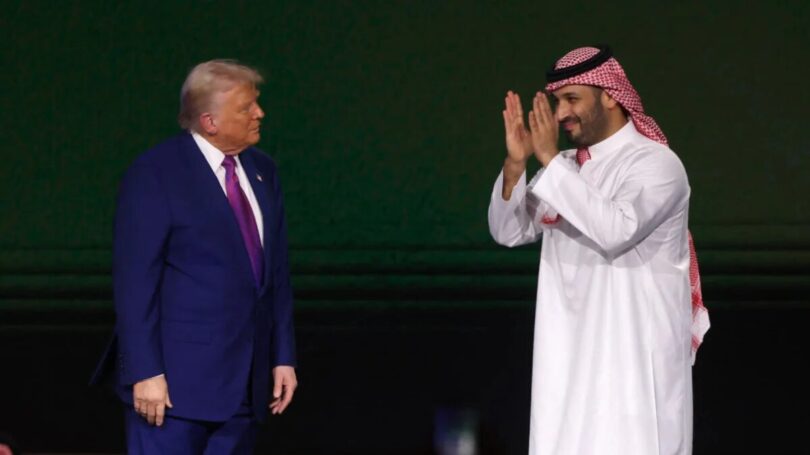
Trump called on several countries that lack diplomatic ties with Israel to normalise, including Saudi Arabia, Qatar, and Pakistan. His request came shortly after he spoke with the leaders of those countries, and then with Israeli Prime Minister Benjamin Netanyahu on a separate call.
The US-Israeli war on Iran has jolted the Arab Gulf monarchs, who depend on the US for their security. The UAE, Saudi Arabia and Qatar lobbied the US against attacking Iran, but bore the brunt of Tehran’s reprisals, with thousands of Iranian missiles and drones hitting their cities, energy infrastructure and US military bases in the countries.
The Gulf states generally responded to the war by giving the US greater access to their bases and overflight permissions. Some, like Saudi Arabia and the UAE, even joined in strikes on Iran, according to Reuters.
But all share some frustration with Washington. Abu Dhabi has at times called for a more aggressive response, while Saudi Arabia and Qatar have advocated for mediation.
Former US officials and Gulf analysts across the region say the war has sparked deep discussions about whether the Gulf states can depend on US security guarantees, but Trump has appeared immune to those concerns.
Crown Prince Mohammed bin Salman “didn’t think this was going to happen…he didn’t think he’d be kissing my ass…he thought it’d be just another American president that was a loser…but now he has to be nice to me,” Trump said at the onset of the war.
“The most troubling part of Trump’s approach is that he genuinely thinks these countries owe him if he ends the war,” the former senior US official added.
Appeasing Netanyahu and Iran hawks
An Arab diplomat told MEE that Trump may have raised the Abraham Accords as a concession to Netanyahu, who analysts say is opposed to ending the war on Iran. Israel is expected to enter elections in the fall, and justifying an end to the war by expanding the Abraham Accords could help it at the ballot box, the Arab official said.

Read More »
Trump may also have to appease Republican allies in Congress who are closely aligned with Netanyahu.
“If it is perceived in the region that a deal with Iran allows the regime to survive and become more powerful over time, we will have poured gasoline on the conflicts in Lebanon and Iraq,” US Senator Lindsey Graham wrote on X after Trump announced a deal to end the war was close.
US Senator Ted Cruz called a peace deal a “disastrous mistake”.
The UAE, Bahrain and Morocco normalised ties with Israel in 2020 under the Abraham Accords, which Trump considers his major foreign policy achievement.
Netanyahu has also been sensitive to the optics of the Abraham Accords at a time when Israel appears isolated on the world stage. His office boasted earlier this month that the Israeli leader made a wartime visit to the UAE, despite Abu Dhabi having to issue an uncomfortable denial.
The Gulf rift
The war on Iran has exacerbated divisions within the Gulf over Israel and Iran. The UAE has moved closer to Israel as it seeks a new security partner.

Read More »
Israel deployed Iron Dome air defence batteries and personnel to the UAE to operate them during the war. MEE revealed that the two also established a fund to jointly acquire and develop new weapons systems.
But Saudi Arabia, which Trump has been lobbying without result to normalise ties with Israel since his first term, has grown even more suspicious of Israel as a result of the war. It was already in a rivalry with the UAE and has since pivoted to deepening defence ties with Turkey, Pakistan and Egypt.
“The rivalry between the UAE and Saudi means Saudi Arabia is not going to join the Abraham Accords now. If they do normalise, it’s going to be under a different name,” Miller said.
“The UAE has already doubled down [on Israel]. But why would any Gulf state tether itself to the most extreme, right-wing government in Israeli history that is in the process of annexing the West Bank and occupying Lebanon,” he added.