Pakistan’s Punjab government has shelved a high-profile decision to restore pre-Partition names of roads and streets in Lahore, backing down after a backlash from religious hardliners and vloggers who attacked the move as an attempt to revive “Hindu and Sikh identities” in a Muslim-majority country.
The retreat, reported on Tuesday, has come barely weeks after Chief Minister Maryam Nawaz and her father, PML-N president and former PM Nawaz Sharif, personally chaired the meeting that approved the plan.
DC says no decision taken: What about official handout?
Lahore deputy commissioner Capt (Retd) Muhammad Ali Ijaz told Pakistani newspaper Dawn on Monday that “no such decision has been taken as yet” — referring to the restoration of names — insisting the matter remains “under discussion”.
The denial came despite the fact that the CM’s office had issued an official press handout on March 20 confirming that the restoration had been approved at a Lahore Heritage Areas Revival (LAHR) meeting jointly presided over by Nawaz Sharif and Maryam Nawaz, news agency PTI reported. Nawaz Sharif, otherwise retired from politics, serves as patron-in-chief of the authority while his brother Shehbaz Sharif is currently PM.
Also read | Trump’s caveat to Iran peace deal: Mediator Pakistan stares at a historic paradox | Explained
What was approved, and what is now in limbo
The meeting in March had cleared a sweeping list of reversions. Fatima Jinnah Road was to become Queen’s Road again. Allama Iqbal Road was to revert to Jail Road.
Islampura, renamed from Krishan Nagar after Partition, was to reclaim its original identity. Maulana Zafar Ali Khan Chowk was to go back to Lakshmi Chowk.
Mustafaabad was to be restored to Dharampura, Hameed Nizami Road to Temple Street, and Babri Masjid Chowk to Jain Mandir Road.
A lot of locals already refer to these places by their pre-1947 names as the new names after the establishment of the Islamic Republic found it hard to penetrate history.
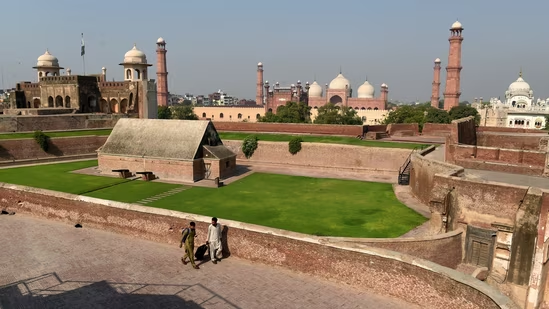
In all, more than 20 streets, roads, localities, and chowks across Lahore were slated for restoration of their original names. The decision was part of a broader ₹50-billion urban conservation drive under the LAHR, aimed at restoring Lahore’s architectural fabric and cultural identity.
Vloggers and religious groups force a climbdown
The government’s retreat, according to Dawn, came in response to pressure from what it described as “extremist elements”, including popular vloggers who amplified the criticism on social media.
The critics framed the renaming exercise in communal terms, accusing the Maryam Nawaz administration of trying to rehabilitate Hindu and Sikh associations. Most Hindus and Sikhs had already migrated from what is now Pakistan to a recarved India.
Following the backlash, the LAHR convened a fresh consultation — this time with historians, architects, urban planners, and scholars — to seek views. The forum concluded with a consensus that Lahore’s historic identity was an invaluable legacy deserving preservation, with most participants backing the restoration. Yet the government has not moved to implement it, Dawn reported.
Old names never really left
The irony is that for many of these streets, the official renaming had always been more administrative fiction than lived reality.
Kamran Lashari, former director-general of the Walled City of Lahore Authority and secretary of the LAHR, told Indian publication The Print recently, “In many cases, even when the names have been officially changed, the people still call them by the old names.” Some of these names continued to be used in official documents too.