
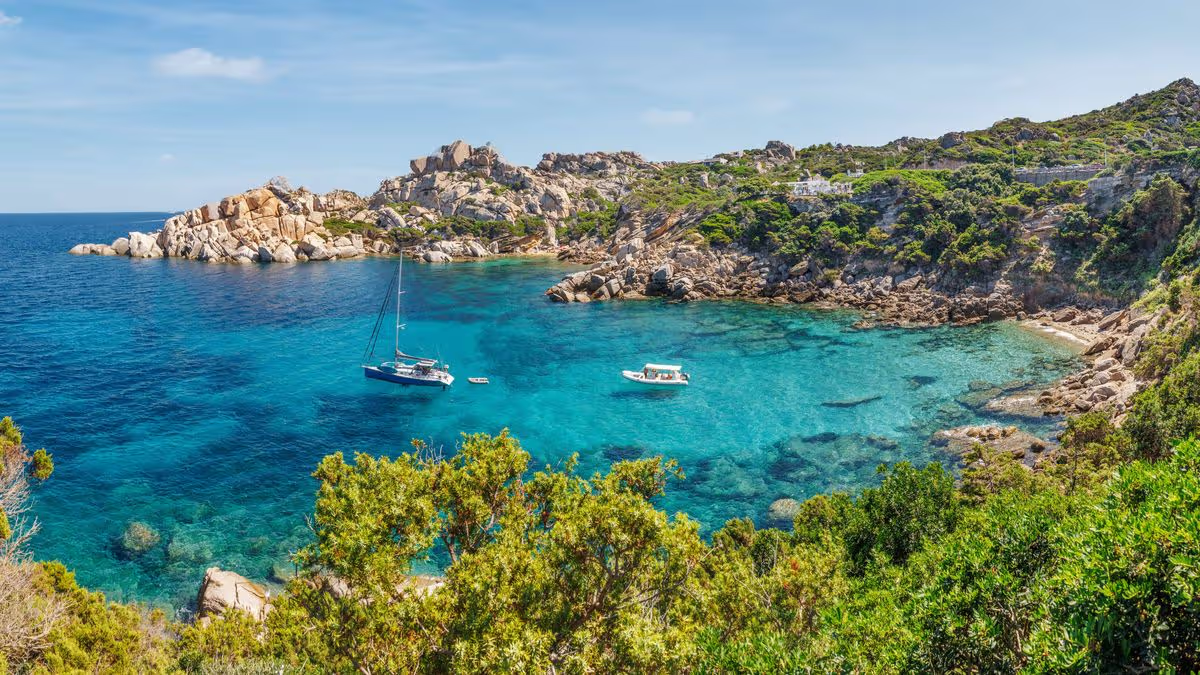
Several stunning countries around the world are offering hefty sums of money to individuals willing to move there to boost population and energise their economy.
‘Pay to move’ schemes are growing increasingly popular worldwide, with numerous countries offering their own bespoke programmes to the public in an effort to draw more people to towns, villages and cities grappling with falling population numbers and a struggling economy.
There are five beautiful countries that will pay you to relocate there in 2026, meaning those seeking a fresh start, who meet the programme’s criteria, can genuinely begin weighing up their options.
These seemingly too-good-to-be-true travel incentives are typically designed to boost the population of these areas and breathe new life into the local economy, as most locations offering these schemes tend to have an ageing workforce, reports the Express.
5 countries that will pay you to move there
Albinen, Switzerland
Since 2018, the picturesque mountain village of Albinen in Switzerland has been offering people attractive incentives to relocate there.
The scheme provides adults with up to 25,000 Swiss francs (roughly £23,600 in 2026) and children with up to 10,000 Swiss francs (approximately £9,400) as an incentive to move to the rural village.
This means a family of two adults and one child would receive a total of 70,000 Swiss francs (around £66,100) – funds that can be used towards purchasing a home or building a new life in the village.
The conditions? All applicants must be aged under 45 and need to pledge to remain in Albinen for at least 10 years. You would also need to purchase or construct a property valued at 200,000 Swiss francs or above and be a Swiss citizen or possess a C Residence Permit to qualify.
Listed amongst Switzerland’s most picturesque villages, Albinen’s former Mayor, Nicole Köppel previously told Watson.ch: “Albinen has no school, no bank, no post office, one remaining pub, one shop and a bus every hour. You have to anticipate that beforehand and accept it when you’re here.”
Chile
In a bid to draw investment and strengthen the national economy, the Chilean government is providing equity-free grants worth up to £74,000 to tech-focused start-ups prepared to establish themselves and work from the South American country.
The programme is available to citizens of any nation and will provide individuals with a two-year work visa.
Those taking up the scheme will also be granted access to networking opportunities, office space, mentors, equity-free funding, and startup support to develop their businesses while located in Chile.
While chiefly aimed at entrepreneurship rather than permanent individual migration, the initiative has successfully drawn thousands of founders and startups from across the world to establish a presence in Chile.
Sardinia, Italy
In an effort to revitalise rural areas that have witnessed their populations dwindle as young people flock to urban centres, abandoning an elderly generation behind — the breathtaking Italian island of Sardinia is offering to pay individuals to relocate there.
The scheme is open to anyone willing to register as a resident in one of the island’s smaller settlements, provided it has fewer than 3,000 inhabitants. To support the move, local authorities are offering a grant of up to €15,000 (around £13,000) per household, which does not need to be repaid.
The funding is intended to help with buying or renovating a home, although it must not exceed 50% of the total expenditure.
Those applying must complete their move within 18 months of purchasing a property or completing refurbishment work, with the aim of encouraging long-term residency rather than fleeting stays.
Beyond the initial grant, there are additional incentives for those wishing to start a family and establish themselves in Sardinia’s smaller communities. Couples can receive monthly payments of approximately €600 (£500) for their first child, and €400 (£350) for a second child until they reach five years of age.
The grant applies only to homes in smaller municipalities, and people already living in comparable towns across the island are ineligible to participate.
Ireland’s Isles
Back in 2023, the Irish government unveiled its ‘Our Living Islands’ initiative, designed to create “creating the conditions which will encourage young people to remain on, or move to, the islands to live, work and raise families” across a carefully selected group of remote Irish islands, working alongside coastal communities.
To put it more precisely: “It aids communities on 30 islands not linked to the mainland by bridges and cut off by the tides.”
The scheme offers eligible applicants between €50,000 and up to €80,000 (£43,000 – £70,000) to relocate to chosen Irish islands, though it comes with a number of conditions and eligibility requirements.
Successful applicants would receive the promised funds, provided the money is put towards purchasing and restoring derelict properties, as part of an extension to the Irish government’s Property Refurbishment Grant Scheme Croí Cónaithe.
Any property in question must have been built before 1993 and no later than 2007, and needs to have sat empty for a minimum of two years.
It must also serve as a genuine primary residence, meaning using it as an Airbnb or short-term let is strictly off the table. Irish residency is likewise a prerequisite, as the scheme does not grant automatic immigration rights.
Rural Portugal
Those keen to live or invest in Portugal’s rural and remote regions should give this relocation scheme serious consideration. The country has long held a reputation for being welcoming to foreigners, and the Emprego Interior Mais programme is a further move in that direction.
Launched in 2020, the scheme offers eligible applicants a one-off cash payment of up to roughly €5,000 (£4,300) to help cover moving and other relocation expenses.
According to gov.pt, eligible participants will receive direct financial support of €2,633 (£2,300) to relocate to Portugal’s interior, plus an additional 20% for every member of the household (up to a limit of €1,316 or £1,100), as well as relocation assistance of up to €878 (£760).
To qualify, applicants must already hold permanent residency in Portugal, sign a new employment contract (with a minimum duration of 1 year) or establish a new business, and relocate to one of the designated rural areas within the country’s interior regions.