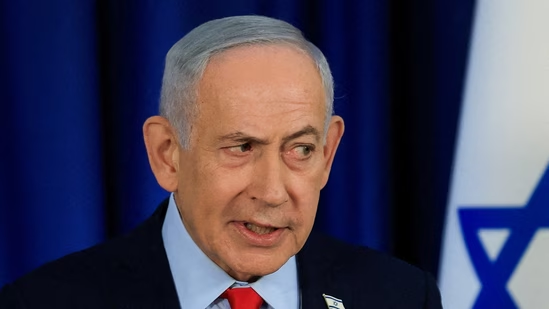

Iranian parliamentary speaker Mohammed Ghalibaf has for weeks insisted that unlocking access to his country’s money should be a confidence-building measure, if not a precondition, for talks with the US.
The issue now appears to be on the table during this latest and seemingly most aggressive round of diplomacy to date, towards a long-term end to the war, reopening the Strait of Hormuz, and paring down Iran’s nuclear capability.
Reports from earlier this week suggest that up to 25 percent of all of Iran’s frozen funds globally could be released by the US if Iran surrenders 400 kilograms of enriched uranium and shuts down its nuclear facilities.
But given that both demands could be non-starters, Iran is said to be requesting access to a lesser $12bn of its frozen funds.
What we know for sure is that both Ghalibaf and Iran’s central bank chief travelled to Qatar on Monday to discuss the release of some $6bn that has been held in the Gulf state since September 2023, which may signal a potential breakthrough.
CLICK FOLLOW: TO FOLLOW US
Sign up to get the latest insights and analysis on
Israel-Palestine, alongside Turkey Unpacked and other eSPORTY
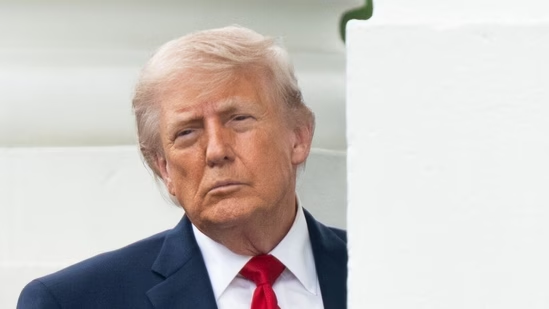
A month ago, the White House denied that any such move was possible. But as President Donald Trump seeks to wind down his joint war with Israel amid skyrocketing US petrol prices and plummeting public opinion, as well as pressure from Arab Gulf partners, the ground realities have changed.
Iran is desperately short of cash, and maintains it is owed up to $120bn of its own revenue that has been withheld by foreign governments and banking institutions, thanks to US sanctions steadily imposed on the country since the 1979 Islamic Revolution.
The 1996 Iran Sanctions Act expanded sanctions to those doing business with Tehran and barred it from obtaining a nuclear weapon. From 2005 onwards, a slew of US sanctions have been coming down on individuals and companies alleged to have ties to terrorist activity.
US sanctions not only prevent anyone living in the US or who is a US national from doing business in Iran, but it also denies Iran access to the US-dominated global banking system, which largely runs on dollars and utilises US transfer mechanisms such as Swift.
Previous thaw
No tangible respite came until the historic signing of the Iran nuclear deal in 2015, under President Barack Obama.
Iran was able to retrieve some $50bn of its frozen funds via the lifting of certain US legal barriers, and it also received a payout of $1.7bn the following year for a legal dispute it had raised at the International Court of Justice over money Washington owed the Iranian government well before the revolution took place.
What we know so far about the US-Iran deal
Read More »
But by 2018, the first Trump administration unilaterally withdrew from the Iran nuclear deal, sanctioned the entirety of the Islamic Revolutionary Guard Corps (IRGC) rather than military leadership, and reinstated all sanctions that included the immediate freezing of Iranian assets held in international banking institutions.
Those assets were held largely in China and India, with some in Turkey and the US.
A $6bn fund was held up in South Korea, which had come from the sale of Iranian oil.
In 2023, as part of a prisoner swap orchestrated by President Joe Biden, five Iranians were released by Washington in exchange for five Americans freed by Tehran. The deal included Iranian access to that $6bn fund, which was moved to Qatar in late September 2023.
Some two weeks later, after the Hamas-led attacks on southern Israel, Qatar suspended the funds because of uncertainty over how Iran would use them, given its allies Hamas and Hezbollah were at war with Israel.
Now, that pool may be up for grabs again under a potential new deal with the second Trump administration.
“It’s Qatari money,” Alex Vatanka, a senior fellow at the Middle East Institute, argued on a discussion panel on Monday.
“Qatar is doing it 1779744018 because they’re saying to Iran, listen, you’ve got to do this diplomacy thing. If the Americans won’t come through, you still get [the money]. That’s the level of anxiety in the Gulf region right now,” he added.
Kevin Donegan, a retired vice admiral in the US Navy, said the money will not be used for humanitarian purposes or post-war rebuilding.
“I’m not a fool here – the first money on sanctions relief or any relief of unfrozen funds is going to go to the IRGC,” he told the panel.
There are some reasons to believe differently, given the state of Iran’s economy.
Among the government’s first priorities will likely be the stabilisation of the financial infrastructure, given that the US-aided collapse of a local bank late last year fed into widespread unrest in the country.
It may also be looking to build on some of the positive public relations it has gained on social media and among young westerners in particular, throughout a 40-day war that it did not start.
In March, some two weeks into the US and Israeli assault, Tehran demanded reparations for the structural and economic devastation as part of any deal that ends hostilities.
It reiterated those demands in its peace proposal sent to the White House last week, upon which the current discussions are based.