
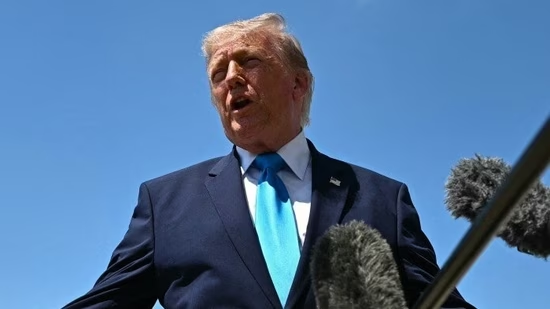
As President Donald Trump calls on multiple Muslim-majority nations to join the Abraham Accords, the term is back in global headlines. But what exactly are these agreements and why do they matter so much?
What is the main goal of the Abraham Accords?
According to the official Abraham Accords declaration, the agreements are built on the belief that peace in the Middle East is best achieved through cooperation and mutual respect rather than hostility. The declaration states that signatories “recognize the importance of maintaining and strengthening peace in the Middle East and around the world based on mutual understanding and coexistence, as well as respect for human dignity and freedom, including religious freedom.”
The name itself comes from Abraham, the common patriarch of the three Abrahamic religions: Islam, Christianity, and Judaism. The official declaration calls for “efforts to promote interfaith and intercultural dialogue to advance a culture of peace among the three Abrahamic religions and all humanity.”
Beyond diplomacy, the Accords also carry broader ambitions. The official text calls for ending radicalization, supporting science, art, medicine and commerce, and giving children “a better future.” As stated in the official declaration, the signatories “pursue a vision of peace, security, and prosperity in the Middle East and around the world.”
At their most practical level, the Accords are about Arab nations formally recognizing Israel and establishing diplomatic ties with it.
Also Read: Why Trump is defending the Iran deal that Republicans are calling a ‘disaster’
Who has already signed and who Trump wants next?
The Abraham Accords were first brokered by Trump during his first term in the White House. According to Reuters, the United Arab Emirates and Bahrain signed in 2020, breaking a longstanding taboo to become the first Arab states to formally recognize Israel in 25 years. Morocco and Sudan followed shortly after.
Now, in his second term, Trump is pushing to expand the Accords significantly. He has asked Saudi Arabia, Qatar, Pakistan, Turkey, Egypt and Jordan to all join at once. Trump posted on Truth Social: “I am mandatorily requesting that all Countries immediately sign the Abraham Accords, and that, if Iran signs its Agreement with me, as President of the United States of America, it would be an Honor to have them also be part of this unparalleled World Coalition.”
The response so far has not been great. Pakistan flatly rejected the proposal, with a Pakistani security source saying: “Pakistan is under no compulsion to adhere to any such demand.” Egypt, Jordan and Turkey already maintain some diplomatic relations with Israel, though those ties have been badly strained since the start of the Gaza war, according to Reuters.
Also Read: Marco Rubio vs JD Vance in 2028? Trump’s next MAGA heir battle may already be underway
Saudi Arabia’s case is the most complicated of all. As per Reuters, the kingdom which is the birthplace of Islam and custodian of its two holiest sites, Mecca and Medina has long maintained that it will not sign the Accords unless there is a clear roadmap toward Palestinian statehood. For Riyadh, this goes far beyond a simple diplomatic decision. It is a deeply sensitive national, religious and political issue.
Trump is linking the Abraham Accords expansion to his ongoing Iran negotiations, telling reporters the talks are “proceeding nicely,” though no deal is close. Senator Lindsey Graham called the combined strategy “beyond transformative for the region and world,” according to Reuters.