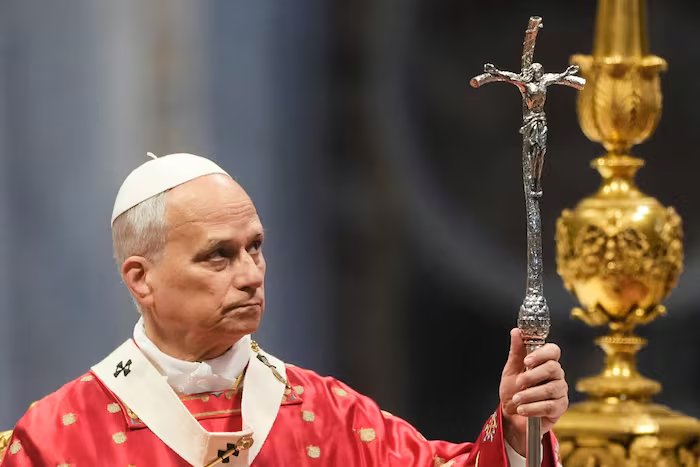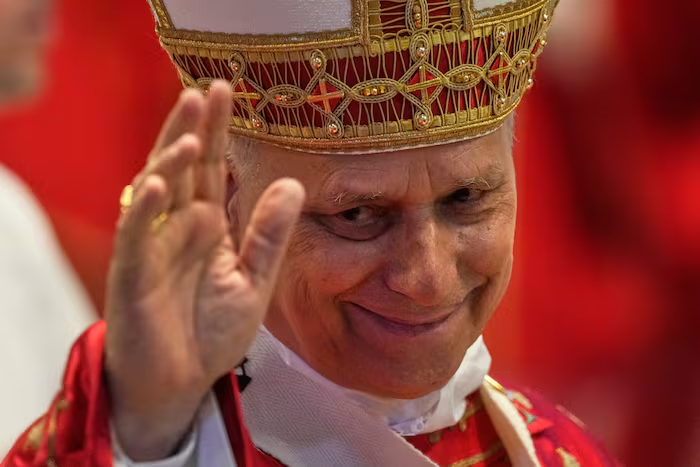
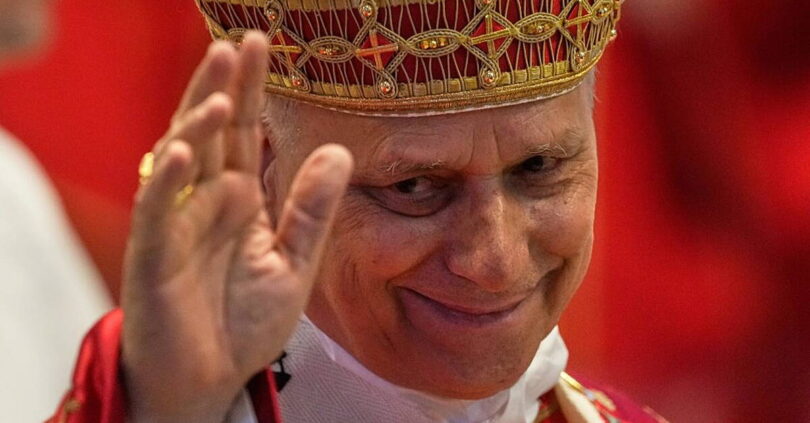
Pope Leo XIV made a historic apology on Monday for the role the Holy See itself played in legitimising slavery and for having failed to condemn it for centuries, calling the Vatican’s record a “wound in Christian memory”.
Past popes have apologised for Christians’ involvement in the transatlantic slave trade.
But no pope has ever publicly acknowledged, much less apologised for, the role that past popes themselves played in giving European sovereigns explicit authority to subjugate and enslave “infidels”.
The first US-born pope, whose family history includes both enslaved people and slave owners, delivered the apology in his first encyclical, Magnifica Humanitas, (Magnificent Humanity), which was released Monday.
The sweeping manifesto is about safeguarding humanity in an era of increasing reliance on artificial intelligence.
In his first #encyclical “#Magnificahumanitas“, on the Church’s social doctrine in the era of #ArtificialIntelligence, Pope Leo XIV appeals for the safeguarding of humanity, promotion of truth, dignity of work, social justice, and peace.https://t.co/4Mev5jVPxD pic.twitter.com/EtoMGByPFe
— Vatican News (@VaticanNews) May 25, 2026
Leo raised the transatlantic slave trade in relation to what he called the new forms of slavery and colonialism that the digital revolution is fuelling, such as the unregulated labour required to procure rare minerals needed for AI chips.
In doing so, Leo responded to decades of calls by black American Catholics, activists and scholars for the Holy See to atone for its own role in the colonial-era trade in human beings.
“It is impossible not to feel deep sorrow when contemplating the immense suffering and humiliation endured by so many in stark contrast to their immeasurable dignity as persons infinitely loved by the Lord,” Leo wrote.
“For this, in the name of the Church, I sincerely ask for pardon.”
The Vatican has said that it always upheld the dignity of all human beings as children of God.
But a series of 15th-century directives from the Vatican authorised Portuguese sovereigns to conquer Africa and the Americas and enslave non-Christians.
In 1452, for example, Pope Nicholas V issued the papal bull Dum Diversas, which gave the Portuguese king and his successors the right “to invade, conquer, fight and subjugate” and take all possessions, including land, of “Saracens, and pagans, and other infidels, and enemies of the name of Christ” anywhere.
The bull also gave the Portuguese permission “to reduce their persons to perpetual slavery”.
That bull and another issued three years later, Romanus Pontifex, formed the basis of the Doctrine of Discovery, the theory that legitimised the colonial-era seizure of land in Africa and the Americas.
Nicholas V’s permissions to the Portuguese were confirmed or renewed by Pope Callixtus III in 1456, Pope Sixtus IV in 1481, and Pope Leo X in 1514, according to the Rev Christopher J. Kellerman, a Jesuit priest and author of All Oppression Shall Cease: A History of Slavery, Abolitionism, and the Catholic Church.
Spanish kings received the rights for the Americas.
In 2023, the Vatican formally repudiated the Doctrine of Discovery, but it never formally rescinded, abrogated or rejected the bulls themselves.
The Vatican says that a later bull, Sublimis Deus in 1537, reaffirmed that indigenous people should not be deprived of their liberty or the possession of their property, and were not to be enslaved.
In his encyclical, Leo recalled that his namesake, Pope Leo XIII was the first pope to explicitly condemn slavery in 1888, though that was long after many countries had already abolished it.
Before that, in antiquity and the Middle Ages, even church institutions had slaves.
Leo said that it was not possible to judge the morality of the decisions with today’s standards.
“Yet neither can we deny or diminish the delay with which both society and the church came to denounce the scourge of slavery,” he said.
The pope said that the church has long affirmed the dignity of every human being as the basis of its doctrine, “even if it took eighteen centuries for its full incompatibility with slavery to be explicitly recognised”.
“This constitutes a wound in Christian memory, one from which we cannot consider ourselves detached,” he said.
Leo said that the church today must firmly condemn all forms of trafficking related to the digital technological revolution “if we want to avoid the need to ask for pardon again in the future for having failed to respect the treasure of human dignity that is required by our faith”.
According to genealogical research published by Henry Louis Gates Jr, 17 of Leo’s American ancestors were black, listed in census records as mulatto, black, Creole or a free person of colour.
His family tree includes slaveholders and enslaved people, Mr Gates wrote in The New York Times.