Abeer was 19 when she heard the news on 25 May 2000 that southern Lebanon had been liberated after 18 years of Israeli occupation.
Within hours, her family had left Beirut and was heading south to their hometown Kfar Kila, a centuries-old village right on the border with Israel.
“It was a joy like I had never experienced before,” said Abeer, now an events coordinator for musicians.
Twenty-six years later, she has been displaced from the city of Nabatieh by Israel’s relentless bombardment of southern Lebanon. She now lives in a tent in Beirut’s Biel district with her two dogs.
Israel’s war on Lebanon has displaced more than one million people since 2 March. Hundreds of thousands remain unable to return home as Israeli troops continue to occupy dozens of villages, while 45 percent of towns in southern Lebanon have been damaged or destroyed.
CLICK FOLLOW: TO FOLLOW US
Sign up to get the latest insights and analysis on
Israel-Palestine, alongside Turkey Unpacked and other eSPORTY
Sitting outside her tent and longing for home, Abeer says she hopes the south will be liberated once again.
“We need to remember this day because we were victorious and hopefully we will be again. They have turned Kfar Kila into a football field,” she told Middle East Eye
Kfar Kila is among a dozen villages along Lebanon’s southern border that have been gradually flattened by repeated Israeli bombardment over the past two and a half years.
“Our grandparents, my mother and father are buried in Kfar Kila,” she said. “I pray we can return to them, to our homes and to our work.”
‘My heart was full’
In 1982, the Israeli army invaded southern Lebanon in an attempt to dismantle the Palestinian Liberation Organisation.
The Israeli parliament approved Operation Peace for Galilee, under then defence minister Ariel Sharon’s claim that troops would advance no more than 40 kilometres, and that the operation would last two to three days.
Instead, Israeli forces reached Beirut and remained there for three years before withdrawing to southern Lebanon, where they stayed for a further 15 years.
A sustained guerrilla campaign mounted by Hezbollah throughout the 1990s, targeting Israeli positions and those of its allied militia, the South Lebanon Army (SLA), forced Israeli troops out of southern Lebanon.
‘We have this country due to people’s sacrifices. These aren’t just words. Liberation cost lives, families, time that detainees spent in prison’
– Tarek Serhan, activist
This was neither Israel’s first nor its last invasion of Lebanon. It entered in 1978 under Operation Litani and had previously occupied the Chebaa Farms in the 1967 Six Day War.
This history is not new to political activist Tarek Serhan, 28, who holds a master’s degree in human rights. Raised in Dahieh, Beirut’s southern suburbs, with roots in Dweir in the Nabatieh district, he remains deeply tied to the south, despite being only two years old on the day of its liberation.
Serhan lives in a small Beirut apartment he shares with his dog, Lexy, its entrance adorned by a Lebanese flag. It was also the home he shared with his parents and grandmother, who had sought refuge there from Israel’s intense bombardment of Dahieh.
He regularly travels to his village of Dweir and others to attend funerals and offer condolences to families he knows.
“When I was in the village three or four weeks ago, people were not afraid,” Serhan said, pointing to the resilience of southerners.
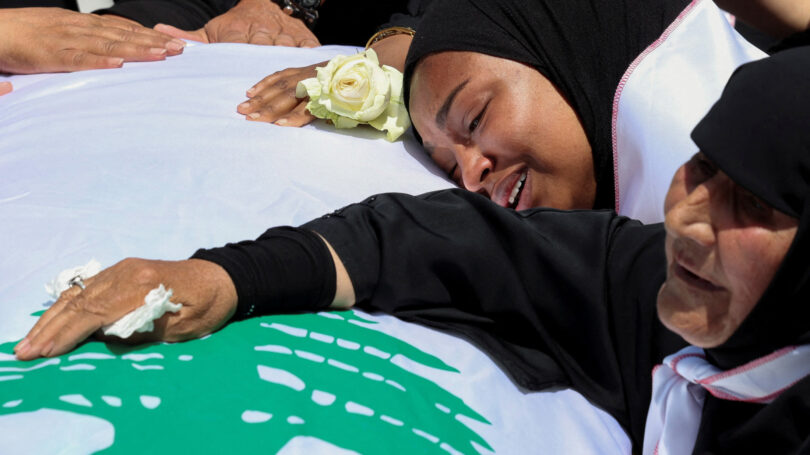
“They were carrying the martyrs on their shoulders during the procession, in the middle of the village, under warplanes and bombardment. My heart was full, honestly.”
Israeli strikes in Lebanon have killed 3,151 people and wounded 9,571 since the start of the war, according to Lebanon’s health ministry.
Despite a ceasefire reached on 16 April, Israel has continued daily strikes and evacuation orders across south Lebanon, targeting civilians, journalists, medics and civil defence teams, often in double-tap attacks.
Lebanon: Those who resist Israel are now called internal enemies of the state
Read More »
Hezbollah has also maintained attacks on Israeli occupation troops, as well as targets across the border.
In Lebanon, where the sound of drones over the capital is omnipresent and the south is once again being occupied, bombed and flattened, some have questioned whether this is still the right time to mark Resistance and Liberation Day.
For Serhan, recognising the withdrawal of the Israeli army after years of resistance against the occupation is a national duty.
“We have this country due to people’s sacrifices. These aren’t just words. Liberation cost lives, families, time that detainees spent in prison, people who are living to this day with physical pain or disabilities,” he said.
“Lebanese were resisting from all areas and all sects. Liberation happened. It’s part of history. It cannot be erased. As Lebanese we have a responsibility to show the danger of the Zionists on our border.
“We need more education and awareness for all people, especially the youth, to know the history and know what has happened to Lebanese like them.”
In the small northern town of Karm Saddeh, near Ehden, one family and all their relatives – grandparents, uncles, aunts and cousins – have done everything to keep that history alive.
‘The south is the land’
It was May 2000 when they boarded a bus and travelled south to see and celebrate a liberated south.
A core moment for their son Dominic, now a designer, who was only eight years old at the time.
Today, he is sat in his Beirut home in front of a fishbowl, surrounded by countless plants and several pets.
“I’m very much from the north, and my heart is very much in the south. That’s what my mother always told me as a kid,” Dominic told MEE.
“I love my village, and the south feels like my village but greener, more natural. Southerners are a lot like northerners, but even more hospitable.”
For him, commemorating Liberation Day should take place over an entire week.
“It was a week of celebrations in 2000. A week of people returning to their land. Let’s take a week to remember what happened, why it happened, and what happened after,” he said.
‘Lebanese were resisting from all areas and all sects. Liberation happened. It’s part of history. It cannot be erased’
– Tarek Serhan, activist
The family made the same journey again after the 2006 July war.
As Tel Aviv and Beirut engage in their first direct talks in decades, some Lebanese have voiced support for the prospect of peace with Israel.
But for Dominic, normalisation with Israel was not part of the conversation in 2006, nor should it be now, two decades later.
If it were up to him, people from across the country would travel south on this day, even amid the threat of bombardment, as an act of solidarity.
“We have festivals for cherries and apples that many attend. They matter because they connect people to the land,” said Dominic.
“But the south is the land, and the most precious olive trees in the world grow there.
“It’s one of the most important parts of our culture. Maybe next year we can hold an olive festival on the border with Palestine – and maybe Palestinians can come too.”