
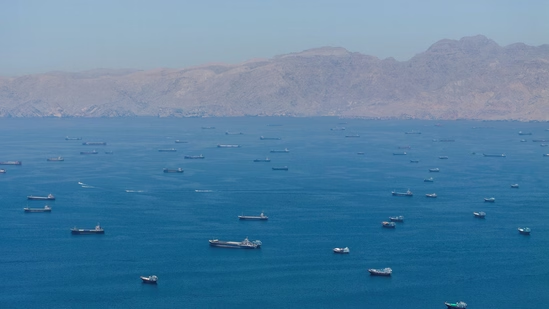
Iran will reopen the Strait of Hormuz and allow free shipping and navigation through the waterway under the proposed framework to end the West Asia conflict, sources said.
The plan, under discussion between US and Iran, would reopen Hormuz 30 days after the two countries agree to a deal to end hostilities in the Middle East, the Nikkei newspaper reported on Monday citing a diplomatic source from the region.
In the 30-day window after the agreement is reached, Tehran would initiate efforts to clear mines from the strait. Thereafter, according to the proposed deal, vessels from all countries would be able to navigate freely and safely, with Iran halting any transit fees for ships, Nikkei reported.
Also Read | US, Iran remain at odds amid peace talks: What needs to be in the deal for the war to end?
Ceasefire extension, Iran’s nuclear program
According to the Nikkei report, the ceasefire agreed upon in early April would be extended for another 60 days. Further, Iran’s nuclear program would be put on hold for two months.
Meanwhile, Iran’s top negotiator and its foreign minister were in Doha for talks with Qatar’s Prime Minister aimed at reaching a potential deal between US and Iran. Negotiations have gained pace over the past few days, with Washington and Tehran both noting progress on sticking points, but acknowledging gaps that have delayed the agreement.
US Secretary of State Marco Rubio, who is in Delhi for the Quad foreign ministers’ meeting, said that America would ive diplomacy every chance to succeed before deciding on dealing with Iran in “another way.” US President Donald Trump too said talks with Iran were going “nicely”, but said it would only be a “great deal” or “no deal at all.”
Iran’s foreign ministry spokesperson Esmaeil Baghaei said conclusions had been reached on several points, but said it does not mean that both sides were close to an agreement.
Trump pushes for Abraham Accords
Meanwhile, Trump has also pushed for the acceptance of the Abraham Accords as part of the proposed framework. In a post on Truth Social, the US President called on more Arab and Muslim states to sign up to the Abraham Accords, brokered during his first term in office.
Also Read | Trump floats Iran-US peace deal, but burning questions still remain: HT decodes
“After all the work done by the United States to try and pull this very complex puzzle together, it should be mandatory that all of these Countries, at a minimum, simultaneously, sign onto the Abraham Accords,” Trump said.
He further named the countries, saying, “Those Countries discussed are Saudi Arabia, The United Arab Emirates (already a Member!), Qatar, Pakistan, Turkiye, Egypt, Jordan, and Bahrain (already a Member!)”