While thousands of Muslims prepare to travel to Saudi Arabia to perform the Hajj pilgrimage, Palestinians in Gaza have been deprived yet again of the opportunity to fulfill one of the five pillars of Islam, as Israel retains control over the Rafah border.
Year after year, Palestinians in Gaza have been prevented from leaving the territory to perform Hajj – a sacred pilgrimage that is the once-in-a-lifetime duty of all Muslims, provided they are physically and financially able.
Instead, we are forced to watch the pilgrimage from afar. This distance is measured not in miles, but in closed borders, as an occupying force stands between us and our sacred journey.
The Rafah border is the only gateway for Palestinians in Gaza to the outside world, and although it has reopened partially, Israel still imposes restrictions on movement through it.
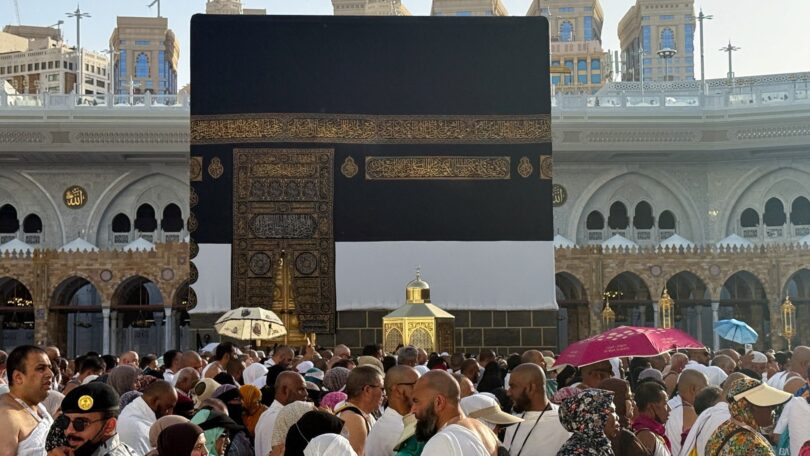
To perform Hajj, which coincides with Eid al-Adha celebrations, Muslims will travel from all over the world in the coming days to Mecca, Saudi Arabia. But Muslims in Gaza will be left facing border closures, displacement, hunger and severe financial hardships.
CLICK FOLLOW: TO FOLLOW US
Sign up to get the latest insights and analysis on
Israel-Palestine, alongside Turkey Unpacked and other eSPORTY
While Hajj now seems impossible for Gaza’s Muslims, it has always been a difficult prospect, with complex travel arrangements costing thousands of dollars. Pilgrims typically travel by bus to Egypt, then by air to Saudi Arabia.
“It took me five years to save Hajj money,” Salwa Akila, a 65-year-old woman from Gaza, told Middle East Eye. “Then the war came, and I spent the money on displacement and food.”
Struggling to survive
Akila and her husband had been approved to perform Hajj in 2024, after spending years imagining the moment when they would stand in front of the holy Kaaba.
But the Gaza war changed everything. Now, like thousands of other Palestinians in the besieged territory, having lost their home during an Israeli bombardment, they are struggling to survive in displacement.
Those who once worked as Hajj and Umrah service providers in Gaza – organising travel, offering guidance and providing assistance throughout the journey – are also facing a severe crisis. Many have either lost their livelihood or suffered deep financial impacts.
It also robs them of experiences that could help to restore dignity, hope and emotional healing after years of brutal bombardment
Indeed, Israel’s genocide in Gaza over the past few years has transformed Hajj from a spiritual obligation into an increasingly unreachable dream.
A friend recently shared photos with me of pilgrims gathering in Mecca, crying tears of joy as they prepared to visit the house of God. “I hope we will have our turn soon,” my friend wrote.
For many Muslims in Gaza, such images are both moving and a painful reminder of what we are missing out on. Israel’s genocidal war has left Palestinians physically and mentally drained, with a sense of helplessness and failure towards a central religious duty.
Visiting Mecca is a deeply spiritual journey of renewal, devotion and healing. Gaza’s Muslims have lost access to this at a time when they need it most.
Israel’s assault thus not only deprives Palestinians of food, medicine and safety. It also robs them of experiences that could help to restore dignity, hope and emotional healing after years of brutal bombardment.
Holding onto hope
As time passes, many elderly people who long dreamed of visiting Mecca are now physically unable to make the journey. Some are living with health conditions that require constant care, and the Hajj pilgrimage is no longer safe for them.
People on the outside might perceive this crisis to be less urgent than the collapsing economy, the broken healthcare system or the blockade on food supplies. But as Muslims in Gaza, we view Hajj as a fundamental right and a vital part of our life’s journey.
Eid in Gaza: Despite immense loss, we deserve to celebrate
Read More »
We are not asking for money, food or material aid, but rather for something more basic and fundamental: an open door, with the ability for a safe departure and return home, in order to fulfill a sacred pillar of the Islamic faith.
In addition to being denied the opportunity to perform Hajj, Muslims in Gaza have also been deprived for the third consecutive year of one of Eid al-Adha’s most important religious rituals: the sacrifice of animals. This tradition has become increasingly impossible under current conditions, including severe shortages and restrictions on goods entering the territory.
Indeed, Muslims in Gaza can no longer fully celebrate Eid al-Adha, amid war, displacement, destruction and a totally collapsed economy.
With each passing year, more names on the list of those still waiting to perform Hajj will disappear – a sacred duty unfulfilled in their lifetime, as death arrives before they ever get the chance.
Yet despite all of these challenges, many Palestinian Muslims in Gaza continue to save what little money they can, holding onto the hope of performing Hajj or Umrah next year.
The views expressed in this article belong to the author and do not necessarily reflect the editorial policy of Middle East Eye.