He promises TO stage a “citizens’ revolution”, hand power to the people, squeeze private ownership, tax the rich, save the planet and bring in the “right to silence” for humans and animals. He is a 74-year-old who delights Gen Z. He is an old-fashioned French revolutionary with a fondness for Latin American populists and millions of TikTok followers. Jean-Luc Mélenchon has tried to win the presidency three times. With a pitch that now finds an echo from New York to Hackney, the firebrand leader thinks his time has come.
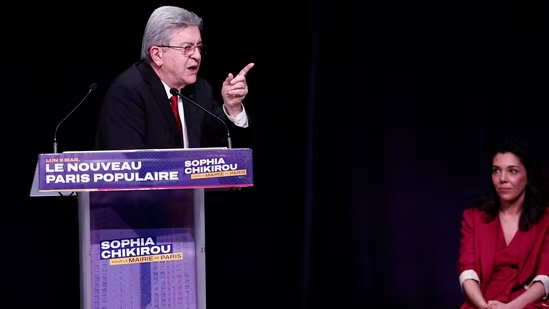
French left-wing party leader Jean-Luc Mélenchon delivers a speech during a campaign rally for left-wing candidates ahead of France’s upcoming municipal elections at La Mutualité in Paris on March 9 (AFP FILE)
As France’s political centre struggles, the populist right is the chief beneficiary. But a form of radical socialism that mixes vintage class warfare with modern critical race theory is also thriving in the shape of Mr Mélenchon’s Unsubmissive France (LFI). At mayoral elections in March the party took towns with symbolic significance. Among them was the Parisian banlieue of Saint-Denis, won by Bally Bagayoko, who is of Malian descent, and Roubaix, a big city in the northern rustbelt.
LFI sits squarely to the left of the Socialist, Green and Communist parties. Its citizens’ revolution would usher in a “new republic” under a fresh constitution, with a less presidential regime to end “monarchical” rule. Mr Mélenchon promises to share wealth more fairly “between capital and labour”. France would leave NATO, seek accommodation with Russia and breach European Union rules if they get in the way. “We were safer during the cold war than now that capitalism is everywhere,” he said on a recent television show.
No poll for next year’s two-round presidential vote, at which Emmanuel Macron cannot stand again, suggests that Mr Mélenchon could win. Yet if he qualified for the run-off he would probably face the populist-right candidate, either Marine Le Pen or Jordan Bardella, and so boost their chances of winning. This is not beyond his reach. A skilled campaigner, he often defies the polls. In 2022, after a late surge, Mr Mélenchon only narrowly failed to beat Marine Le Pen into the run-off.
What explains the stubborn appeal of the French populist left? One factor is the enduring allure of Marxist thought in a country where until the 1970s the left was dominated by the Communist Party. Another is France’s rebellious history. LFI’s revolutionary discourse goes down well in certain quarters. Students like his promise to usher in a “more inclusive, anti-racist” world, says one in Paris; another cites the fact that he is “an intellectual”, the ultimate badge of left-bank approval. His stance on Gaza and Palestine has won him a big student following.
Fully 58% of French 18- to 24-year-olds view Mr Mélenchon favorably, according to a poll last month, next to a mere 14% of those aged 50-64. With the moral clarity of the ideologue, the 74-year-old Mr Mélenchon manages to speak to a fretful younger generation by promising to focus on humanity, banish racism and make the world fairer. “What do we have to tell younger generations?” he asked on television recently, mocking other parties: “Save money and cut public services!”
Above all, Mr Mélenchon, a former Trotskyist, is a canny tactician. The Communists have long lost working-class voters to Ms Le Pen; the Socialists are now backed predominantly by public-sector workers and bookish types. A keen student of Spanish and Latin American populists, Mr Mélenchon has methodically built an electoral base that marries educated young voters with ethnic minorities and those living in social housing. Noé Fridman and François Kraus of Ifop, a polling group, call this Mr Mélenchon’s “magic mix”.
In Saint-Denis, for instance, 43% of residents live in social housing and immigrants make up 38% of the population. A striking 69% of Muslim voters backed Mr Mélenchon at first-round presidential voting in 2022, according to another Ifop poll. The LFI leader has taken far-right scaremongering tropes and turned them into his own slogans. Born in Morocco, he speaks of his “shame” at not speaking Arabic and embraces the “creolisation” of the French population.
There are plainly limits to Mr Mélenchon’s appeal, not least due to his domineering character and disregard for certain democratic norms. Polls show him to have a particularly high disapproval rating. His party has links to violent anti-fascist movements. Charges of antisemitism abound. Raphaël Glucksmann, a centre-left leader, recently accused Mr Mélenchon of “playing with the worst extreme-right codes” after he mocked the pronunciation of Mr Glucksmann’s name at a rally. An alliance with the other parties of the left in 2024 has since collapsed. In private Mr Mélenchon is scathing about the squabbling Socialists he once teamed up with, whom he considers a disconnected “caste”.
Mr Mélenchon’s brand of left-wing populism borrows heavily from his longstanding links to Venezuela, Ecuador and Spain. It also chimes with players outside his natural orbit, including Zohran Mamdani’s democratic socialism in New York and Zack Polanski’s Greens in Britain. But few on the left can match his durability. “He’s the most Trumpian figure in France,” suggests Philippe Marlière, a political scientist at University College London; “he’s faced so many scandals and setbacks, but he’s still around.”