ISLAMABAD, Pakistan (AP) — The United States and Iran are closing in on a deal to end the war in the Middle East, a regional official with direct knowledge of the Pakistan-led mediation efforts said Saturday, as the U.S. has weighed a new round of attacks on the Islamic Republic.
The official, speaking on condition of anonymity to discuss closed-door deliberations, said the parties have made “significant progress” in talks, but cautioned that “last-minute disputes” could blow up the efforts. This is not the first time in recent weeks that a deal has been described as close.
He said the potential deal would include an official declaration of the war’s end, with two-month negotiations on Iran’s nuclear program. The Strait of Hormuz would be reopened and the U.S. would end its blockade of Iran’s ports. He did not give details.
Earlier, two regional officials and a diplomat expressed hope that a final decision on the Pakistan-prepared draft could come within 48 hours as both sides review it. They spoke on condition of anonymity because they were not authorized to talk to the media.
Iran, meanwhile, signaled “narrowing differences” in negotiations with the U.S. after Pakistan’s army chief held more talks in Tehran, and U.S. Secretary of State Marco Rubio told journalists in India that “there’s been some progress made” and “there may be news later today.”
U.S. President Donald Trump has been hearing a range of opinions on what a person familiar with the latest White House and Middle East allies’ deliberations called the proposed 60-day ceasefire extension. Regional players are divided on whether the extension is a good idea, the person said, speaking on condition of anonymity to describe the deliberations.
Trump spent Saturday out of sight and largely silent on social media.
Both Iran and the U.S. emphasized their key positions and have warned of the risks of resuming attacks and disrupting their ceasefire. Rubio repeated the U.S. stance that Iran can never have a nuclear weapon and must turn over its highly enriched uranium, and the Strait of Hormuz must be open.
Iran describes it as a ‘framework agreement’ for more talks
Iran state TV quoted Foreign Ministry spokesperson Esmail Baghaei as describing the draft as a “framework agreement” and adding: “We want this to include the main issues required for ending the imposed war and other issues of essential importance to us. Then, over a reasonable time span, between 30 to 60 days, details are discussed and ultimately a final agreement is reached.”
He said the Strait of Hormuz is among the topics discussed.
Positions have moved closer in recent days, Iran’s official IRNA news agency quoted Baghaei as saying.
“Over the past week, the trend has been toward narrowing differences,” he said. “We will have to wait and see what happens over the next three or four days.”
Baghaei said nuclear issues are not part of the current negotiations, as Tehran first seeks to end the war before discussing its nuclear program that has long been at the heart of international tensions.
“Our focus at this stage is on ending the war on all fronts, including Lebanon,” Baghaei said, adding that lifting sanctions on Tehran “has explicitly been included in the text and remains our fixed position.”
The Iranian-backed Hezbollah’s Al-Manar TV reported that the Lebanese militant group’s leader, Naim Kassim, received a letter from Iranian Foreign Minister Abbas Araghchi saying Tehran will not abandon its allies. There is a fragile, U.S.-brokered ceasefire in the Israel-Hezbollah war in Lebanon, a conflict that began two days after the Iran war started.
Limiting Tehran’s support for armed proxies in the region has been a stated goal in the war, along with targeting its ballistic missile program.
Iran’s parliament speaker, Mohammad Bagher Qalibaf, the lead negotiator in historic face-to-face talks with the U.S. last month in Islamabad, said Iran has rebuilt its military assets and if Trump resumes attacks, the result would be “more crushing and more bitter” than at the start of the war.
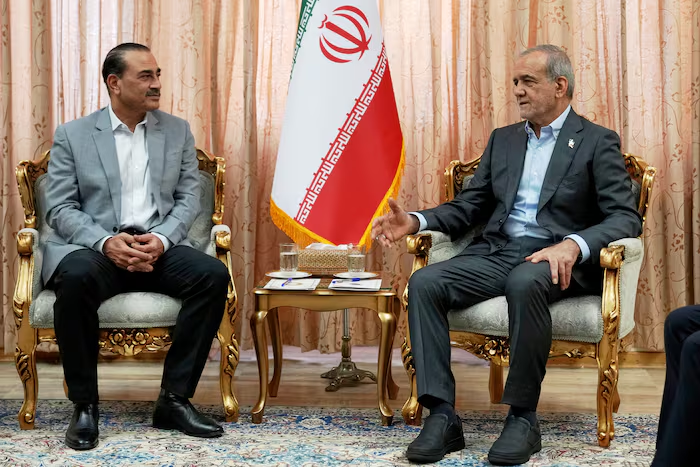
State TV said he spoke after meeting with Pakistan’s army chief Asim Munir, who also met with Araghchi, President Masoud Pezeshkian and other senior officials. Qatar sent a senior official to Tehran to support Pakistan’s efforts.
Trump had said ‘serious negotiations’ were underway
Trump earlier said he was holding off on a military strike against Iran because “serious negotiations” were underway, and at the request of allies in the Middle East. Trump has repeatedly set deadlines for Tehran and then backed off.
The U.S. and Israel sparked the war with attacks on Feb. 28, cutting short nuclear talks with Iran. Tehran retaliated by effectively closing the Strait of Hormuz, a key waterway for the region’s oil, natural gas and fertilizer, causing global economic pain.
The U.S. then blockaded Iranian ports. The U.S. Central Command on Saturday said U.S. forces had turned away more than 100 commercial vessels and disabled four since the blockade began April 13.
___
Magdy reported from Cairo and Lee from Washington. Associated Press writers Darlene Superville and Aamer Madhani in Washington and Bassem Mroue in Beirut contributed to this report.
Copyright 2026 The Associated Press. All rights reserved. This material may not be published, broadcast, rewritten or redistributed without permission.