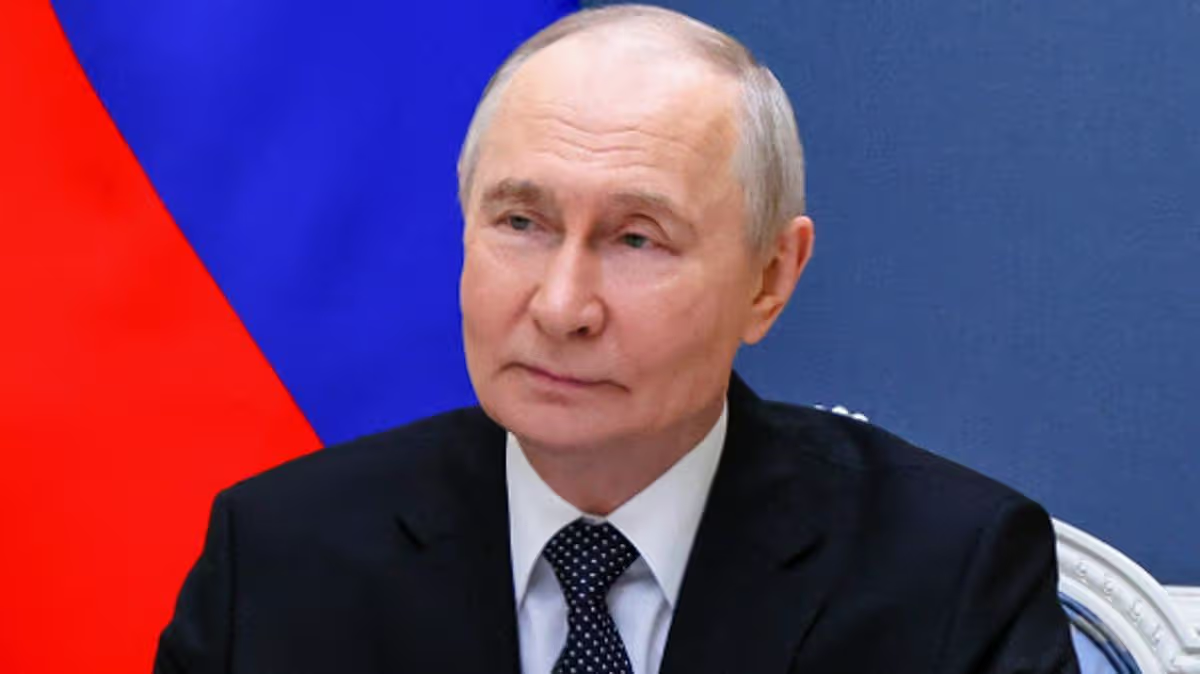
Maligned Russian leader Vladimir Putin presided over joint military drills in Belarus in another showing of strength, but he faces increasing pressure at home and in the war
Experts have warned of “something big” taking place as Vladimir Putin showed off his nuclear arsenal again.
The maligned Russian leader presided over joint military drills in Belarus, alongside his “lapdog” counterpart Alexander Lukashenko, this week. Russian arsenals in Belarus include its latest intermediate-range nuclear-capable Oreshnik missile system.
On Thursday, Putin said it was “important to further boost the level of readiness of strategic and tactical nuclear forces”, as drills including the firing of a hypersonic missile were carried out.
Exercises involved over 200 missile launchers, 73 surface warships, 13 submarines and 140 aircraft along with 64,000 troops, the Russian Defence Ministry said. The drills, which were ministry said was for the “preparation and use of nuclear forces under the threat of aggression”, included eight submarines armed with nuke-laden intercontinental ballistic missiles (ICBMs).
The manoeuvres featured a broad assortment of short and medium-range weapons. Unlike the intercontinental missiles that can destroy entire cities, tactical nuclear weapons intended for use against troops on the battlefield are less powerful. They include aerial bombs and warheads for short and medium-range missiles and artillery munitions.
Russian armed forces test-fired Yars and Sineva ICBMs, as well as medium-range sea-launched Zircon and air-launched Kinzhal missiles, noting that all missiles hit their designated practice targets. Belarusian troops test-fired a short-range Iskander ballistic missile inside Russia.
“Something big is taking place, something that will be significant for international politics in general, and for mass media, including the very supply of nuclear arms,” Bremen University researcher Nikolay Mitrokhin warned, speaking to Al-Jazeera.
Putin has repeatedly deployed ‘sabre-rattling’ rhetoric involving the use of nuclear weapons since the full-scale invasion of Ukraine in February 2022.
He has said that Moscow will retain control of its nuclear weapons deployed in Belarus, which borders Ukraine and NATO members Latvia, Lithuania and Poland, but would allow its ally to select the targets in case of conflict.
Since the full-scale war, the Russian president changed Moscow’s nuclear doctrine so that any nation’s conventional attack on Russia that is supported by a nuclear power will be considered a joint attack on his country. It was a change by the Kremlin clearly aimed at discouraging the West from allowing Ukraine to strike Russia with longer-range weapons and appears to significantly lower the threshold for the possible use of Moscow’s nuclear arsenal.
The use of nuclear weapons in Ukraine would be met with a “devastating” response, NATO secretary general Mark Rutte said this week. The drills this week were a response to a “threat of aggression”, according to Minsk and Moscow. It is not clear what the perceived threat they were referring to was.
Ukrainian President Volodymyr Zelensky has warned that Russia may try to “drag Belarus into an expansion of the war”. Russia’s presence in Belarus created an obvious pressure point for Kyiv and Zelensky has said there are “additional tasks for our intelligence regarding this threat”. Belarus was previously used as a launch point for Russian forces in February 2022.
But warnings of a new offensive into northern Ukraine have been tempered. The Kyiv-based Penta think-tank said the number of Russian forces in Belarus is “insufficient” for a new attack.
Putin is what a number of analysts are suggesting is an increasingly tricky situation in Ukraine. His attempts to sell the war to the public as a far-away ‘special operation’ could be increasingly undermined by continued Ukrainian strikes on Russian infrastructure.
There is further pressure at home, with Russian discontent at a crackdown on internet access, and problems in the war. Last month, Ukraine gained more territory than it lost for the first time in two years, the US-based National Security Journal has said Russia has lost “more soldiers than it can replace” for five months in a row.
Its invasion continues to falter, but there is so far little to suggest its growing manpower problem is at a critical stage. The same can be said for the Russian economy, although its slowing down has clearly irked Putin, who blasted officials for not coming up with a plan.
Overnight, a Ukrainian drone attack caused a fire at another Russian oil terminal, local officials in Russia’s Krasnodar region said on Saturday, in what appeared to be the latest attack on Moscow’s vital oil industry. Authorities in the city of Novorossiysk said falling drone debris sparked a fire at an oil terminal, injuring two people.
Russia’s Astra news outlet said Ukrainian drones struck the Sheskharis oil terminal and depot, the terminus for Russian state-controlled pipeline company Transneft’s main oil pipelines in the region. Images posted by Astra appeared to show smoke rising above the oil terminal, but they could not be verified.
On Saturday afternoon, Ukraine’s General Staff said its forces had struck the Sheskharis oil terminal overnight. “The facility provides shipment of oil and oil products for export and is involved in meeting the needs of the Russian army,” the General Staff wrote on Telegram, adding that Ukrainian forces had also hit a tanker in the Black Sea belonging to Russia’s so-called “shadow fleet”.
Ukraine has expanded its mid- and long-range strike capabilities, deploying drone and missile technology that it has developed domestically to battle Russia’s four-year-old invasion. Attacks on Russian oil assets that play a key part in funding the invasion have become almost daily occurrences.
Meanwhile, the death toll from a Ukrainian drone strike overnight into Friday on a college dormitory building in Starobilsk, a city in Ukraine’s Russia-occupied Luhansk region, rose to 18, the press service of Russia’s Ministry of Emergency Situations said. According to the ministry, 60 people were wounded in the attack.
Russian President Vladimir Putin on Friday denounced the attack on the dormitory as a “crime” and ordered the military to submit its proposals for retaliation. He said there were no military or law enforcement facilities near the college.
At a UN Security Council emergency meeting on the strike, held at the request of Russia, Ukrainian Ambassador Andrii Melnyk denied his Russian counterpart’s accusations of war crimes, calling them a “pure propaganda show” and asserting that the May 22 operations “exclusively targeted the Russian war machine”.