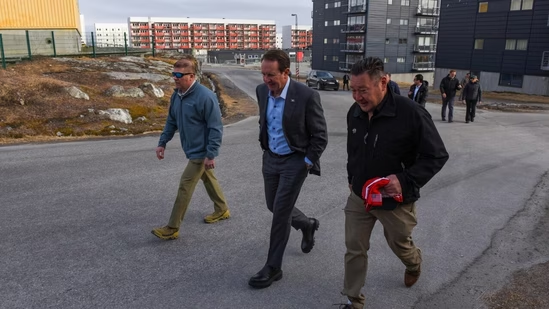
NUUK, Greenland—Jeff Landry, the emissary picked by President Trump to win hearts and minds in Greenland, walked through the quiet morning streets of the capital this week, trailed by one local woman.
“Colonizers, go home,” she shouted at the Louisiana governor and his entourage. “We don’t want you here.”
Landry said Trump sent him to Greenland this week to “listen and learn” and “make a bunch of friends.” He got a chilly reception from many locals and Greenland’s leaders, who accused him of turning up uninvited in an attempt to circumvent official diplomatic channels.
Landry, in an interview with The Wall Street Journal, brushed off such criticism. “They don’t get a say-so in what the United States’s policy is,” he said. “Tell them to take it up with Donald Trump.”
A few hundred yards down the road from where the woman was shouting at Landry, hundreds of officials, business leaders and decision makers were gathered in a conference center to discuss Greenland’s economic future.
Landry wasn’t invited. He paid his own way to participate as a private citizen. He spent less than an hour at the event’s opening day, choosing instead to meet with Greenlanders outside of the conference, in coffee shops and private homes.
His delegation included his wife, dressed in hunter’s camo; her twin sister; an ex-Green Beret who helped with logistics; and a doctor who volunteered to assess medical needs on the island. They were guided by Jørgen Boassen, a Greenlandic bricklayer who serves as the Trump administration’s primary liaison in Greenland.
Boassen spends most of his time abroad because of pressures he says he has faced since coming out as Greenland’s only publicly fervent MAGA supporter. He also helped arrange last year’s visit by Donald Trump Jr. and the late Charlie Kirk. He wants Greenland to leave the Kingdom of Denmark and enter into a form of free-association agreement with the U.S. that protects it militarily and recognizes the rights of its Inuit people.


Landry’s mission this week to pull Greenland closer into America’s orbit was his first trip to the Arctic island, which is a semi-autonomous territory of Denmark, a founding North Atlantic Treaty Organization member.
The appointment of Landry is emblematic of Trump’s approach to diplomacy. The president has delegated significant chunks of his foreign policy to envoys outside traditional State Department channels, such as Steve Witkoff and Jared Kushner.
But Witkoff and Kushner have often been welcomed as official White House representatives. Landry got a very different reception in Greenland this week.
His visit was seen by leaders in Denmark and Greenland as an attempt to bypass official channels between the U.S., Greenland and Denmark, including a working group launched in January to discuss American presence on the island.
Greenlandic Prime Minister Jens-Frederik Nielsen, in an interview, said Landry’s visit was inappropriate. “Any discussion about our relationship, and the current situation, must take place in the working group,” Nielsen said.
Many also saw it as an attempt to influence public opinion on the island and identify people who would be willing to amplify U.S. messaging against Danish rule.
“He may well be there to collect information and contacts, but it’s likely with the intent of using such information and contacts to advance Trump’s ambition to control Greenland,” said Rasmus Sinding Søndergaard, senior researcher with the Danish Institute for International Studies, a Copenhagen-based think tank.
Landry did join a meeting between Greenland’s prime minister and foreign minister and the U.S. ambassador to Denmark, Kenneth Howery. Both officials said Greenland would only communicate with the U.S. through official channels.
Landry rejected criticism that he was visiting without an official invitation and that he had signed up to the conference as an excuse to travel to Greenland in a private capacity.
“I know what the game is here. They want to watch who I’m talking to. I don’t want them to see who I’m talking to, because I want people to be able to talk freely to me,” Landry said. “I want them to express either a frustration or an irritation in honest dialogue, and quite frankly, I’m getting it.”
In February, after consulting with Landry, Trump proposed sending a hospital ship to Greenland, which hit a sore spot on the island, where the healthcare system is pressured by vast distances and a shortage of staff. During the four-day visit, the doctor in Landry’s delegation, Joseph Griffin, asked residents about their healthcare concerns and whether they still practiced indigenous medicine.
On Wednesday morning, Landry and his delegation walked up the hill from their hotel, carrying baseball caps emblazoned with “Make America Great Again” and “USA,” to the home of Nikolaj Heinrich, an 88-year-old ex-mayor of Nuuk.
“Before Trump, the United States didn’t pay any attention to Greenland. But now, we are going to pay more attention,” Landry told Heinrich.

Over buttered raisin bread and tea, Landry and Heinrich, who also used to head the national fishing association, agreed that Greenland would benefit from more direct trade with the U.S.—something that Copenhagen supports, but which has historically been complicated by logistics and limited demand.
Special envoys like Landry, who arrived on a government plane wearing jeans, aren’t accountable to the U.S. Senate and cannot be summoned for a consultation by the Danish foreign ministry, as the U.S. ambassador has been.
“While there are diplomatic relations behind closed doors, there is also external pressure, in the form of Landry, which is meant to curry favor with Greenlanders, but also demonstrate that the U.S. maintains its ambition to control Greenland,” said Søndergaard. “It is a reminder that if the negotiations don’t work out in its favor, the U.S. can activate the other track, intensify influence campaigns, or even return to threats,” he said.
Landry’s status, however, also allows the Danish government to ignore him. No Danish minister was in Greenland this week. The foreign ministry dispatched senior officials to meet Howery and Landry, and said Denmark was “appropriately represented.”
“The U.S. special envoy, Jeffrey Landry, is not part of the diplomatic process that we launched in Washington in January,” the ministry said.
Landry, an ex-police officer and businessman who also served with the National Guard in the Gulf War, doesn’t have prior foreign policy experience. He was meant to travel to Greenland in March to attend a dog sled competition, but the trip was called off because of opposition from the race organizers, said Kristian Jeremiassen, a local politician who invited Landry.

The working group established between the U.S., Denmark and Greenland in January has met about five times to discuss the U.S. presence on the island, according to officials familiar with the discussions.
According to a 1951 defense treaty, the U.S. already has the right to deploy troops and build bases in Greenland. The treaty, however, is contingent on U.S. membership of NATO, which Trump has thrown into doubt. Washington is now seeking to modify the agreement to allow for American troops to stay in Greenland indefinitely, beyond potential Greenlandic independence from Denmark, according to the officials.
The U.S. is eyeing a military expansion to new areas in Greenland, including the southern town of Narsarsuaq and Kangerlussuaq, north of Nuuk. The existing treaty would allow such a move, officials say. The U.S. was present in those areas during World War II, and currently flies Hercules C-130 military transport planes out of Kangerlussuaq for several months of the year.
The conference, Future Greenland, was marked by a dearth of U.S. companies.
“Businesses worry about the local impact on them and their brand if they cooperate with Americans,” said Christian Keldsen, managing director of the Greenland Business Association, which organized the conference. “That’s actually a shame because Greenland has for decades worked to attract investments and interest from, among others, the U.S.”
Before returning to Louisiana, Landry dismissed the idea that Greenlanders should be wary of the U.S.
“I haven’t come with any threat,” he said. “Or certainly, I’ve come with way more opportunities.”
Write to Sune Engel Rasmussen at sune.rasmussen@wsj.com