As Shell announces a profit boom amid the ongoing energy bill crisis, the Mirror hears from Holly Donovan, a fuel poverty campaigner living with disabilities who can only afford to put the central heating on for a few hours at Christmas
As Shell becomes the latest oil and gas company to announce eye-watering profits, millions of people are seeing their energy bills and prices at the pump spiralling upward.
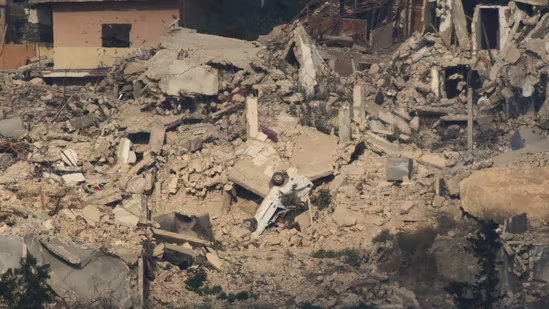
The oil giant Shell raked in nearly £5.1billion in the first three months of this year on the back of the Iran war. The industry heavyweight was among producers to benefit from a surge in wholesale oil and gas prices. Its profit was more than double the £2.4billion it made in the final three months of 2025 and up from £4.1billion a year ago. The rise came despite Shell’s oil and gas output falling 4% compared with the previous quarter due to the US-Israeli war on Iran, including damage to its Qatari gas plant, where repairs might take about a year.
As the wars in the Middle East heap expenses on ordinary working people, for the one-in-five households in fuel poverty the impact is even worse.
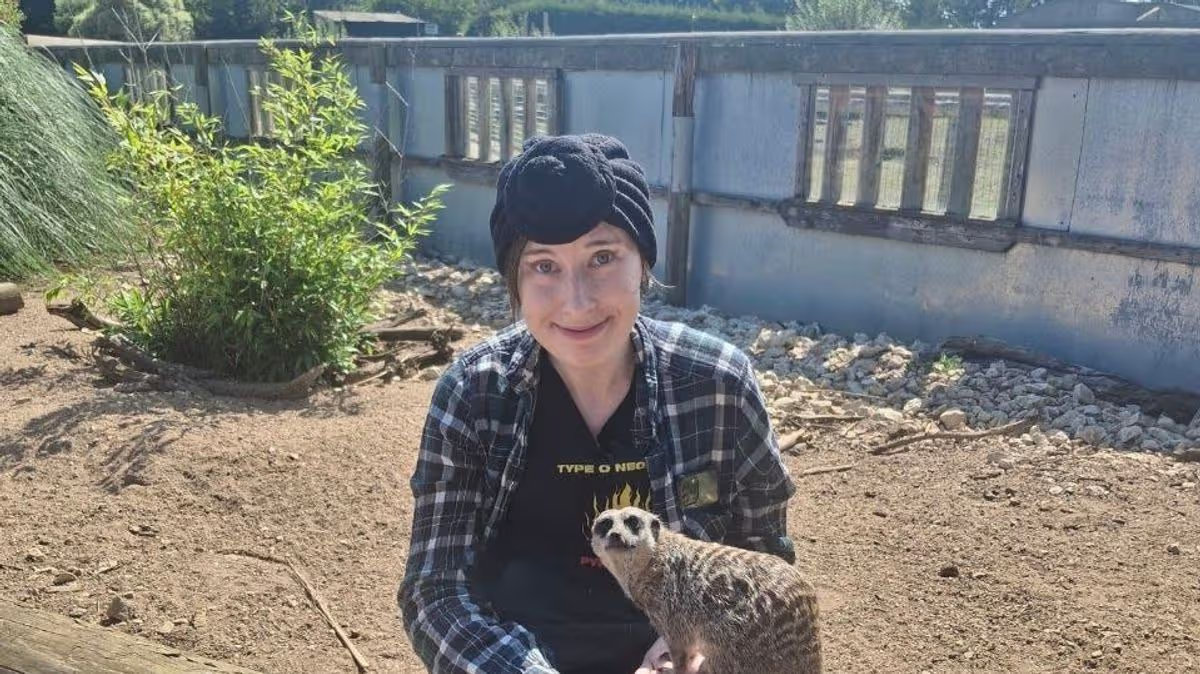
Holly Donovan, a disabled person living in the Midlands, describes what it’s like living in fuel poverty…
READ MORE: Oil giant Shell posts mega quarterly profit of £5.1 billion after Iran war chaos
I remember being shocked as a child when I was invited over to a friend’s house and it felt warm. Not just warm when we put our coats on and huddled round the fireplace, like we did at home, but properly warm all the time. I used to ask my mum if we were poor but she always said: “no, we’re comfortable”. It was only around other friends’ houses that I discovered the real meaning of the word ‘comfortable’.
It wasn’t that we didn’t have central heating at home – it just never got switched on. Neighbours would donate stacks of newspapers or we’d find wood in skips to burn in the open fire in our sitting room. As a treat we would sometimes buy some coal, but the radiators were always cold.
We had loads of weird little rules: turn off the light when you leave a room, switch the electricity off at the plug, know what you’re looking for before you open the fridge door. Other people didn’t seem to live by these rules, but they were second nature to me as a child living in fuel poverty. What other people would wear to go outside, we wore inside.
If this sounds like a tale from the distant past, here’s the thing: I’m 40 years old and my home is still freezing in the winter. My partner and I can’t afford to turn on the central heating except for a few hours at Christmas. Living in constant cold means there isn’t a single room in my flat that isn’t mouldy. Any clothes I do not wear regularly become damp and start to smell. There’s even mildew behind the sofa – it creeps up on you.
As a disabled person living with chronic pain, I feel the cold. My spine is fused and held together with a metal rod, so when it’s cold in the winter I’m in agony. I know that if I could afford to have the heating on all the time, I wouldn’t have that pain. In the summer, it’s the opposite problem: my flat becomes unbearably hot. As with using the boiler for hot water, the electric fan is strictly rationed to keep our bills down.
Last winter, it reached a point where my partner couldn’t put up with it anymore and we decided to turn the heating on for a few hours each evening. We’re still paying off the bill for that little ‘luxury’. When I called our energy provider [British Gas] to tell them I was struggling to pay my bills, all I got was a payment plan. Apparently I didn’t qualify for a social tariff.
One of the worst things is knowing that even though the boiler is switched off at the wall most of the time, we’re still paying a standing charge every day for the privilege of being connected. How is that not a tax on the poor? Even though I barely dare to use any energy, my bills are still going up and up. I just feel like we’re being ripped off.
It makes me angry to think that giants in the oil and gas industry like Shell and BP are raking in billions while everyone else is getting poorer. The 100 biggest fossil fuel companies combined cashed in to the tune of $30m every hour in the first month of the Iran war. It’s criminal, but what’s even more criminal is that the government allows it to happen. These companies are being subsidised and paying very little tax at the same time as benefits for sick and disabled people are being cut. Stronger taxes on these outrageous profits could help people like me as well as those whose lives have been torn apart by floods, wildfires and extreme weather.
I believe the only way to stop fossil fuel and energy companies profiteering is to get off oil and gas for good, by building cheap renewables. That’s why I’ve been working with Greenpeace to lobby our council to build a local solar farm. But that’s only half of the problem: we also need the benefits of cheap, homegrown renewable energy to reach everyone in society.
I’ve signed up to the Make Green Fair campaign along with more than 10,000 people and over 50 organisations. We are calling on the government to guarantee that everyone in the UK gets a fair share of the benefits of renewable energy. It’s great that they are pushing for more renewables, but there’s a lot more they could do such as breaking the link between energy bills and the cost of gas, or fitting decent insulation and ventilation in homes like mine.
Affordable energy would be an utter game changer for me. I could afford to live in warmth without pain and without the psychological toll of debt. I could even afford to upgrade some of the disability aids that would allow me to get out of the house and live a bit more. But most of all, it would give me freedom from all those weird little rules that keep me locked in constant fear of using the energy I need to be comfortable.
Holly Donovan is a fuel poverty campaigner with Fuel Poverty Action.
Do you have a story to share? Email me at julia.banim@reachplc.com
READ MORE: Woman loses nearly 4 stone and smiles on holiday with weight loss app now 80% off