Cuba’s armed forces once fielded tens of thousands of well-trained soldiers during the height of the Cold War, deploying to conflicts from Angola to Syria.
Today, as the U.S. sends an aircraft carrier to the Caribbean in a pressure campaign to change the island’s communist government, Cuba’s military is a ghost of its former self.
Until the decline and fall of its benefactor, the Soviet Union, Cuba had an army of more than 200,000 soldiers. Now that force is down to some 40,000 to 45,000 active-duty soldiers divided in three parts to defend the country’s east, west and center.
Its air force was once considered to be among the best in Latin America, with modern Soviet MiG jet fighters. Its navy had boasted three Soviet-built frigates.
Today, the air force’s handful of warplanes likely aren’t air worthy, and Cuba’s naval vessels don’t work beyond the small boats operated by its coast guard, said Frank Mora, who was President Barack Obama’s top defense official for Latin America.
“Cuba had a First World military in a Third World country,” Mora said. Now, it has no chance against the U.S. military, he added. “It’s a shell of a shell of what it used to be.”
The Trump administration disagrees. In January, President Trump signed an order declaring Cuba “an unusual and extraordinary threat” to American national security, saying the country’s government aligns itself with U.S.-designated terrorist groups, transnational criminal organizations and rivals to Washington such as Russia and China.
This month, the U.S. indicted Raúl Castro, the country’s 94-year-old former president and an icon of the Cuban Revolution, on murder charges and imposed new sanctions on its military leadership.
Axios reported this week, citing classified intelligence, that Havana has acquired 300 drones and was working on plans to potentially fire them at the Guantánamo Bay U.S. naval base or even Key West, Fla., if Cuba is attacked.
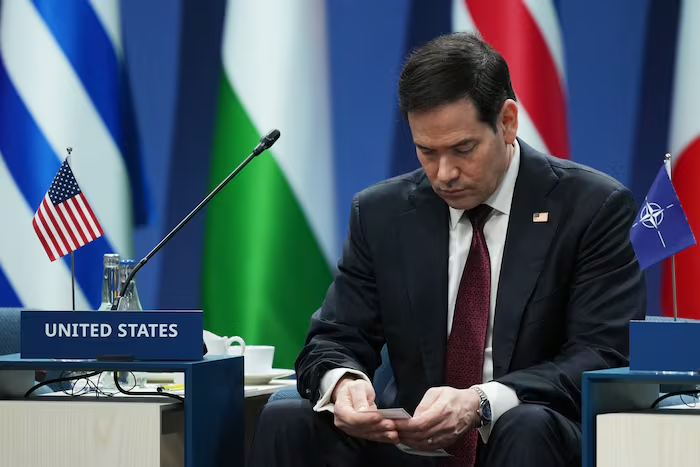
On Thursday, Secretary of State Marco Rubio, a Cuban-American who has long criticized the Havana government, accused Cuba of hosting intelligence bases for China and Russia. Cuba and the U.S. are in talks about changes that would satisfy Trump, but Rubio said the chance of success “is not high.”
“Having a failed state 90 miles from our shores run by friends of our adversaries,” Rubio said, constitutes a national-security threat.
The drone news and the indictment of Castro are part of a narrative being constructed by the U.S. government to justify an invasion or other military action against Cuba if negotiations fail, said Brian Fonseca, an expert in Cuba and defense studies at Florida International University.
“The U.S. leaked that to make Cuba seem like an imminent threat,” Fonseca said of the drone report. “The Cuban military would never launch a pre-emptive strike against the U.S. It would be suicidal.”
Cuban President Miguel Díaz-Canel warned Monday that military action against the island would provoke “a bloodbath of incalculable consequences.” Earlier, he had vowed to fight and die in defense of the country if the U.S. attacked.
To fend off invading troops, presumably from the U.S., Cuba depends on a defense doctrine known as “War of All the People.” The doctrine dates back to the post-Vietnam War era and was instituted by Fidel Castro in 1980. Since relations with the U.S. have deteriorated, the Cuban government has stepped up what it calls national days of defense to practice repelling invaders.
Television footage shows elderly people firing worn AK-47 rifles, and matrons planting mines. One video showed ox carts transporting artillery pieces.
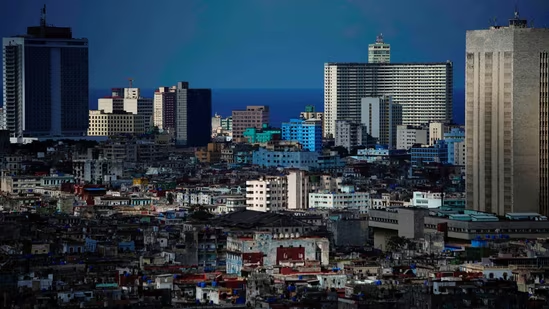
The Cuban military would be hampered in any fight by the U.S. blockade of oil shipments to the island, which produces only about 40% of its crude oil needs every day. Cuba has been undergoing daily nationwide blackouts that sometimes last for days. Its streets are empty amid a lack of fuel for even the most essential transport.
Morale and motivation also are factors. Cuba’s military has been living through a yearslong economic crisis that has exhausted the population. And those troops have been unable to train or maintain their weapons, said Craig Deare, who served early in Trump’s first administration as senior director for Western Hemisphere affairs at the National Security Council
“Maybe their rifles work and maybe they have bullets,” Deare said. “But when you’re going against the best in the world, you don’t have a chance.”
There is no indication that Cuba has any offensive capability, but it could fight a war for survival in the event of a U.S. invasion, said Evan Ellis, professor of Latin American studies at the U.S. Army War College.
“It would come down to how long they could hold out with guerrilla tactics,” Ellis said. “The core strategy of the Cuban Communist Party is survival.”