
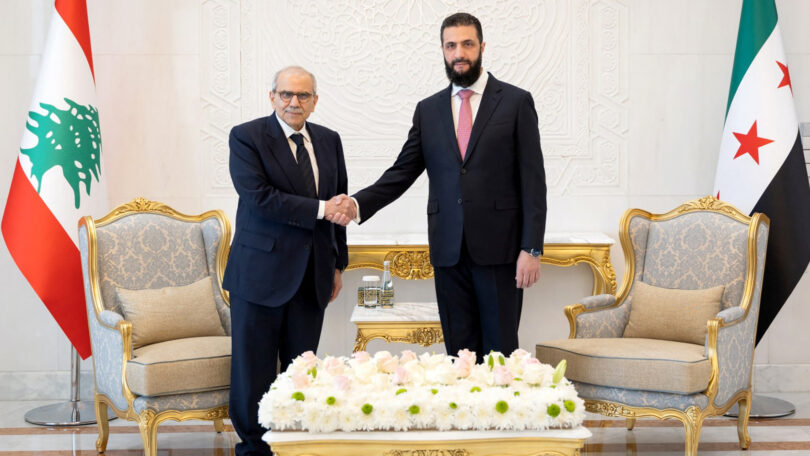
Since the fall of Syrian President Bashar al-Assad, the relationship between Lebanon and Syria has moved carefully, almost nervously, between necessity and mistrust.
The two countries are bound together by geography, history, security, and a long list of unresolved issues. But neither side has fully escaped the weight of the past.
Lebanon remains wary of any return to Syrian tutelage, while Syria’s new leadership is alert to the possibility that unilateral Lebanese decisions could spill across the border and weaken Damascus at a sensitive moment.
That tension is now resurfacing around one of the region’s most delicate files: direct negotiations with Israel.
According to a senior Lebanese official familiar with recent discussions between Beirut and Damascus, Syria has voiced concern that Lebanon’s fast-moving negotiation track with Israel is unfolding without sufficient coordination with Damascus, at a time when its own contacts with Tel Aviv have stalled.
CLICK FOLLOW: TO FOLLOW US
Sign up to get the latest insights and analysis on
Israel-Palestine, alongside Turkey Unpacked and other eSPORTY
The message, according to the official, was raised during Lebanese Prime Minister Nawaf Salam’s recent visit to Syria, where he met President Ahmed al-Sharaa.
“The Syrian leader spoke in a diplomatic and non-confrontational tone, but made clear that coordination between the two countries on vital issues was essential to strengthen the positions of both sides,” the official said.
The concern in Damascus is not only that Lebanon is negotiating separately, but that Beirut’s approach could set a precedent Syria may later be pressured to follow.
High stakes
For months, US officials have reportedly pointed to the Syrian-Israeli talks to encourage Lebanon to enter its own direct negotiations with Israel. But with the Syrian track now largely stalled, partly because Damascus sees Israel as unwilling to offer meaningful concessions, the dynamic may now be shifting.
A process once used to pressure Lebanon to follow Syria’s path may now become a means of pressuring Syria to follow Lebanon’s.
How Lebanon’s leaders are enabling Israel’s war on their own country
Read More »
Lebanon’s path has been especially sensitive because of the conditions under which it has unfolded. Lebanese President Joseph Aoun had previously said Beirut would not negotiate before a ceasefire was reached. Yet contacts have continued while Israeli attacks in Lebanon have persisted despite the ceasefire agreed in mid-April.
For Damascus, this raises a strategic concern: if Lebanon moves forward with negotiations while violence continues, and with concessions appearing to be offered early in the process, Syria could face growing pressure from Washington and other international actors to accept a similar framework.
The issue comes on top of an already fragile relationship between the two neighbours.
Lebanon and Syria are still dealing with several unresolved files: Syrian detainees in Lebanese prisons; land and maritime border demarcation; the future of relations with Hezbollah; the presence of former Assad government figures in Lebanon; and the broader question of how the two states manage their security relationship after decades of domination, hostility and mutual suspicion.
Syrian unease over Lebanon has already surfaced in several of these issues.
In December, Damascus raised concerns about Assad-linked officers residing in Lebanon. Syrian security officials reportedly handed Lebanese authorities lists of names, warning that some of those figures could use Lebanese territory to threaten Syria’s new leadership. Damascus has also treated the issue of Syrian detainees in Lebanese prisons as central to any improvement in bilateral relations.
The negotiations file has now become the latest layer in this complex relationship. For Syria, the issue is not simply one of diplomatic protocol, but of leverage.
Beirut’s unilateral moves
Damascus believes that Lebanon and Syria, despite their difficult history, share overlapping vulnerabilities. Any Lebanese concession to Israel, particularly on security arrangements, border issues or the shape of post-war guarantees, could indirectly impact Syria’s own negotiating position.
“This is why Sharaa stressed that coordination on vital issues was not an optional courtesy, but a strategic necessity,” the Lebanese official said.
“If Syria takes one step in favour of Lebanon, Lebanon should understand that its own vital interests require it to take many steps in favour of Syria.”
The remark reflects the asymmetry in how Damascus views the relationship: while Lebanon may fear a return of Syrian dominance, Syria believes Lebanon’s decisions can still expose it to serious risks.
‘If Syria takes one step in favour of Lebanon, Lebanon should understand that its own vital interests require it to take many steps in favour of Syria’
– Lebanese official
The maritime file adds another layer of complexity.
Turkey’s unease over Lebanon’s 2025 exclusive economic zone agreement with Cyprus – reached without sufficient consideration of Syrian and Turkish interests in the eastern Mediterranean – has also fuelled a regional perception that Beirut tends to move ahead on sensitive issues without adequate coordination with neighbouring stakeholders.
In this context, Lebanon’s direct talks with Israel are not viewed in Damascus as an isolated Lebanese decision. Rather, they are seen as part of a broader pattern of Beirut moving unilaterally on issues that extend beyond Lebanon itself.
A senior Syrian official said Damascus has repeatedly stressed in meetings with Arab states the need for coordination and the importance of avoiding separate negotiation tracks that could weaken the broader Arab position.
“There is a positive atmosphere, but there are realities on the ground that cannot be ignored,” the official said. “Cooperation with Lebanon is growing, but it has not yet reached the required level. The issue is less about disagreement and more about poor coordination.”
The official added that Syria has a clear interest in a stable neighbour.
“The Syrian state wants Lebanon to be strong and capable of standing on its own feet,” the official said, adding that Sharaa had stressed in his meetings that Lebanon was in a sensitive position and required more than the traditional solutions it had relied on in the past.
Damascus believes Lebanon needs “precise tools” to navigate the current phase, and that Syria’s role should be to support Lebanon rather than add to the pressure on it, the official added.
A familiar dilemma
The risk for Lebanon is that it may believe it is creating room for manoeuvre while, in practice, narrowing its own options.
A unilateral track with Israel could deepen Syrian mistrust, unsettle Turkey, complicate relations with Hezbollah, and expose Lebanon to pressure from international actors seeking quick arrangements rather than durable settlements.

Smart borders, military gates and land seizures: How Israel is encroaching in southern Syria
Read More »
The danger for Syria is different.
Having inherited a fractured state, a weakened regional position and difficult negotiations with Israel, Damascus fears that Lebanon could inadvertently weaken its hand by accepting a framework that Israel and the US could later present as a regional model.
This does not mean Syria and Lebanon are moving towards open confrontation. By most accounts, the tone remains cautious.
Both sides still need each other: Syria needs Lebanon to prevent its territory from becoming a platform for hostile activity, while Lebanon relies on Syria for border control, detainees, refugee returns, smuggling oversight, security coordination and any serious regional settlement.
For Lebanon, the question is whether it can negotiate with Israel while maintaining a coherent regional posture. For Syria, the question is whether it can prevent Lebanon’s decisions from becoming precedents used against it.
But the latest developments suggest the post-Assad relationship has not yet become institutional, strategic or trust-based. It remains largely transactional, reactive and shaped by old suspicions.
Between the two lies a familiar dilemma: Lebanon and Syria may no longer be bound by the old order, but neither can afford to act as though the other does not matter.