
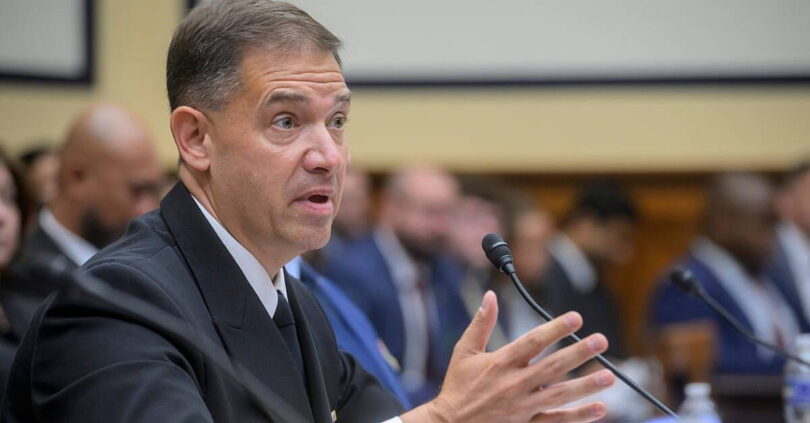
Help from Britain and other European allies in securing the Strait of Hormuz “would be appreciated at the appropriate time”, a top US commander has said.
Admiral Brad Cooper, who heads American forces in the Middle East, made his comments as he was pressed over a proposed UK and France-led defensive mission to safeguard shipping in the strategic waterway once the Iran conflict is over.
While he made clear its operation was a matter for the respective governments, he told Congress there had been talks at a military level in relation to planning.
Admiral Cooper appeared before a hearing on Capitol Hill as Donald Trump said he had given Tehran “a limited period of time” to reach a deal to end the war after calling off fresh strikes in the face of “serious negotiations”.
Repeating Iran cannot be allowed to get a nuclear weapon, the US president said: “Whether it’s popular or not popular, I have to do it – because I’m not going to let the world be blown up on my watch. It’s not going to happen.”
Insisting Iran only had a narrow window to come to an agreement or risk renewed attack, he said: “I’m saying two or three days, maybe Friday, Saturday, Sunday, something, maybe early next week, a limited period of time, because we can’t let them have a new nuclear weapon.”
The Strait of Hormuz has become the focus of a stand-off between the US and Iran, with clashes testing the fragile Middle East ceasefire.
Tehran’s stranglehold on the sea route since the US and Israel triggered the conflict in February has affected economies around the world, including the UK’s, sending oil prices soaring and threatening the supply of other vital products, including fertiliser for crops.

It has led the UK Foreign Secretary Yvette Cooper to warn over the risk of “sleepwalking into a global food crisis”.
As part of the planned post-conflict defensive mission, the UK would deploy autonomous mine-hunting equipment, anti-drone systems and Typhoon jets, alongside the destroyer HMS Dragon.
Asked about the proposed British and French-led operation when he appeared before the House armed services committee, Admiral Cooper said: “Much of that is a policy matter, not a military matter.
“What I can say is, we’ve continued to work very closely with military partners in the region to support future operations and planning that’s gone on, and we’ve also connected at a military to military level with our European allies from a planning perspective.
“What that looks like in execution is a civilian policy decision.”
Republican congressman and committee member Derek Schmidt said: “Would it be fair to say that it would be helpful if there is a European role going forward?”
In reply, Admiral Cooper said: “All help would be appreciated at the appropriate time.”
He also told the committee that despite the US offensive, Iran still retained 10% of its mining capability.

Later, at a White House press conference, US vice president JD Vance, who is sceptical of foreign military intervention, defended the administration’s approach to Iran, pointing out a ceasefire was currently in place.
He said: “We’re going to get a good settlement that actually gets the American people what they need, or we’re going to go back to a kinetic operation.”
He added: “This is not a forever war.
“We’re going to take care of business and come home.”