
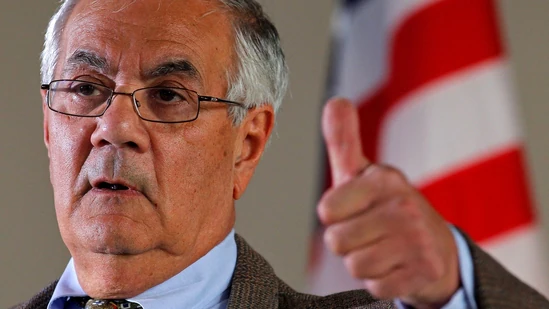
Barney Frank, the progressive Democrat who led one of the most important financial reform laws since the Great Depression, passed away on Tuesday night following a struggle with congestive heart failure. He was 86 years old.
“He was, above all else, a wonderful brother. I was lucky to be his sister,” Frank’s sister, Doris Breay, stated to NBC10 Boston on Wednesday morning while confirming her brother’s death.
Also Read: Lorna Hajdini case takes new twist as counter-suit filed after JPMorgan Chase’s 1mn settlement offer to ex-banker
Barney Frank entered hospice care
The former congressman from Massachusetts spent his final months receiving hospice care at his residence in Ogunquit, Maine, which is the hometown of his spouse, Jim Ready.
A look at Barney Frank’s career
Born in 1940 in Bayonne, New Jersey, Frank advocated for a diverse range of issues throughout his 32-year tenure — including abortion rights, environmental protection, LGBTQ rights, and economic reforms.
In the aftermath of the 2007-2008 financial crisis, Frank collaborated with then-Senator Chris Dodd (D-Conn.) to develop the Dodd-Frank Wall Street Reform and Consumer Protection Act, commonly referred to as Dodd-Frank, which sought to diminish the influence of financial institutions and safeguard American consumers.
Among the significant reforms introduced by the act was the establishment of the Consumer Financial Protection Bureau (CFPB), the creation of the Financial Stability Oversight Council to monitor systemic risks within the financial system, and the abolition of taxpayer-funded bailouts for failing large banks through the Orderly Liquidation Authority.
Dodd-Frank also codified the Volcker Rule, which prohibited Wall Street banks from participating in high-risk or speculative investments using depositor funds and enhanced the oversight of major financial institutions by the Federal Reserve.
The act was enacted into law by former President Barack Obama in 2010.
Frank, who became the first openly gay member of Congress after coming out publicly in 1987, was a passionate supporter of LGBTQ rights, advocating for the repeal of the “Don’t Ask, Don’t Tell” policy from the Clinton administration concerning homosexuals in the military and the enactment of the Matthew Shepard Hate Crimes Act.
Barney Frank’s family members
Frank is survived by husband Jim Ready and three siblings: his brother David and his sisters Doris Breay and Ann Lewis.
Barney Frank’s net worth
His net worth was $1.5 million at the time of his passing, as per Celebrity Net Worth.
During his time in Congress, Frank, like all other members, was obligated to submit annual financial disclosure reports. These reports do not specify exact dollar values for assets and liabilities; rather, they categorize them into broad ranges. Consequently, external organizations such as OpenSecrets estimate net worth by determining midpoints within these ranges.
By the conclusion of his congressional career, Frank had become a millionaire, although his wealth was relatively modest in comparison to numerous peers in Washington, as per Celebrity Net Worth.
According to evaluations of his final disclosures: In 2010, his estimated net worth was between approximately $619,000 and $1.51 million, with an average estimate of around $1.06 million.
In 2011, his last full year of reporting, his estimated net worth increased slightly to about $1.08 million.
While this level of wealth positioned him comfortably within the upper echelon of American households, it remained significantly below the average for members of Congress at that time. In 2011, the average net worth for Democratic members of the House was estimated to be approximately $7.8 million, underscoring the relatively modest nature of Frank’s personal finances in comparison to many of his colleagues.