The Royal Navy’s RFA Lyme Bay is on standby in Gibraltar, ready to lead an international mine-clearing mission in the Strait of Hormuz once a US-Iran peace deal is finalised — as at least 6,000 ships remain blocked from the vital shipping lane
Aboard the RFA Lyme Bay moored off Gibraltar’s coastline, hundreds of British sailors are standing by for deployment on a mine-clearing operation to the Strait of Hormuz that remains uncertain.
US President Donald Trump has criticised allies for failing to contribute more to America’s military campaign in Iran, whose grip on the strait has paralysed global shipping and caused energy costs to skyrocket. In March, Trump instructed NATO partners to “go get your own oil” and safeguard the strait independently.
On the southernmost point of the Iberian Peninsula, within the British Overseas Territory of Gibraltar, the UK’s Royal Navy is gearing up to do precisely that – but only after a peace settlement is secured. Trump announced on Saturday that an agreement with Iran has been “largely negotiated” following discussions with Israel and other regional partners, though it requires finalisation.
READ MORE: Donald Trump hit with major setback as ‘allies’ question Iran war deal before it’s even announcedREAD MORE: Nigel Farage’s crypto donor’s bases – anonymous Bangkok tower and run-down apartment block
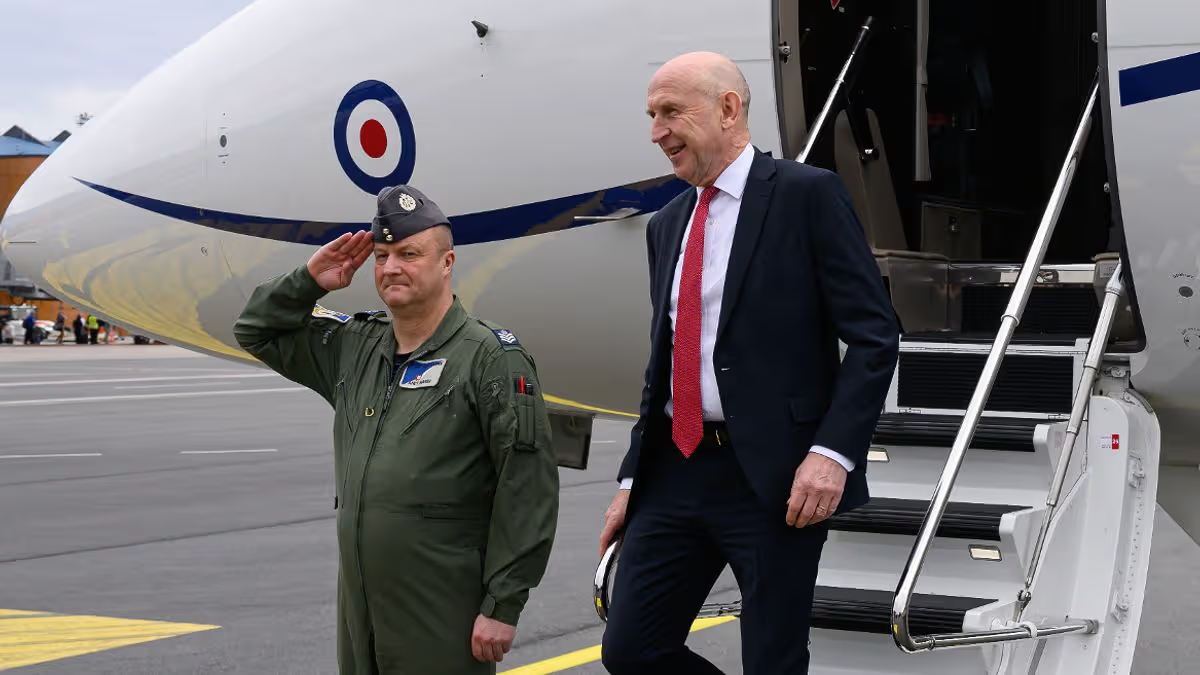
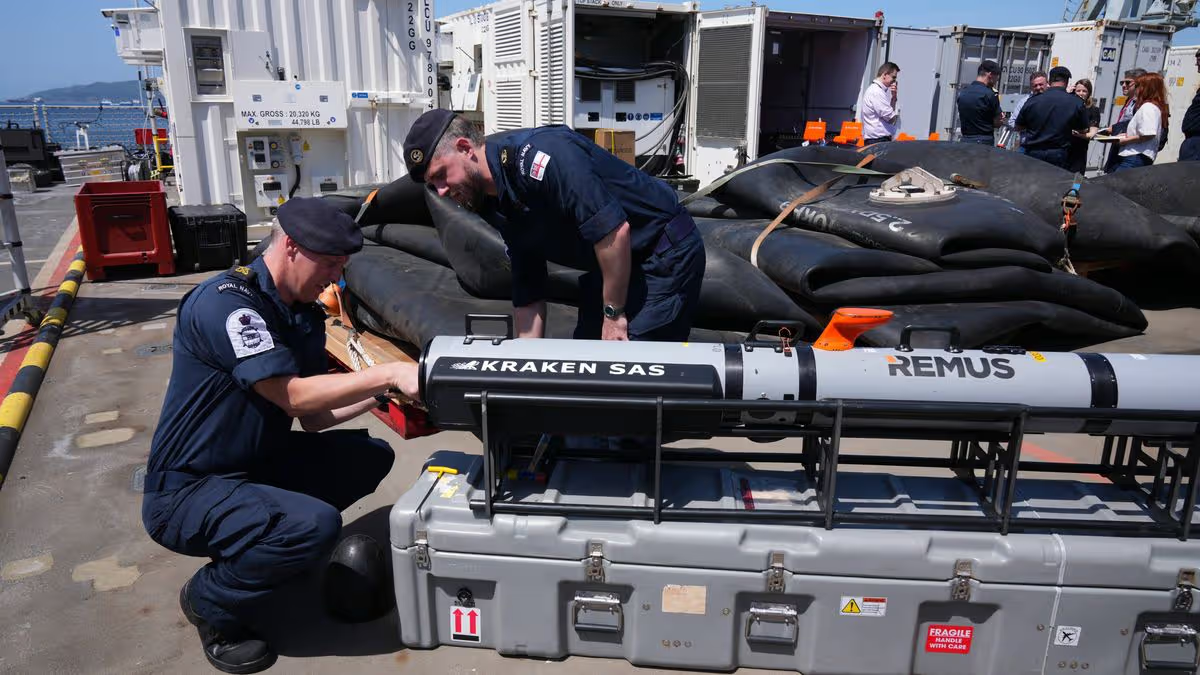
Britain’s Armed Forces Minister Al Carns brought a select group of journalists to tour the RFA Lyme Bay as it readies itself for a potential multinational mission, spearheaded by the UK and France, to protect the strait. During Carns’ remarks, the amphibious landing craft, stationed at the Mediterranean’s entrance, was being stocked with munitions and mine-detecting underwater drones fitted with sonar technology.
Crewed by several hundred personnel, the RFA Lyme Bay will shortly leave Gibraltar to rendezvous with the UK destroyer HMS Dragon and partner vessels for aerial coverage before navigating through the Suez Canal towards the Persian Gulf. “Which other country can pull together 40 nations and come up with a solution to deal with a complex problem that we couldn’t predict because we weren’t involved?” asked Carns, responding to a question about what Trump wants from his British ally.
Following the launch of military action by the US and Israel on February 28, Tehran hit back by effectively shutting down the strait, a crucial shipping route for the region’s oil, natural gas and fertiliser, triggering worldwide economic disruption. The UK has particularly attracted Trump’s criticism, with the president branding Britain’s navy as “toys” and Keir Starmer as “not Winston Churchill”.
More than 6,000 vessels have been prevented from navigating through the strait since hostilities commenced, Carns said. Iran could have deployed a “huge” array of mines throughout the strait, said Cmdr. Gemma Britton, who leads the Royal Navy’s Mine and Threat Exploitation Group. Mines could be rocket-propelled, tethered or positioned on the seabed and activated by sound, movement or light.
AP was given access to autonomous systems capable of scanning the seabed and surrounding waters with sonar in roughly half the time required for a crewed vessel to enter and chart potential hazards. The unmanned sea drones fitted with sonar generate imagery of underwater objects, from fishing equipment to pipelines.
This imagery is then used to identify mines which can be examined further with sophisticated acoustic systems and cameras, Britton said. Some of the systems aboard the RFA Lyme Bay can be transferred onto a smaller vessel that can be launched and operated autonomously from the ship, which serves as a mother ship, waiting beyond any potential minefield, Britton explained. This cuts down the number of personnel required to enter the area, she said.
Once a mine has been identified, a diver carrying explosives would ordinarily place a charge on the mine before retreating to detonate it. However, the RFA Lyme Bay is currently trialling a remotely operated vehicle that submerges and deposits a charge next to a mine before triggering it, Britton said.
The primary aim, she said, will be to clear a transit lane through the strait to allow approximately 700 ships to depart. A lane running in the opposite direction will subsequently be cleared, enabling vessels to enter, she said, though she cautioned that clearing the entire strait could take months or even years.
It remains uncertain whether any mines are actually present in the strait – or indeed whether the UK and its allies will be deployed to remove them. A US official, speaking anonymously to discuss sensitive military matters, said the US has neither located nor destroyed any mines in the strait, and no vessels have sustained damage.
Commercial traffic has quietly continued to move through, albeit at significantly lower volumes than prior to the conflict. When quizzed on whether the British operation was partly a gesture designed to win favour with the US, Carns said he was confident some mines had been destroyed or swept away, but stressed that such assurances simply weren’t sufficient for commercial insurance firms. He explained that those companies require “absolute certainty” before vessels can once again navigate the strait safely.
“That’s what this capability will provide,” he said. The global push to secure the strait would only get under way once the fighting has ceased.
“Final aspects and details of the Deal are currently being discussed, and will be announced shortly,” Trump said Saturday on social media, with no details on timing. This is not the first time in recent weeks that a deal has been described as close.
“We don’t know when the Americans, Iranians and Israelis are going to come up with a suitable solution,” Carns said. In the meantime, the RFA Lyme Bay and its crew will be on standby and will be “really, really ready,” Carns said.