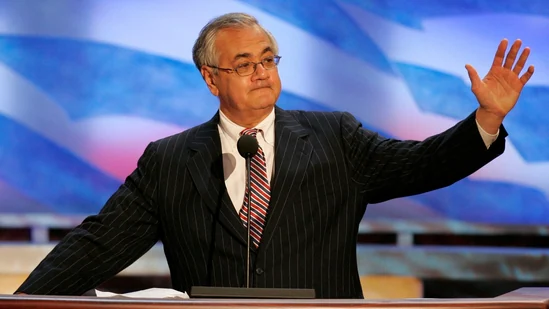
Former US Representative Barney Frank has died, his sister Ann Lewis confirmed on Wednesday. The 86-year-old Democrat, who gave his name to a landmark financial reform bill after the economic crisis of 2007-2009, was one of the most popular openly gay politicians. Now, President Donald Trump’s old tweet about Frank’s ‘disgusting nipples’ has surfaced.
When Trump tweeted about Barney Frank
Back in 2011, Frank wore a light blue crewneck shirt and a navy blue jacket on the House floor, speaking about bank failures. Trump body shamed him almost immediately.
“Barney Frank looked disgusting–nipples protruding–in his blue shirt before Congress. Very very disrespectful,” the then-reality TV star and businessman wrote on X, platform formerly known as Twitter.
Read More: Trump was ’60 minutes away’ from ordering fresh Iran strikes before ‘hold off’ decision
Barney Frank and Trump often clashed
Frank became a fierce critic of Trump, especially over efforts to roll back financial regulations during Trump’s presidency. Still, the 86-year-old, occasionally acknowledged areas where he agreed with the president, particularly on NATO spending and military burden-sharing among US allies.
He also noted that Trump treated same-sex marriage as largely settled law during his presidential campaigns, though Frank remained critical of Republican positions on transgender rights.
Even after retiring from Congress in 2012, Frank stayed deeply engaged in political debates and remained outspoken on issues involving democracy, economics, and social equality.
Barney Frank cause of death update
Barney Frank died Tuesday night. The longtime Massachusetts lawmaker had entered hospice care in April after battling congestive heart failure. He is survived by his husband, Jim Ready, sisters Ann Lewis and Doris Breay, and brother David Frank. An official cause of death was not released immediately.
From civil rights activism to Congress
Born in Bayonne, New Jersey, in 1940, Frank often pointed to the murder of Emmett Till as the moment that pushed him toward public service and activism. During the civil rights movement, he volunteered in Mississippi during Freedom Summer in 1964.
Reflecting on that experience years later, Frank joked about the difficulties his speaking style created in the Deep South.
“My direct organizing of Mississippi voters was limited by the fact that my accent (to this day more New Jersey than New England), my poor diction, and my rapid speech, especially when I got excited, rendered me largely incomprehensible to rural Mississippians of both races,” he wrote.
Read More: Donald Trump says $400 million White House ballroom will act as ‘shield’ against drones
Frank began his political career as an aide to Boston Mayor Kevin White before winning a seat in the Massachusetts House in 1972. He later entered Congress in 1980 during the same election cycle that swept Ronald Reagan into the White House.
Though considered a leading figure on the Democratic Party’s left wing, Frank frequently described himself as a pragmatist willing to compromise to secure policy victories.
Years before leaving office, he explained how he abandoned ideological purity during a major tax debate to preserve affordable housing benefits.
“I was happy to sacrifice my ideological purity to improve legislation that was going to become law with or without me,” he wrote.
In one of his final interviews before entering hospice care, Frank warned Democrats against forcing politically unpopular positions into mainstream campaigns as the party looks ahead to the 2028 presidential election.
“I hope I made the point that the best way to accomplish the improvements in our society that we need, particularly in making it less unfair economically and socially, is by conventional political methods,” Frank said.
“The main obstacle to our defeating populism and going further in the right direction is that mainstream Democrats have to make it clear that we oppose that part of the agenda of our friends on the left that is politically unacceptable. They’re right about a lot of things but you have to have some discretion.”
“You should not take the most unpopular parts of your agenda and make them litmus tests,” he added. “And that’s what my friends on the left have been doing.”