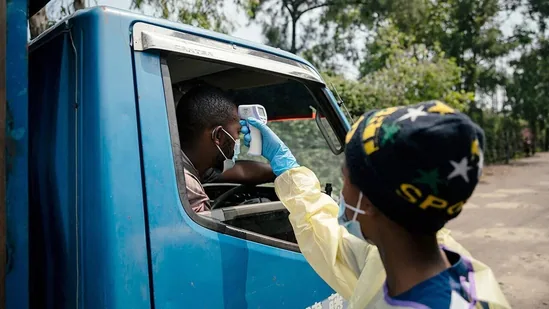
“SINCE APRIL, we’ve seen people dying,” says Sylvie Kabuo-Kinyoma, who sells vegetables in Mongbwalu, a gold-mining town in Ituri, a province in eastern Democratic Republic of Congo. At first she thought the deaths were due to witchcraft. But then a nurse spotted a patient with a severe fever who was bleeding from their nose—a sign of Ebola, a virus with a fatality rate of up to 50% that spreads through direct contact with bodily fluids. “We’re afraid,” says Ms Kabuo-Kinyoma. “I don’t want to lose my children.”
On May 17th the World Health Organisation (WHO) said the outbreak was a “public health emergency of international concern”, only the ninth such declaration since 2005
On May 17th the World Health Organisation (WHO) said the outbreak was a “public health emergency of international concern”, only the ninth such declaration since 2005. Though it has not been declared a pandemic, it is shaping up to be the worst Ebola epidemic since at least 2018, when more than 2,000 people died in eastern Congo. Some experts worry that it could be as bad as in 2014-16, when an epidemic in west Africa killed 11,000. That is because of a fatal blend of bad luck, a country at war and a world cutting health aid.
As of May 19th there have been more than 500 suspected cases and 130 deaths in Congo. There are almost certainly more, according to modelling by the MRC Centre for Global Infectious Disease Analysis, an institute at Imperial College in London. The virus has already been circulating for several weeks (Congolese authorities first detected it on April 24th). Two Congolese nationals have been diagnosed with it in Kampala, the capital of neighbouring Uganda. An American doctor working in the area was also found to have the disease and has been evacuated to Germany. There have also been cases in Goma, the capital of North Kivu, a Congolese province to the south of Ituri (see map). Rwanda has reportedly closed some border crossings with Congo. Public-health experts worry the disease could spread to Burundi and South Sudan.
Since the west African disaster, governments and international bodies have vastly improved how they respond to the spread of the virus. Vaccines against the most common strain, known as Zaire, have allowed medics to isolate infected populations. Genetic sequencing of this strain has enabled rapid diagnostic testing. Local health workers, backed by international NGOs and African governments, have got better at educating people about Ebola, earning their trust and isolating those with symptoms.
Yet none of that is likely to be much help with this outbreak, the 17th recorded in Congo since 1976. Bundibugyo, the strain that is causing it, is a bit less fatal than Zaire. But it is less common, and there is no licensed vaccine or rapid diagnostic testing for it. Samples taken in Ituri must be flown to Kinshasa, the capital of Congo, some 2,000km away. It can take several days to receive an official result. “This feels like we’re back to square one,” says Bob Kitchen of the International Rescue Committee (IRC), a humanitarian NGO, likening the situation to the start of the epidemic in 2014, before vaccines against any strain were available.
The kaleidoscope of conflicts in eastern Congo further complicates the picture. More than 100 militias are active across Ituri and the Kivus. In the last major Ebola outbreak in Congo in 2018 some of these groups burned down clinics run by Médecins Sans Frontières (MSF), another NGO. “We are taking safeguarding very seriously,” says Alan Gonzalez of MSF. Armed groups, along with some of the worst roads in Africa, make it hard for medics to get to remote areas.
The state presence in Ituri is incredibly weak, as it is in much of Congo. “We are very worried because, so far, the provincial authorities have taken no action,” says Machozi Mwanamolo, a university professor in Bunia, a city in Ituri province. He laments that people from Mongbwalu have been “allowed to move about freely when they should be restricted to prevent the spread of the virus”. He is wearing face masks and making ginger tea with lemon and garlic “to boost our antibodies”. Academics, normally a polite and formal bunch, have stopped shaking hands.
Farther south in the Kivus, the situation is even trickier. In the past two years M23, an armed group backed by Rwanda that is at war with the Congolese government, has taken control in much of the two provinces, causing many aid workers to leave. It has replaced officials across the local bureaucracy, including in the health ministry. When your correspondent visited a government-run clinic near Goma at the end of April, it was struggling to contain a measles epidemic. M23 has also declined to reopen the airport in Goma, forcing NGO workers to make some journeys to parts of North Kivu via Rwanda and Uganda. Humanitarians complain of supplies being held up by M23 officials demanding payment.
Then there are the aid cuts. Before 2025 American funding helped pay for surveillance (typically in the form of community health workers) and preparedness (for instance education schemes and protective gear). But over the past year these programmes have been slashed; IRC, for example, went from working in five areas in Ituri to just two after March 2025. On May 18th the State Department promised $13m to help with the response, a fraction of what America spent to combat the epidemic in 2014-16. Other Western governments, including Britain and Germany, have also dramatically reduced aid spending.
Much will depend on whether the WHO, international NGOs and African organisations can fill the gap. Jean Kaseya, the head of Africa CDC, the continent’s main public-health body, implicitly criticised as inadequate America’s decision to restrict travel to non-Americans who had recently been to Congo, Uganda or South Sudan. “Global health security cannot be achieved through borders alone,” he said. “It is achieved through partnership, trust, science and rapid investment in preparedness and response capacity.”
Responding to Ebola was incredibly difficult even with more of that around. In the 2018 outbreak it took two years, around 300,000 doses of vaccine and a well-funded aid response to end the epidemic. Without vaccines, the support of local Congolese for public-health measures is even more important, just as there is less money to fund schemes that build trust. That sort of education matters, says Foibe Mbusi, a market seller from Bunia: “There’s a segment of the population, even female vendors like us, who don’t believe Ebola exists.”