The arrival Tuesday of Russian President Vladimir Putin in Beijing will mark a watershed moment for Chinese leader Xi Jinping, one that he has pursued since taking power in 2012—and bet his country’s future to achieve.
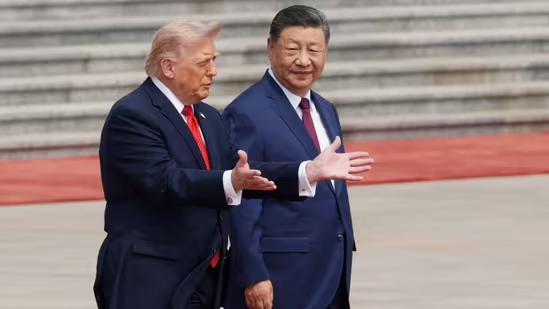
Welcoming Moscow’s ruler just days after President Trump’s motorcade swept out of the Chinese capital represents, for Xi, a vindication of 14 years of relentless economic competition with the U.S. and his strategic embrace of the Kremlin through the Ukraine war. No Chinese leader before him has staged back-to-back state visits in the same month from a sitting American president and a sitting Russian president.
With the dueling visits, “Xi is sending the message that ‘I’ve established parity with Trump. I made no concessions to Trump, and I’m still maintaining my basic foreign policy, which is supportive of Russia, Iran and North Korea,’” said Stephen Hadley, national-security adviser to former President George W. Bush.
It is a victory on the world stage that has come at a cost at home. The economic policies that Xi has accelerated gave China leverage over the U.S. but also left it with too many factories and triggered a U.S. backlash that is cutting into American demands for Chinese goods. His support for Russia has alienated another big market in Europe, where fewer countries are inclined to play the part of friend.
The number of industries where China dominates more than half of global exports nearly doubled between 2021 and 2024, from 192 to 315—a measure of the strategy that increasingly produces more than the rest of the world is willing to absorb, according to a new study from the U.S. Chamber of Commerce and Rhodium Group.
At the same time, Beijing set its lowest annual growth target in more than three decades, aiming for GDP growth of between 4.5% and 5% this year, compared with around 5% in recent years and 7% to 8% a decade ago.
For Xi, outcompeting the U.S. is the only contest that matters and trumps any economic changes that analysts think would put China’s economy on steadier footing. He has dismissed encouraging American-style consumerism and warned subordinates against raising a generation of “lazy people.”
Xi has drawn one lesson from the Soviet Union’s collapse above all: Moscow’s economy was too narrow—dependent on a handful of industries such as steel, energy and weapons—to sustain a world power.
“China, in his vision, must produce virtually everything important, dominate every significant link and avoid vulnerability in every major supply chain,” said Robert Hormats, who was former Secretary of State Henry Kissinger’s senior economic adviser in the 1970s and has met Xi several times.
The result is a country that can stand strong with the U.S. as an economic superpower and prop up its old patron in Moscow—but also one that has a structural weakness, making more than it can sell at home and must sell abroad.
Putin’s arrival Tuesday will mark his ninth face-to-face meeting with Xi since launching the war on Ukraine in February 2022. It is an extraordinary cadence for a Russian leader and a measure of how much Moscow has come to lean on Beijing.
Putin arrives as his strongman image at home is fading, and against a strategic ledger that has only grown more lopsided. Russia couldn’t save Bashar al-Assad in Syria. It couldn’t deter Israel and the U.S. from striking Iran. And it watched as the U.S. brokered a peace deal between Armenia and Azerbaijan on Russia’s own southern border.
Xi will receive Putin this week less as a peer than as a junior partner.
Analysts say that Putin must persuade Xi he is still the strong leader Xi originally backed; confirm there are no undisclosed Xi-Trump understandings, particularly any in which Xi would pressure Iran in ways that would deliver Washington a clear win; and ensure the maintenance of Beijing’s material support for Russia’s war—including oil purchases and military components.
If Xi is the clear leader in his partnership with Putin, his summit with Trump was an attempt to show he was an equal peer. Late last year, it was Trump, not Xi, who called his meeting in South Korea with the Chinese leader one of the “G-2,” a nod to the world’s Group of Seven economic powerhouses that doesn’t include China.
Trump again called his Beijing summit a “G-2.” Though China relishes the status of equal partner, it hasn’t embraced the label publicly. Chinese policy advisers say doing so would alienate the Global South audience that has become central to Xi’s goal of reshaping the world order in Beijing’s favor.
Xi used the summit with Trump last week to try to lock the administration into a more predictable framework. The vehicle was a phrase Beijing threaded through its accounts of the meeting: a “constructive strategic partnership.”
The wording has a back story, said Yun Sun, director of the China program at the Stimson Center. When Secretary of State Marco Rubio met Chinese Foreign Minister Wang Yi last year in Malaysia on the sidelines of a Southeast Asian nations conference, Rubio said the goal was “strategic stability.” The Chinese side added “constructive,” a deliberate echo of the formula former President Bill Clinton and Jiang Zemin adopted in 1997. Back then, Washington’s posture toward Beijing was still partnership rather than rivalry, built on the bet—since abandoned—that economic integration would over time make China open up politically.
In a fact sheet about the Beijing summit, released Sunday, the White House adopted the “constructive strategic partnership” framing, although it added “on the basis of fairness and reciprocity.”
Still, none of the underlying tensions—over technology, Iran or Taiwan—were resolved.
“We will have both strategic stability and strategic rivalry,” Hadley said. “The challenge is, can we manage the strategic rivalry so as to maintain the strategic stability, so we don’t come into conflict or war with China.”
Xi unleashed China’s economic might as a weapon against the U.S. for the first time last year in response to new tariffs from Trump, demonstrating he could shut off access to critical minerals that the world needs to produce everything from laptops and cellphones to chips and jet fighters. It showed that, despite all of the domestic problems caused by Xi’s industrial policies, China can throw its weight around with the world’s most powerful country and attain leverage on its most important geopolitical goals.
Among those goals, no agenda items matter to Xi more than Taiwan, the self-ruled democracy China vows to bring into its fold. Trump has signaled a posture that Beijing welcomes. In a Fox News interview the night after the summit, Trump blamed Taipei for the rising tensions in the strait, said he wouldn’t “let someone declare or go independent thinking they have the backing of the United States,” and indicated he would treat a pending arms-sale package to Taiwan as a bargaining chip.
The test of the American commitment to Taiwan is whether Trump approves the pending arms package, or instead uses arms sales to extract concessions from Taipei. Such a move would violate a U.S. reassurance since 1982 not to consult Beijing on arms sales to the island.
Beneath Xi’s diplomatic stagecraft is a single bet: that the contest with the U.S. will ultimately be decided in factories and supply chains—and that whatever pain winning the competition causes at home will produce a China that is harder for the U.S. to contain, and harder for the rest of the world to live without.
Write to Lingling Wei at Lingling.Wei@wsj.com