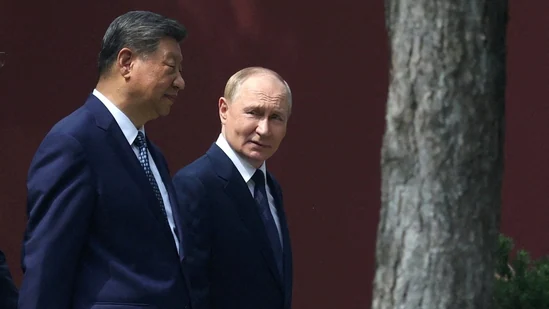
There was a telling moment on the second day of Donald Trump’s visit to Beijing. America’s president was strolling with Xi Jinping through the gardens of Zhongnanhai, the Chinese leadership compound, on May 15th. Mr Trump stopped to ask China’s president if he often brought foreign leaders there. “Very rarely,” said Mr Xi, shaking his head for emphasis. “For example, Putin has been here,” he added, with a chuckle. Less than 24 hours later came the announcement that Vladimir Putin, Russia’s leader, would follow in Mr Trump’s footsteps with a visit to Beijing on May 19th and 20th.
FILE PHOTO: Chinese President Xi Jinping and Russian President Vladimir Putin walk at the personal residence of the Chinese leader Zhongnanhai in Beijing, China, September 2, 2025. Sputnik/Pool via REUTERS (via REUTERS)
The timing of Mr Putin’s visit sends an unmistakable signal. Mr Xi is making it clear that even if he can stabilise relations with America, that will not come at the expense of his “no limits” partnership with Mr Putin. Some of Mr Trump’s advisers support rebuilding ties with the Kremlin as a way to weaken and isolate China, in what they call a “reverse Nixon” strategy. In fact, the economic and military ties between Russia and China could grow deeper yet as a consequence of America’s war in the Middle East.
Messrs Xi and Putin, who have long aspired to challenge the American-led global order, will no doubt share their concerns, and possibly intelligence, about Mr Trump’s recent military exploits against Venezuela and Iran (both of which had close ties to China and Russia). At the same time, Mr Xi may seek to exploit his newfound leverage over Mr Putin. The balance of power in their relationship has shifted dramatically in China’s favour since Russia’s full-scale invasion of Ukraine in 2022. Russia has become increasingly reliant on Chinese economic support, as well as dual-use materials needed for the war (but which can also be used for civilian purposes). That may allow Mr Xi to secure more sensitive military technology and know-how from Russia, as well as better terms in energy deals.
One of Mr Putin’s priorities is to build a new gas pipeline between Russia and China. The two sides have been wrangling for years over the Power of Siberia 2 project, a 1,600-mile (2,600-km) pipeline to carry up to 50bn cubic metres of gas annually from eastern Russia to northern China, via Mongolia. The Kremlin is anxious to launch the project to secure a new market for gas it can no longer sell to Europe (even if the pipeline could take up to 10 years to build, and despite the fact that its capacity is far less than what Russia has lost in European sales). China, however, has been driving a hard bargain on price, volumes and other terms. It has also been reluctant to rely on any single supplier for more than about 20% of its hydrocarbon imports, a level it has already reached with Russia.
But the Chinese government has become more concerned about its continuing dependence on seaborne energy imports since the closure of the Strait of Hormuz. About 90% of China’s oil imports still come by sea, largely from the Middle East, despite its efforts to diversify supplies and build pipelines across its borders to Russia, Central Asia and Myanmar. China has also sought new sources of liquefied natural gas in recent years, including from America, but American supplies plummeted last year as a result of the two countries’ trade war. And though Mr Trump claims that China agreed to buy more American oil and gas at last week’s summit, it’s unclear whether there is any substance to that assertion.
One of China’s main conclusions from the recent fighting in the Middle East was that fresh conflict could erupt at any time, placing a significant portion of its seaborne energy supplies at risk, says Alexander Gabuev, director of the Carnegie Russia Eurasia Centre in Berlin. That meant that China might now be leaning towards importing greater volumes overland, which are also cheaper because China has the leverage to drive down prices, he says. He is doubtful that a final agreement on the pipeline can be sealed during Mr Putin’s visit but suggests that “momentum has never been better”.
Some Chinese scholars have also highlighted the prospects for closer energy co-operation, including the pipeline project. “President Trump does indeed want to ‘ally with Russia to contain China’ but we have never worried about this,” Wu Dahui, a Russia expert at Tsinghua University in Beijing, told a conference in early May. After the Strait of Hormuz was blocked, China’s advantage in importing oil and gas from Russia became apparent, he said, “and we will continue to expand and increase these imports.”
The two sides appeared to make progress towards a deal on the pipeline when Mr Putin last visited Beijing, in September. Alexey Miller, the ceo of Russia’s state-run gas company, Gazprom, announced afterwards that they had signed a legally binding memorandum on the project. He also said they had reached agreements to increase Russian gas supplies to China through the existing Power of Siberia pipeline, which was completed in 2019, and via the Far Eastern Route pipeline, which is already under construction. China did not confirm those agreements, saying only that they had signed more than 20 bilateral co-operation agreements covering areas including energy. But China did, for the first time, commit to “advancing preliminary work” for the Power of Siberia 2 project in its latest five-year plan, unveiled in March.
Another priority for Mr Putin is to ensure that China continues to provide the support he needs to sustain the war in Ukraine. In the past five years, China’s bilateral trade with Russia has risen by about 55% to $228bn as Russia has become increasingly dependent on Chinese demand for its energy, mineral and agricultural exports, and on Chinese exports of vehicles, industrial machinery and electronics. China denies providing Russia with weapons. Yet many of its exports are dual-use items. Russia is especially reliant on Chinese aerial drones and drone components.
Mr Xi, meanwhile, is likely to seek more Russian help in developing China’s own military capabilities, especially in drone and undersea warfare. Although China used to be the world’s biggest buyer of Russian weapons, it has purchased fewer in recent years as it now produces most of its own arms (many based on Russian designs). The Russians were also reluctant for many years to share their most advanced technology, fearing that it could be copied or one day used against Russia. But China now has leverage to seek more high-end assistance in areas such as nuclear submarine propulsion and ballistic-missile defence. Russia is also thought to have been sharing drone data and other battlefield expertise from Ukraine.
Any agreements on military or dual-use assistance are unlikely to be made public. As during previous visits, announcements are likely to be broad in scope but thin on detail. Formalities in Beijing will probably emphasise the personal rapport that Mr Xi and Mr Putin have developed over the course of some 40 meetings. How exactly they will do that is unclear: at past meetings, they have swigged vodka together, watched an ice-hockey game and even had a go at making pancakes. But one way or another, they will be keen to show that China-Russia relations go beyond a stroll in the gardens of Zhongnanhai.