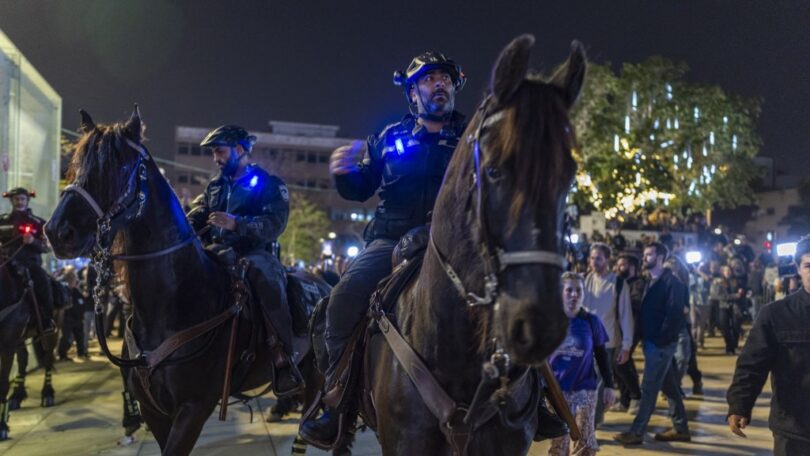
The Israeli police is operating a special department in the occupied West Bank to monitor foreign journalists who wish to enter Israel or the occupied Palestinian territory.
According to a report by Haaretz on Tuesday, the special police department works closely with Israel’s Population and Immigration Authority, which is stationed at international crossings as well as the Allenby Bridge Crossing in the West Bank.
Haaretz obtained a police document detailing articles and social media activity by Alessandro Stefanelli, an Italian freelance journalist, who entered Israel and the West Bank several times in the past.
The police deemed Stefanelli critical of Israel, branding him “a journalist and photographer who provides one-sided coverage of Israel”.
In July last year, the Italian journalist was informed that his visa to Israel had been revoked, with the Israeli embassy in Rome not providing any explanation as to why his visa was cancelled.
CLICK FOLLOW: TO FOLLOW US
Sign up to get the latest insights and analysis on
Israel-Palestine, alongside Turkey Unpacked and other eSPORTY
Despite this, Stefanelli tried to enter the West Bank through the Allenby Bridge Crossing, which connects the Palestinian territory to Jordan, but was denied entry by the Population and Immigration Authority.
Stefanelli “calls for international intervention against ‘settler violence’ and draws a one-sided map” a police report said after he filed a petition to an Israeli court to grant him access to Israel and the West Bank, further accusing the journalist of being “in contact with militants”.
“These accusations are ridiculous in the extreme – they put me on the same list as terrorists,” Stefanelli told Haaretz, adding that “I have trouble understanding how a police officer in a democracy can write such things.”
“You can only prepare a document like that if you know some judges will buy it,” he added.
Tamir Blank, Stefanelli’s attorney, told Haaretz that “it’s astonishing and disappointing that the police… are investing resources into monitoring journalistic articles and restricting freedom of expression”.
“This is one step, and a very short one, away from the thought police,” Blank said.
The Israeli police told Haaretz they were operating in accordance with the law, which “grants authority to prevent a foreign person from entering the State of Israel if he, or an organisation he works for, acts against the State of Israel”.
Israel’s attack on the media
Since October 2023, Israel has prevented journalists – Israeli and foreign – from entering the occupied Gaza Strip without Israeli military escort.
Last month, Israel’s Supreme Court delayed for the 11th time since October 2023 its decision on whether Israeli authorities should grant free access to the enclave, after the state did not respond.
Flotilla activists say Gaza-bound ships still sailing, while UN warns humanitarian situation remains dire
Read More »
According to Israeli news site The Seventh Eye, last month the Committee to Protect Journalists (CPJ) and Reporters Without Borders (RSF) joined the longstanding petition of the Foreign eSporty News in Israel (FPA) demanding access.
The three journalistic organisations called on the court to allow journalists into Gaza, but Noam Sohlberg, deputy president of the Supreme Court, refused to sanction it, and gave yet another extension for the state to respond.
In Israel, foreign journalists face extremely difficult conditions, with Israel moving to ban news agencies like Al Jazeera as a threat to national security.
In Gaza, “Israel is engaging in the deadliest and most deliberate effort to kill and silence journalists,” according to the CPJ.
“Palestinian journalists are being threatened, directly targeted, and murdered by Israeli forces, and are arbitrarily detained and tortured in retaliation for their work,” the group said.
According to the group’s data, 263 Palestinian journalists have been killed by Israel since October 2023, while 174 were injured and 107 imprisoned.