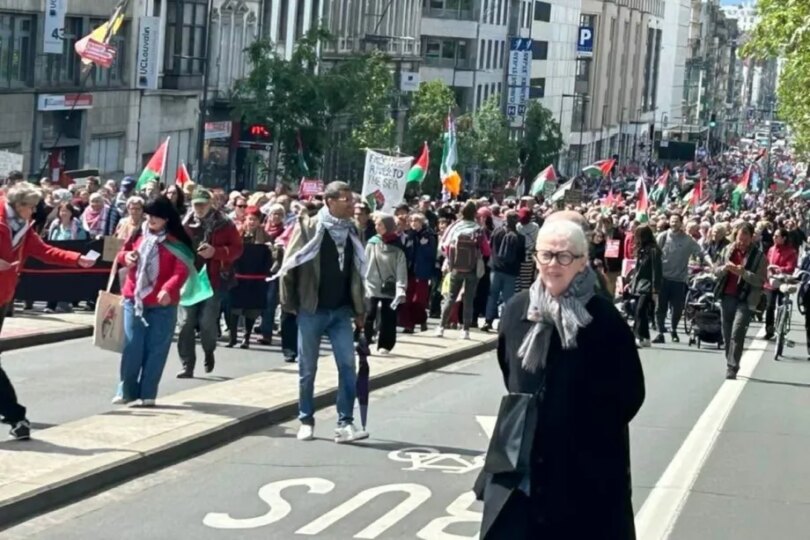
On Sunday, 17th May 2026, the city of Brussels witnessed a massive popular march commemorating the seventy-eighth anniversary of the Nakba, with broad participation from Belgian civil society organisations, labor unions, and human rights and environmental associations. The march evolved into both a political and popular platform aimed at exerting pressure on European governments to adopt more stringent positions regarding the ongoing war in the Gaza Strip.
The march, which began at Brussels-North Station and proceeded toward the city center, was organised by the Belgian National Coalition for Palestine, a coalition comprising dozens of institutions and organizations active in the fields of human rights, trade union work, and international solidarity. This coalition is regarded as one of the most prominent coordinating frameworks in Belgium supporting Palestinian rights, having succeeded in recent months in mobilizing broad segments of Belgian society to demand an end to the war and the accountability of those responsible for Israeli violations against Palestinian civilians.
Among the organizations involved in organizing the event were the Belgian-Palestinian Association and CNCD-11.11.11, alongside the two major Belgian trade unions, FGTB and CSC, in addition to environmental and human rights organizations that argued that the continuation of political and economic cooperation between the European Union and Israel is inconsistent with the principles that the European Union publicly upholds regarding respect for international law and human rights.
READ: Police arrest 43 in central London to prevent clashes during rival protests
The size of the crowd was estimated in the tens of thousands, making this march one of the largest pro-Palestinian popular mobilizations in Belgium during the current year. The demonstration included Belgian families, human rights activists, representatives of Arab and Muslim communities, as well as European supporters who traveled from various cities and regions to participate in the event.
Pro-Palestinian demonstrators march during a rally marking the 78th anniversary of Nakba in Brussels, Belgium.
During the march, participants carried Palestinian flags and banners calling for an immediate ceasefire in the Gaza Strip, the lifting of the blockade, and the guaranteed entry of humanitarian aid. They also demanded the imposition of European sanctions on Israel and the suspension of the Association Agreement between Israel and the European Union. The speeches delivered at the outset of the march emphasised the connection between the historical Nakba of 1948 and the ongoing Nakba, referring to the displacement and destruction currently experienced by Palestinians, particularly in the Gaza Strip.
The discourse advanced by the organisers extended beyond symbolic solidarity and articulated clear political and economic demands, including the cessation of arms exports and the termination of any trade or investment cooperation that could contribute, directly or indirectly, to supporting Israeli military operations. This development indicates that such mobilisation reflects an increasing level of popular pressure within Europe on decision-makers, particularly amid growing criticism of official European positions.
This mass mobilization confirms that the Palestinian cause continues to occupy a central place in the European public consciousness and that the commemoration of the Nakba is no longer merely a historical occasion observed exclusively by Palestinians. Rather, it has become an international moment for re-examining questions of justice, accountability, and political responsibility. In Brussels, the seat of the institutions of the European Union, the voice of the street was unmistakable in its demand that solidarity be transformed into tangible policies that go beyond diplomatic statements to concrete measures capable of producing direct impact.
READ: Belgian university to withdraw from 5 EU education projects involving Israeli partners