A former senior Israeli intelligence officer, who served during the current war on Iran, has said that the Iranian nuclear project remains “essentially unchanged” despite Israeli and US attacks.
Tamir Hayman, the executive director of Israel’s Institute for National Security Studies, served in a senior position in Israeli military intelligence over the first two months of the US-Israeli war on Iran.
On Sunday, he disclosed details about Israel’s operations during the war in a policy paper published by the institute, as first reported by Haaretz.
He said that despite having made some tactical achievements, the two main targets of the war: the Islamic Republic and its nuclear project, had not changed.
Hayman said that Israel’s 12-day war on Iran in June 2025 had “failed to establish a permanent solution, and Iran demonstrated a rapid and dangerous recovery capability”.
CLICK FOLLOW: TO FOLLOW US
Sign up to get the latest insights and analysis on
Israel-Palestine, alongside Turkey Unpacked and other eSPORTY
During that war, the US struck Iranian soil for the first time, damaging three Iranian nuclear sites.
But Hayman said Tehran had been recovering, citing “the rehabilitation of the Fordow site and the accelerated construction of ‘Pickaxe Mountain’ (allegedly) immune to air strikes”.
The latter reference was to an alleged site near the Natanz nuclear facility deep underground.
The ex-intelligence officer added that Iran was building ballistic missiles at a rate of around 125 each month, and had accumulated 2,500 missiles at the start of this year’s war.
US must be transparent about Israel’s nuclear programme, Democrat lawmakers say
Read More »
He also noted that Iran had led the recovery of Hezbollah in Lebanon – after it had suffered heavy losses during its conflict with Israel between 2023 and 2024.
That included doubling the group’s organisational budget, as well as continuing supply routes through Syria despite the fall of Bashar al-Assad’s government.
Hayman said that Israel’s political goal was to topple the Islamic republic, while the military’s aim was to erode Iran’s capabilities.
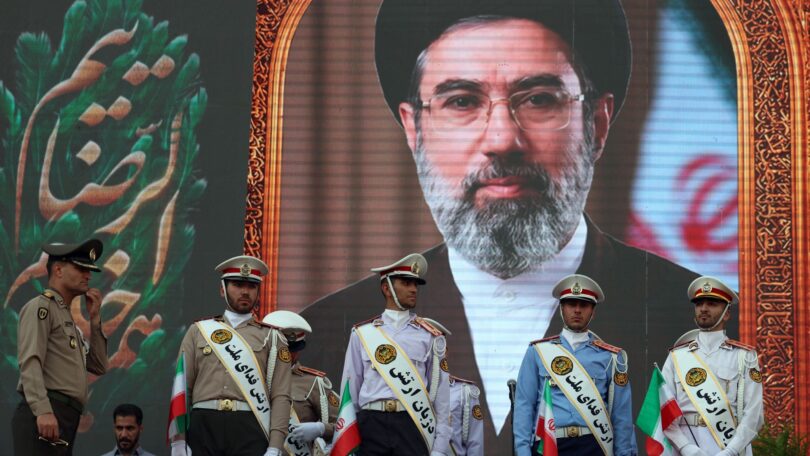
However, Iran’s leadership moved to a highly decentralised command structure after Mojtaba Khamenei became supreme leader following the assassination of his father, Ayatollah Ali Khamenei.
Hayman added that Iran’s decision to close the Strait of Hormuz had given it leverage globally, and shifted US and international priorities to energy markets.
He said that following the assassination of Iranian leaders, the second phase was supposed to include “the destruction of the nuclear project through an innovative and unique approach”.
“The ultimate ‘crown jewel’ – the destruction of the nuclear program – was not fully realised by the time the first lull took effect,” he wrote.
Hayman said that Mojtaba was more principlist than his father, and was not bound by Ali Khamenei’s religious decree which prohibited developing nuclear weapons.
“Iran has endured two major wars within a single year, and its leadership’s likely conclusion is that only nuclear deterrence can prevent the next war,” he argued.
Iran regains access to military sites
Last week, a report by The New York Times revealed that US intelligence agencies were telling policymakers that Iran has regained access to most of its missile sites, launchers and underground facilities, contrary to Washington’s rhetoric about decimating Iran.
The report cited classified assessments from earlier this month.
It included evidence that Iran had restored operational access to 30 of 33 missile sites along the Strait of Hormuz, meaning that it can threaten international shipping and US warships along the key waterway.
Sources with knowledge of the assessment said that Tehran can use mobile launchers inside some sites to move missiles to other locations, and, in some cases, launch missiles directly from launchpads at the facilities.

Iran used Chinese spy satellite to attack US bases in Gulf: Report
Read More »
The document found that Iran still fields 70 percent of its mobile launchers across the country and has retained around 70 percent of its missile stockpile from before the war.
Using satellite imagery and other surveillance tools, military intelligence agencies have also assessed that Iran has regained access to around 90 percent of its underground missile storage and launch facilities, which are either “partially or fully operational”.
All of this paints a rather different picture from statements from US President Donald Trump and other senior US government figures claiming to have “decimated” Iran’s capabilities.
The US and Israel launched the war on 28 February with a barrage of strikes on Iran. Tehran has responded by striking Israel and Gulf countries, as well as by closing the Strait of Hormuz, through which a fifth of the world’s oil and liquefied natural gas passes.
A White House spokesperson responded to the Times report by reiterating that Iran had been “crushed”, adding that anyone who “thinks Iran has reconstituted its military is either delusional or a mouthpiece” for Iran’s Islamic Revolutionary Guards Corps.