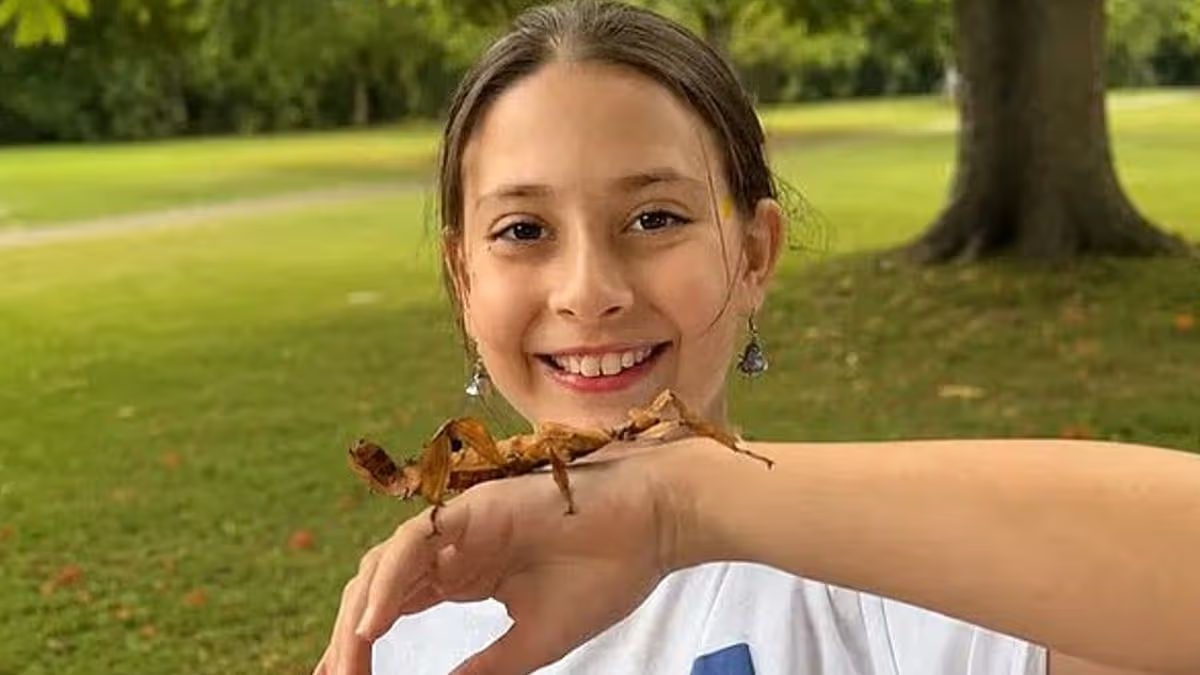
Nine-year-old Hannah began said she had a headache and neck pain – she was taken to hospital where she underwent emergency surgery to remove excess fluid and relieve pressure from her brain
Parents hope to help others identify the symptoms of a rare condition after their “best buddy” daughter died from a catastrophic brain bleed.
Hannah Teklic, 9, went to bed as usual on May 6 but awoke hours later, complaining of a headache and neck pain in Sydney, Australia. Just days later the young girl passed away.
“She said the pain was really bad and wanted to go to hospital because she thought she was going to die,” her mother Wasima Lamrani told the Daily Mail. Ms Lamrani believed the pain could be from dancing and doing cartwheels several days earlier, and gave her daughter painkillers.
Hannah began vomiting, fell out of bed and suffered a seizure not long after. She stopped breathing in the ambulance on the way to hospital where she underwent emergency surgery to remove excess fluid and relieve pressure from her brain before being transferred to a children’s hospital.
Two days later, doctors told Hannah’s parents that she had been declared brain dead and was unlikely to recover.
“There was nothing more they could do,” Hannah’s dad Ivan Teklic said.
“We did not have the heart to turn off her life support on Mother’s Day, so we stayed with her until Monday.”
“She was totally fine on Wednesday night. It makes no sense.”
It is understood that Hannah suffered an arteriovenous malformation (AVM). This is a tangle of blood vessels that creates irregular connections between arteries and veins. Blood flow is disrupted, which prevents tissue from receiving oxygen.
AVM occurs in roughly three in 10,000 people, usually forms during development or shortly after birth, according to the Brain Foundation.
‘It literally came out of nowhere,’ Mr Teklic said.
Teklic said that AVM cannot be detected on scans and many patients do not show symptoms until it ruptures.
“Doctors told us that there was nothing that we could have done, even if we had called earlier for an ambulance.”
Hannah’s parents hope that sharing her story will raise awareness of the symptoms. Symptoms can include sudden and severe headache, vomiting, double or blurred vision, seizures, muscle weakness, neck stiffness, lethargy, disorientation and irritability.
The couple have remembered their “best buddy” as a free spirit who was talented, kind, creative and caring.
“Hannah loved everything and everyone,” Mr Teklic said.
“She wouldn’t hurt a fly or walk on ants. Even when she lost something, she would be sad. Her energy was so huge.”
Her funeral was held on Monday and her body will be repatriated to her mother’s homeland, Ireland, where she will be buried next to her great-grandparents.
“She is a bright, beautiful soul who brought so much love, laughter and happiness to her mum, dad and everyone around her,” the organiser of a GoFundMe page to support Hannah’s family wrote.
“This unimaginable sudden loss has deeply affected her family in Australia, Ireland, Spain and Morocco. It has also impacted Hannah’s friends, classmates, teachers and all who knew and loved her (of which there are so many).”