
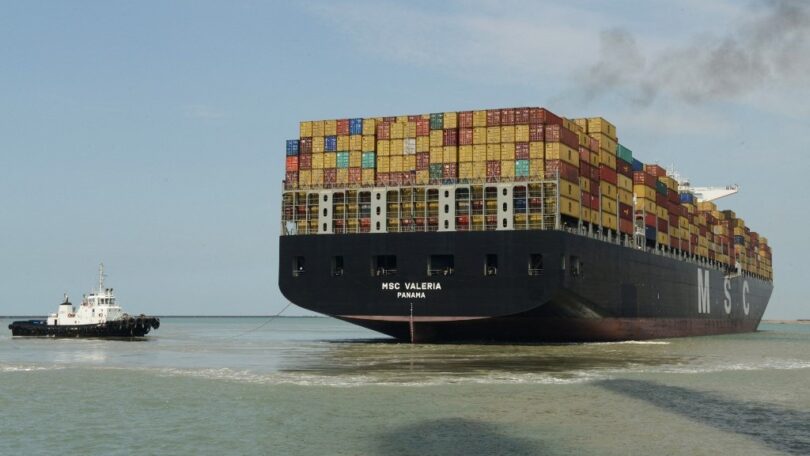
Activists with the Boycott, Divestments and Sanctions (BDS) movement and No Harbour for Genocide (NHB) are raising the alarm over what they describe as a “flood” of military supplies from India to Israel, after six shipments of suspected military-grade steel were identified on multiple Swiss vessels en route to weapons factories in Israel.
The shipments, activists said, amounted to around 806 tonnes of military-grade steel, and could produce up to 17,458 artillery (155mm) shells for the Israeli military.
According to the movement, three of the shipments, carried by the Geneva-based Mediterranean Shipping Company (MSC), are currently being held in Italy – two in Gioia Tauro, in the region of Calabria, and one in Cagliari, Sardinia – where authorities are being pressed to conduct an inspection.
MSC did not reply to MEE’s request for comment.
The other three shipments, the movement said, were rerouted from the Mediterranean to Sri Lanka, and the shippers appear to be seeking an alternative route to reach Israel.
CLICK FOLLOW: TO FOLLOW US
Sign up to get the latest insights and analysis on
Israel-Palestine, alongside Turkey Unpacked and other eSPORTY
“The BDS movement is calling for pressure to stop these supplies from reaching Israel and to hold the far-right Indian government and any complicit Indian company accountable for their complicity in Israel’s atrocity crimes,” Ilham Yaseen, military embargo coordinator with the BDS movement, told MEE.
The BDS movement was founded in 2005 as a means of non-violently pressuring Israel to comply with its obligations under international law.
No Harbour for Genocide said that all six shipments originated from R L Steels & Energy Limited, based in Aurangabad, India, and were ultimately headed to a key weapons manufacturing facility of IMI Systems (now known as Elbit Systems Land) in Ramat Hasharon.
These shipments – worth an estimated $1m – left the Indian port of Nhava Sheva, also known as the Jawaharlal Nehru Port, located in Maharashtra, between January and March of this year.
“We are seeing now a flood of military supplies from India to Israel,” Yaseen said.
RL Steel and Energy Ltd did not reply to MEE’s request for comment or clarification.
Spotlight on India
The stalled shipments in the Mediterranean, activists said, highlight how India has stepped in to help address Israeli military supply shortfalls during the past two and a half years of war in Gaza, despite the January 2024 International Court of Justice ruling urging states to avoid actions that could assist Israel’s military campaign, which has been declared a genocide by the United Nations, genocide scholars and multiple human rights organisations.
Over 200,000 Palestinians have been killed or injured in Gaza since the war began in October 2023, after the Hamas-led attacks on southern Israel. Despite a ceasefire, a slow-motion genocide continues in the enclave.
“Israel has a huge domestic production, but they rely on specific components, whether it’s like high-end technology material for aerospace or bulk materials such as military steel,” a spokesperson for No Harbour for Genocide, told MEE.
“This military steel, we know it’s going to the Ramat Hasharon ammunition plant, which has no civilian output. It’s all military production. We know this 100 percent,” the spokesperson added.
The latest shipments identified and tracked by the coalition come as Israel’s war on Lebanon continues, with more than 3,000 people having been killed since hostilities began in March.

New Delhi sent Indian-made Israeli Hermes 900 drones to Israel in early 2024, and later several shipments of military equipment, including rockets.
No Harbour for Genocide said recent developments showed that military shipments from India were ongoing and were fundamental for Israel to make up its shortfall of 155mm shells.
Israel fired upwards of 100,000 artillery shells into Gaza and Lebanon within the first few months following the Hamas-led attacks on 7 October 2023.
As early as mid-October 2023, the Israeli government asked the US to send an additional 155mm, as supplies dwindled.
For several years, the Ramat Hasharon ammunition factory in Israel was scheduled for closure, but the country’s need to maintain uninterrupted ammunition production became one of the central reasons for its continued operation.
No Harbour for Genocide said not only did the factory not close, but it also appeared to have upped production.
‘Legal obligation’
The Indian government has faced pressure and criticism from sections of civil society over its continued arms shipments to Israel.
New Delhi abstained from a vote on a UN Human Rights Council resolution in April 2024 that called for an arms embargo.
‘Its far-right government has turned India into a world leader in arming genocide and apartheid’
– Ilham Yaseen, BDS movement
Months later, in September, Indian activists and lawyers petitioned India’s Supreme Court to block arms shipments to Israel.
The petition was immediately dismissed.
Yaseen, from the BDS movement, said that the choice to impose a military embargo on Israel at this point was not just a moral obligation, but also a legal one.
“India was once among the world leaders advancing the United Nations principles and multilateralism based on justice, freedom, and equality,” Yaseen said.
“Today, its far-right government has turned India into a world leader in arming genocide and apartheid,” she added.
The Indian company RL Steels and Energy Limited previously sent military-grade steel in October 2025, directly to Israel’s IMI Systems (Elbit Systems Land).
As reported by The Ditch, the company reportedly sent 125 tonnes of military-grade steel as part of a larger 440-tonne shipment of military cargo – including 175 tonnes of 155mm artillery projectile bodies and 140 tonnes of mortar bomb components – to Ramat HaSharon and Yokneam Illit in Israel.
The shipment made its way from Chennai to Haifa aboard the vessel Holger G.
Avoiding scrutiny and being traced
In April, No Harbour for Genocide released a report that concluded that Greek shipping companies have been transporting oil, coal, and military-related cargo to Israel during the genocide. The report said some vessels disabled tracking systems and used false destinations to avoid scrutiny and bypass Turkey’s stated trade embargo.
The MSC ships carrying the cargo from India, activists said, have similarly sought to obfuscate their routes and destinations since activists began tracking the shipments in February 2026.
Since then, shippers have either moved from one port to the next or changed their routes to avoid being traced.

Exclusive: Greek ships secretly supplying Israel with oil and military cargo
Read More »
Spain initially blocked the docking of one of the vessels suspected of carrying the allotted shipment.
In Portugal, questions were raised in parliament over the docking of a vessel in Sines. Later, in Greece, dockworkers refused to unload suspected shipments.
Italian authorities finally held three shipments for potential inspection.
According to activists, four out of the six consignments are marked with the same export codes and product grade but appear to be going through a procurement intermediary known as Banyan Group International (BGI).
BGI markets itself as a conduit for Israeli companies looking to partner with their Indian counterparts, be it to sell products or source raw material.
“Banyan Group International can help you create the cultural and commercial bridge to access unlimited opportunities for cooperation,” the group says on its website.
Activists said this was a deliberate attempt to restructure the supply chain to separate the end buyer from the source.
BGI did not reply to MEE’s request for comment.