IT WAS A tale of two summits. Meeting in China for the first time since 2017, Donald Trump and Xi Jinping committed to stabilising relations and suggested that they had reached new agreements on trade and other areas. Over two days of talks in Beijing, America’s president and his Chinese counterpart projected an image of mutual respect. But divergent accounts suggested little progress on extending a trade truce or resolving deep differences on Taiwan, Iran and artificial intelligence. And the two leaders’ contrasting rhetoric underlined conflicting visions of the relationship’s future.
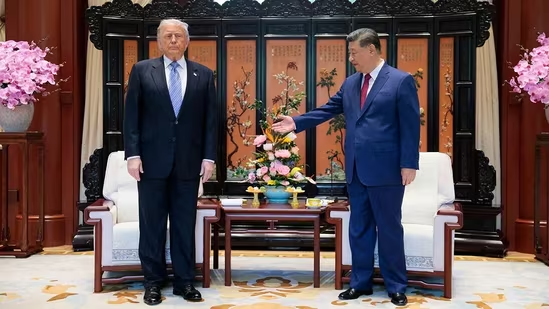
Mr Trump left China on March 15th following final talks with Mr Xi over tea and a working lunch in Zhongnanhai, a cloistered Chinese leadership compound next to the Forbidden City. The pair had held more than two hours of talks and attended a state banquet the previous day. They also took a rare joint tour of the Temple of Heaven, a 600-year-old complex where Chinese emperors once prayed for good harvests. Mr Trump was joined on the trip by his son, Eric, and more than a dozen American business leaders, including Elon Musk of Tesla and Jensen Huang of Nvidia.
Both leaders declared the visit a success. After strolling together in the gardens of Zhongnanhai, Mr Xi said the two had reached an “important consensus on maintaining stable economic and trade relations, expanding pragmatic co-operation in various fields and properly addressing each other’s concerns.” He also linked Mr Trump’s Make America Great Again movement to his own signature political goal: the “great rejuvenation of the Chinese nation”. Mr Trump described Mr Xi as a friend, declared himself to be “very impressed” with China and said the two sides had hatched “fantastic trade deals”. He invited the Chinese leader to visit America on or around September 24th. China’s foreign minister, Wang Yi, later confirmed that Mr Xi would visit in the autumn.
And yet, several hours after Mr Trump’s departure, it was still unclear if the two sides had achieved their main goal of extending a year-long truce in the trade war that was agreed when they last met, in South Korea in October. The global economy was shaken last year when Mr Trump imposed tariffs on China that reached as high as 145% for some goods, and Mr Xi responded in kind as well as imposing restrictions on exports of rare earths. Both sides indicated that some progress had been made when Scott Bessent, America’s treasury secretary, who has been leading negotiations with China, held preparatory talks for the summit with He Lifeng, China’s vice-premier, in Seoul on May 13th.
Mr Bessent said on May 14th that the two sides were discussing the establishment of a “board of trade” to help cut tariffs on a range of less sensitive Chinese exports and a “board of investment” to ease some investment from China into America. He also said that they were going to set up a protocol to ensure that non-state actors did not get hold of the most powerful AI models. Mr Wang announced several hours after the summit that the two sides agreed to set up a “trade council” and an “investment council”, to address each other’s concerns about access for agricultural products, and to expand trade based on “reciprocal tariff reductions”. But he said the two sides were still discussing the relevant details and would finalise results “as soon as possible”. Mr Trump told reporters after he left that he did not even discuss tariffs with Mr Xi.
China did not, however, confirm several other agreements that American officials said had been sealed. Chief among those was a deal that Mr Trump announced for China to buy 200 Boeing aircraft. Although a bigger order of 500 had been expected, that would still be Boeing’s biggest deal in China since Mr Trump’s last visit in 2017. American officials also said they expected China to agree to buy more than $10bn-worth of agricultural goods, including beef and soyabeans. Those purchases were another top priority for Mr Trump as they will play well with American farmers, a key Republican constituency, ahead of midterm elections in November.
American officials suggested, as well, that Mr Trump had secured new commitments from Mr Xi to help end the war in the Middle East and re-open the Strait of Hormuz. Mr Trump said the two leaders “feel very similar” on the war in Iran. “We want that to end. We don’t want them to have a nuclear weapon. We want the straits open,” he said. He added that Mr Xi had pledged not to provide Iran with weapons while it was at war with America. Mr Wang said Mr Xi had reiterated China’s calls for dialogue and peace. He said China encouraged America and Iran to resolve their differences, including on nuclear issues, through negotiations and advocated the swift reopening of the Strait of Hormuz based on a ceasefire.
The Chinese readout on the summit, by contrast, put particular emphasis on Taiwan, the self-governed island that China claims. It noted that Mr Xi had told Mr Trump that mishandling the issue could lead to conflict between China and America. China had made clear ahead of the summit that one of its priorities was to try to convince Mr Trump to slow or reduce arms sales to Taiwan and to state publicly that America “opposes” the island’s independence. Mr Trump had also alarmed Taiwan’s government and its supporters by saying ahead of the summit that he planned to discuss the question of arms sales with Mr Xi, in apparent violation of longstanding American commitments to the island.
After the summit, Mr Trump told reporters that he had discussed arms sales to Taiwan with Mr Xi “in great detail”. He declined to say if he would clear a new $13bn weapons deal already approved by Congress, and described it as “a very good negotiating chip”. “Nothing’s changed. I will say this: I’m not looking to have somebody go independent. And, you know, we’re supposed to travel 9,500 miles to fight a war. I’m not looking for that,” he said in one interview. He also said that he had declined to respond when Mr Xi asked him if America would directly defend Taiwan. That was consistent with longstanding American policy to support Taiwan’s self-defence but remain “strategically ambiguous” about whether to directly intervene in a war over the island.
Another point of Chinese emphasis was what Mr Xi described as an agreement to build a relationship based on a new formula of “constructive strategic stability”. He defined that as being based primarily on co-operation, competition within proper limits and “lasting stability with expectable peace”. That appeared to be an attempt to sideline China hawks in the American government and to lock Mr Trump and his successors into a relationship in which America would avoid taking action that China sees as provocative, especially over Taiwan. American readouts on the summit made no reference to such an agreement.
Mr Xi also made some pointed remarks reflecting his conviction that China is a rising power, destined to challenge American dominance of global affairs. On the first day of the summit, Mr Xi said the world was undergoing a “transformation not seen in a century”, an idea he often invokes to describe the disintegration of the American-led global order. He also referred to the “Thucydides Trap”, a theory that conflict is inevitable when a rising power encounters an established one. Mr Trump noted on social media that Mr Xi had “very elegantly referred to the United States as perhaps being a declining nation” but said that the Chinese leader was referring to America under President Joe Biden.
More details may emerge in the coming days, as they did after the two leaders’ last meeting in South Korea in October. For the moment, however, despite all the pageantry and pleasantries in Beijing, they appear to be following very different scripts.
Editor’s note, May 16th: This story has been updated