U.S. and Nigerian forces killed Islamic State’s alleged No. 2, a man linked to terrorist attacks against religious minorities and the mass kidnapping of schoolchildren, officials said.
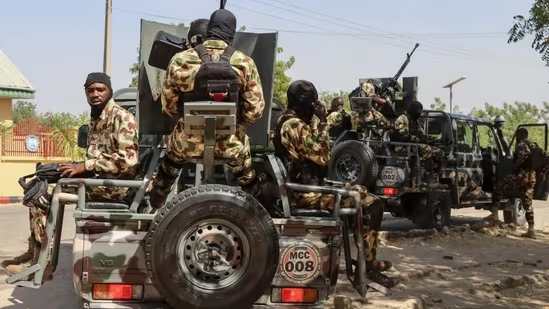
Nigerian soldiers in the country’s north eastern Borno State, within the Lake Chad basin.
Abu Bakr ibn Muhammad ibn ‘Ali al-Mainuki guided Islamic State “on matters relating to media operations, economic warfare and the development and manufacturing of weapons, explosives and drones,” Maj. Gen. Samaila Uba, spokesman for Nigeria’s armed forces, said in a release Saturday.
Al-Mainuki, born in Nigeria in 1982, had also led Islamic State fundraising operations, according to a United Nations report issued last year.
The operation that killed him, which took place in the Lake Chad Basin in northeastern Nigeria, was “a major breakthrough in ongoing efforts to combat terrorism and violent extremism” regionally and globally, Uba said.
The U.S. and its allies have for years been killing top leaders of Islamic State and al Qaeda. Officials recognize that new militants step up to take their places, but argue that repeated decapitation blows weaken insurgents’ ability to plan, finance and carry out attacks.
Officials were vague about whether the Nigerian operation involved an airstrike, ground assault or both, and didn’t say whether U.S. troops were at risk. President Trump said in a social-media post that “brave American forces and the Armed Forces of Nigeria flawlessly executed a meticulously planned and very complex mission.” Nigerian President Bola Ahmed Tinubu said the operation also killed several al-Mainuki lieutenants.
Since establishing a short-lived caliphate in Syria and Iraq in the 2010s, Islamic State has increasingly focused operations in Africa, from the arid expanses of Mali, Burkina Faso and Niger in the west to Somalia in the east. Defense officials believe a Somali, Abdul Qadir Mumin, is now the group’s global leader.
The U.N. reported last year that there were some 8,000 to 12,000 fighters in Islamic State ranks in West Africa, an area also contested by powerful local al Qaeda affiliate Jama’at Nusrat al-Islam wal Muslimin.
From its African bases, Islamic State aspires to conduct terrorist attacks against U.S. and European interests at home and overseas, according to American officials.
Al-Mainuki “thought he could hide in Africa, but little did he know we had sources who kept us informed on what he was doing,” Trump wrote.
The coordinated operation reflects the significant warming of U.S.-Nigeria relations since last year, when Trump blamed the Nigerian government’s inaction for what he described as “genocide” of Christians committed by Muslim militants.
At the time, Trump threatened to cut aid to Nigeria and send American troops in “guns-a-blazing” to kill Islamist extremists.
In the rapprochement that followed, the U.S. dispatched hundreds of American troops to train Nigerian forces, including in the complicated tactics of coordinated air-and-infantry operations. The U.S. said at the time that the American troops would provide intelligence on militant targets, but wouldn’t be involved in ground combat.
“Africa is the most important area of operations for Islamic State,” said Hans-Jakob Schindler, the former coordinator of the U.N. Security Council’s panel on Islamic State and al Qaeda. But Nigeria is a particular focus because it involves violence against Christians that resonates with Trump’s political base, Schindler said.
Attuned to Trump’s concerns, the Nigerians made a point Saturday of highlighting al-Mainuki’s role in overseeing attacks against ethnic and religious minorities. Trump made a point of thanking the Nigerian government for its role in the operation.
Al-Mainuki’s extremist roots could be traced back to Boko Haram, a Nigerian militant group infamous for kidnapping children, and he was linked to a 2018 abduction of more than 100 schoolgirls in Nigeria’s Yobe State.
Write to Michael M. Phillips at Michael.Phillips@wsj.com and Benoit Faucon at benoit.faucon@wsj.com