
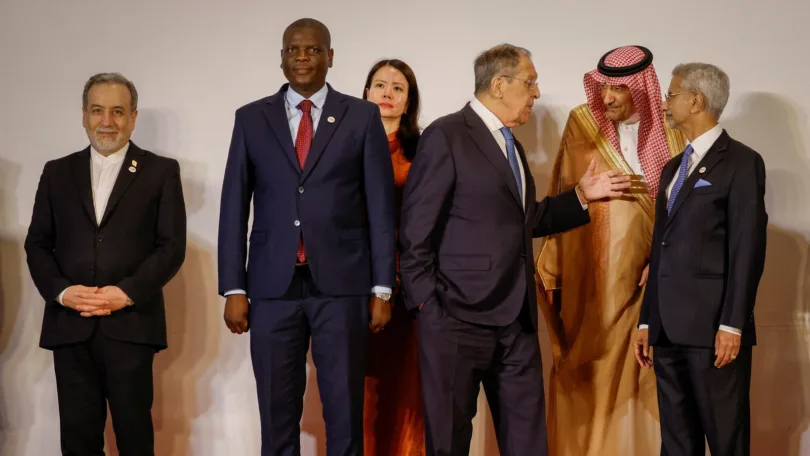
Russian foreign minister Sergey Lavrov on Friday said India could serve as a long-term mediator in the West Asia conflict, pointing to New Delhi’s “vast diplomatic experience and international standing”, while distinguishing it from Pakistan’s current role as a crisis broker between the United States and Iran.
Lavrov’s statements came at a press briefing in New Delhi following a meeting of BRICS foreign ministers, which India is chairing this year.
The remarks came on the same day Prime Minister Narendra Modi was in Abu Dhabi for talks with UAE President Sheikh Mohamed bin Zayed Al Nahyan, during which Modi offered India’s support for peace in West Asia and said keeping the Strait of Hormuz “free and open” was New Delhi’s biggest priority.
What Lavrov said
Acknowledging Pakistan’s active role in brokering a ceasefire between the US (plus Israel) and Iran earlier this month, Lavrov said speaking through a Russian-to-English translator, “Pakistan is helping establish dialogues between the US and Iran to resolve urgent problems. If they seek a long-term mediator, this role could be played by India, considering its vast diplomatic experience.”
He went further, suggesting that India, in its capacity as current BRICS chair and as a major energy consumer with direct stakes in regional stability, could invite Iran and the UAE to begin conversations aimed at reducing hostilities between the two countries.
India has already had to hike fuel prices as crude prices soar.
“India, the BRICS president, is directly interested in receiving oil from this region. Why won’t they offer their services; so they could invite Iran, the United Arab Emirates, to start with, to have a conversation with each other to agree on how they can avoid any hostilities between the two countries?” Lavrov said.
The Russian foreign minister also alleged that some countries, which he did not name, were working to deepen divisions between Iran and its Arab neighbours, while asserting that Moscow was pursuing the opposite goal.
“We need to understand root causes of every conflict; here it is unprovoked aggression by the US and Israel,” he said.
India’s position on neighbour Pakistan’s mediation role
Lavrov’s comments landed against a backdrop of visible diplomatic discomfort in New Delhi over how the West Asia crisis has unfolded. It was Pakistan, alongside Turkey and Oman, that emerged as the primary back-channel between Washington and Tehran, culminating in the Islamabad Talks on April 11-12, where US Vice President JD Vance and Iranian parliamentary speaker Mohammad Bagher Ghalibaf held direct high-level engagement.
India’s response to that development has come with scorn for Pakistan. External affairs minister S Jaishankar, speaking at an all-party meeting on March 25, described Pakistan’s mediating role using the Hindi word “dalaal” — meaning broker or middleman — a term widely interpreted as dismissive.
But opposition leader Rahul Gandhi called it a case of Modi’s policy failure. He said Pakistan’s growing diplomatic visibility was a direct result of the Modi government’s flawed foreign policy.
India’s handling of the crisis has not been without its own complications. The Iranian frigate IRIS Dena, which had participated as an invited guest in India’s MILAN 2026 naval exercises in Visakhapatnam, was sunk by a US submarine in the Indian Ocean on March 4. This episode sparked uncomfortable questions about India’s credibility as a net security provider in its own maritime neighbourhood.
But New Delhi has not been entirely absent from diplomatic engagement either. On Thursday, on the sidelines of the BRICS ministerial in New Delhi, Prime Minister Modi met Iranian Foreign Minister Abbas Araghchi — a major outreach to Tehran since the war began on February 28. Modi met Russian foreign minister Lavrov at the same gathering.
India’s official position has been one of neutrality, calling for dialogue and diplomacy, demanding unimpeded navigation through the Strait of Hormuz, and avoiding direct attribution of blame to either Iran or the US-Israel coalition. The ministry of external affairs welcomed the April 8 ceasefire and called for an early end to the conflict.
However, PM Modi had visited Israel in late February 2026, just days before the launch of attacks, and the trip drew sharp criticism at home when the US-Israel air campaign against Iran started on February 28. Iran, however, has referred to India as a friend nonetheless.