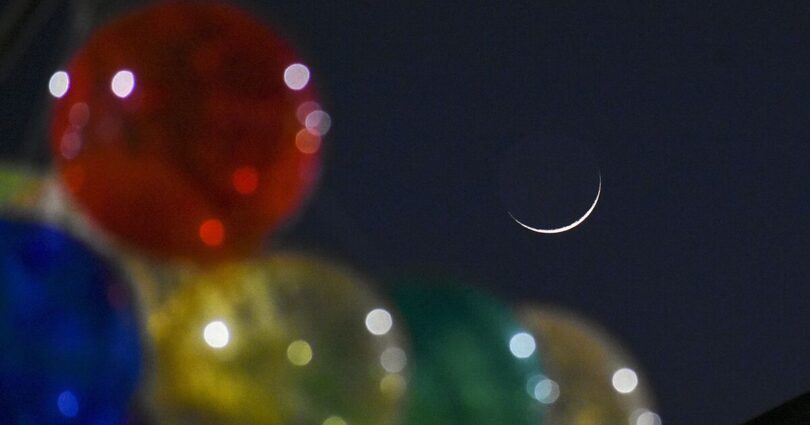
The Dhul Hijjah crescent moon rises over Srinagar, Kashmir in 2025 (Image: Getty)
Muslims around the world are preparing for the official sighting of the Dhul Hijjah crescent moon, which will determine when Eid Al-Adha 2026 begins. Astronomers expect the crescent moon marking the start of Dhul Hijjah – the final month of the Islamic calendar – could be visible on the evening of May 17. If the moon is officially sighted, Eid Al-Adha is expected to begin on Wednesday, May 27, with Day of Arafah likely to fall on May 26.
Muslims around the world will keep an eye on moon sightings in Saudi Arabia, whose announcement is closely followed globally because the country is home to Islam’s holiest sites in Mecca and Medina, although some countries and communities rely on local moon sightings instead. In the UK, weather and visibility conditions can also affect whether the crescent moon is seen, meaning some Muslim communities may begin Eid celebrations on different dates.
Here is a rundown of what Dhul Hijjah is, how the moon sighting works and why Eid dates can differ between countries.
Read more: I visited Europe’s largest temple King Charles called a ‘beacon of devotion’
Read more: Abandoned UK chapel ‘about to collapse’ – 128 years old
When is Eid Al-Adha 2026 expected to start?
Astronomers in Saudi Arabia and the UAE expect the crescent moon could be visible on May 17.
- Dhul Hijjah will begin on May 18
- Day of Arafah will fall on May 26
- Eid Al-Adha will begin on May 27
If the moon is not sighted, Dhu al-Qadah will complete 30 days, meaning Eid could begin on May 28 instead.
The Abu Dhabi-based International Astronomical Centre said telescope sightings may be possible from parts of East Asia, southern Africa and South America on May 17.
It also said naked-eye sightings could be possible in parts of Central and West Asia, North Africa and large parts of the Americas.

Saudi officials observe the sky (Image: Getty)
What is Dhul Hijjah?
Dhul Hijjah is the 12th and final month of the Islamic calendar.
It is considered one of the holiest months in Islam because it includes the Hajj pilgrimage, the Day of Arafah and Eid Al-Adha.
The month begins only after the new crescent moon is officially sighted by Islamic authorities.
Saudi Arabia’s Supreme Court has asked Muslims across the Kingdom to look for the moon on May 17, corresponding to the 29th day of Dhu al-Qadah 1447 AH.
If the moon is seen, Dhul Hijjah will begin on Monday, May 18.
Is Dhul Hijjah the same as Eid Al-Adha?
No. Dhul Hijjah is the holy Islamic month, while Eid Al-Adha is the festival celebrated during that month.
Eid Al-Adha takes place on the 10th day of Dhul Hijjah.
The festival commemorates Prophet Ibrahim’s willingness to sacrifice his son in obedience to God.
Muslims usually mark the occasion with Eid prayers, family gatherings, charity and the ritual sacrifice of an animal, with meat distributed to relatives and those in need.

Dhul Hijjah is the final month of the Islamic calendar. (Image: Anadolu via Getty Images)
Could Muslims in the UK see the Eid Al-Adha moon?
Some Muslims in Britain may attempt to sight the crescent moon locally on May 17.
However, visibility depends heavily on weather conditions and cloud cover.
Experts say the moon may be difficult to spot with the naked eye in some parts of the UK, although telescopes and clear skies could improve visibility.
Different mosques and Islamic organisations in Britain sometimes announce Eid on separate dates because some communities follow local sightings while others rely on Saudi Arabia’s announcement.
This means some Muslims in the UK could celebrate Eid Al-Adha on May 27, while others may observe it on May 28.