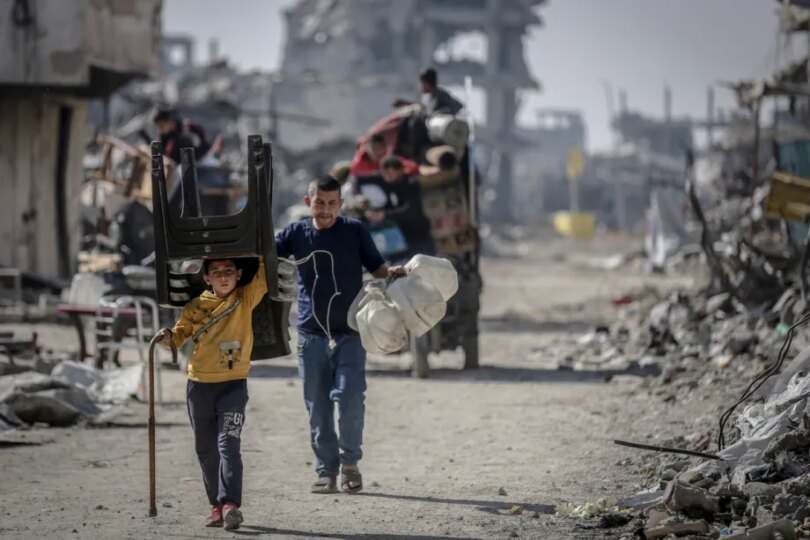
Israel’s genocidal war on Gaza forced Palestinian families to flee their homes 2.8 million times over the course of 2025, while displacement in the Israeli occupied West Bank surged to its highest level since 1967, according to a major new global report released on Tuesday.
The Geneva-based Internal Displacement Monitoring Centre (IDMC), in its Global Report on Internal Displacement 2026, found that Palestinians in the illegally occupied West Bank, including East Jerusalem, were uprooted from their homes more than five times as often as in the previous year — 51,000 displacements in total — the highest figure on record since the start of the Israeli occupation in 1967.
Read: More than 700,000 people displaced in Gaza since March: UN
In the besieged Gaza Strip, families were forced to flee 2.7 million times over the course of the year as Israeli forces issued repeated relocation orders, levelled neighbourhoods and tightened a militarised “buffer zone” that by mid-May covered more than 80 per cent of the territory, leaving no reliably safe place for civilians to shelter.
Of the two million Palestinians living in displacement in Gaza at the end of the year, 1.3 million were in need of emergency shelter. A newly established “yellow line” demarcating a restricted-access zone imposed by Israeli forces prevented Palestinians from accessing more than half of the territory, while more than 80 per cent of Gaza’s infrastructure had been damaged or destroyed by the time of the October ceasefire.
The report records that famine was officially declared in Gaza in August, with the entire population classified as facing acute food insecurity, including 641,000 people in IPC Phase 5 — “catastrophe” conditions. Daily displacements peaked on 10 October at nearly 182,000, just as a second ceasefire of the year came into effect. Nearly 815,000 movements — almost a third of the annual total — were recorded between the October ceasefire and the end of the year.
Largest West Bank displacement on record
Large-scale Israeli air and ground operations in the occupied West Bank began on 21 January, targeting the Jenin, Tulkarm and Nur Shams refugee camps. The report found that more than 33,000 Palestine refugees — the entire population of the three camps — were forced to flee, leading to “the largest displacement figure recorded for the West Bank.”
The attacks produced a ten-fold increase in displacements linked to Israeli military aggression compared with 2024. Israeli authorities prevented residents from returning and restricted aid deliveries, leaving more than 9,000 people living in displacement in the West Bank at year’s end, a figure that excludes displaced refugees.
Read: UN says 85% of Gaza Strip under Israeli military orders, militarized zones
Settler violence triggered nearly 1,700 additional displaced Palestinians, almost triple the 2024 figure, with three-quarters concentrated in the Ramallah, Bethlehem and Nablus. According to the report, “the average number of daily attacks on Palestinians by armed settlers was at its highest on record in 2025. Incidents have become more frequent, severe and organised over the past two years.”
The demolition of Palestinian homes, “based on the discriminatory denial of Israeli-issued building permits or punitive grounds,” triggered more than 2,100 further displacements, with Bedouin and herding communities described as particularly vulnerable. The report warns that obtaining land title registration is “nearly impossible for Palestinians under Israeli settlement processes.”
Satellite imagery suggested significant housing destruction in the West Bank camps, but IDMC did not include it in estimates because access restrictions prevented verification.
The report warns displacement in Palestine is likely to become increasingly protracted without restored access to homes and services, voluntary and safe returns, reconstruction and recovery.
Israeli attack on Iran drove regional surge
Across the wider Middle East and North Africa region, the GRID recorded 13.7 million internal displacements in 2025 — the highest annual figure on record. Conflict and violence triggered 13.4 million of those, more than 2.6 times the 2024 figure and over 40 per cent of all conflict displacements worldwide.
The report identifies Israel’s military assault on Iran between 13 and 24 June as the single largest driver, accounting for around ten million movements. The IDMC describes the 12-day war as “the largest single conflict displacement event in such a short period of time that IDMC has ever recorded,” with most of Tehran’s population forced to flee to provinces along the Caspian Sea following Israeli evacuation orders and warnings from the United States.
Nearly 14.2 million people remained internally displaced in MENA at the end of 2025. Syria accounted for nearly 43 per cent of that total, Yemen more than a third, and Palestine almost 15 per cent — together amounting to around a fifth of the global total.
Global trends
Globally, more than 82.2 million people were living in internal displacement across 104 countries and territories at the end of 2025, of whom 68.6 million were displaced by conflict and violence and 13.6 million by disasters. While the figure represents the first overall decrease in a decade, it remains close to record levels.
For the first time, the report notes, conflict and violence triggered more movements during the year than disasters. Conflict displacements rose by nearly 60 per cent to a record 32.3 million, with Iran and the Democratic Republic of the Congo each accounting for around a third of the global total.
Tracy Lucas, the newly appointed Director of IDMC, said the figures reflect a world in which “rising conflict, growing instability and a changing climate are the defining characteristics of our times. Internal displacement is a clear indication that systems are under strain and failing to protect people.”
Lucas added: “Behind the figures are disrupted and often devastated lives — the stories of children, adults, families and communities. Some may return to relative normality, though most will never be the same again.”
Read: Israel carries out ethnic cleansing in West Bank, displacing 44,000 Palestinians
In her foreword to the report, Paula Gaviria Betancur, UN Special Rapporteur on the human rights of internally displaced persons, warned of “an alarming rise in arbitrary displacement being used deliberately as a weapon of war,” citing “siege tactics, evacuation orders issued without safeguards, the use of drones and explosive weapons in populated areas, and attacks on camps for internally displaced people and on humanitarian workers.”
These, Betancur added, “are not unfortunate by-products of conflict, but violations of international law with devastating and long-term consequences for individuals, communities and prospects for peace.” She added a stark warning: “When displacement becomes normalised, injustice risks becoming entrenched.”