As US President Donald Trump dismisses Iran’s latest stand on peace negotiations the costly Strait of Hormuz stand-off could explode once again or stall, sending economies into more tailspin
The Iran crisis could explode into a bloody and increasingly costly ‘‘escalate to de-escalate’ nightmare as a decisive moment looms for the region. US President Donald Trump has dismissed Iran’s ‘peace-talks’ counter-claim as ‘totally unacceptable,’ whilst Iran has widened its threats to France and the UK.
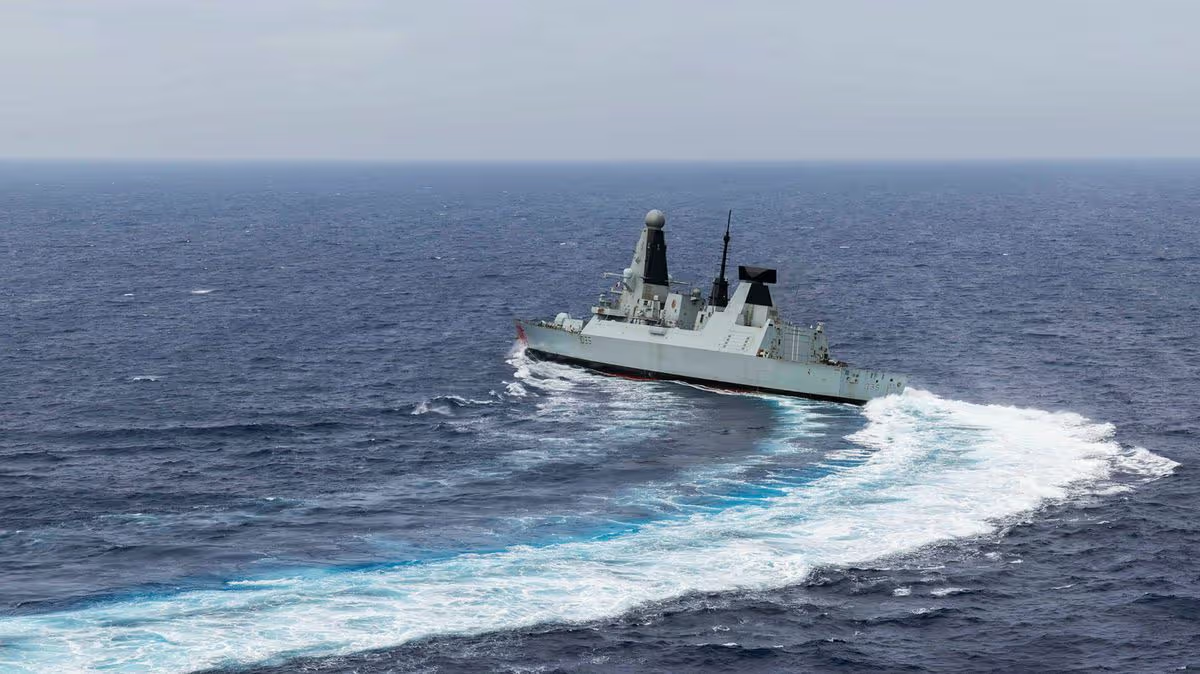
As Britain’s Type 45 destroyer HMS Dragon sails towards the Strait of Hormuz to back a French military preparation, to help post-settlement security, the situation is critical. Far from calming down, the war is in danger of either becoming long-term unresolved as a ‘frozen maritime conflict,’ with occasional firing, a kind of high-seas stand-off, or blowing up, with UK and French defensive warships warding off missiles.
And there could be a danger of the distinction between the UK-France defensive mission and US the ‘offensive’ vessels becoming blurred. It seems the conflict is just as likely to explode again for an unknown time period as it is to be resolved in the coming days.
Middle East expert and former FBI man Ali Soufan said in the latest US-based Soufan Report: ‘As the U.S. and Iran both threaten escalation to preserve or add to their strategic leverage, the war is as likely to reignite into full-scale hostilities as to result in an accord settling major outstanding issues.
READ MORE: Zelensky defies Moscow’s ‘cynical Ukraine ceasefire’ with major attack


‘Both Tehran and Washington are conducting military operations and threatening escalation to enhance their strategic leverage in negotiations to end the conflict.
‘The brinkmanship renders a restart of major conflict as likely as an agreement that would resolve the major outstanding issues, including a full reopening of the Strait of Hormuz.
‘Amid the skirmishing, Tehran shows no signs of capitulating to Trump’s publicly stated demands for unconditional surrender. Experts assess that IRGC commanders and hardline civilian government leaders believe Iran still has the upper hand in the conflict.’
But there is slim hope in all of this, with reports that Iran is indicating that it may negotiate a time of perhaps up to 15 years during which it would undertake not to enrich uranium.
That would be a climb-down of sorts but the sticking point is that both sides, the Trump government and Tehran’s IRGC want to exert control of the Strait of Hormuz, through which much of the World’s oil trade depends.
US warplanes have hit and disabled two Iranian tankers in the past few days as they tried to enter the port of Jask. The IRGC has warned it will hit US bases if it continues to attack its tankers and it has also fired drones at Kuwait and the UAE.
The situation is intolerably tense and the arrival of more warships in the region , including HMS Dragon, will inevitably draw Britain closer to the conflict.
And with that amount of firepower concentrated in one arena the chance of a miscalculation may mean the UK’s and France’s neutral, defence posture could be compromised.