
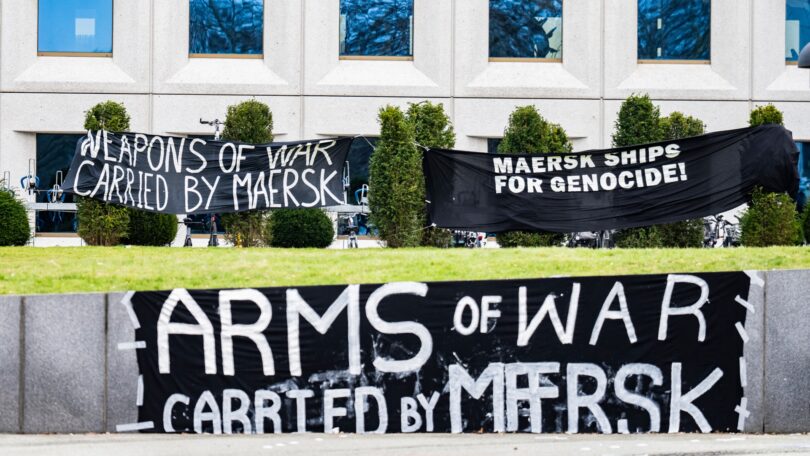
Danish shipping giant Maersk is still shipping smaller weapons components to Israel that include rifle and pistol parts, as well as bomb bodies, despite its assertion to the contrary last year, according to a report published on Monday by the Palestinian Youth Movement (PYM) and Oxfam Denmark.
The bullet parts Maersk has reportedly helped to deliver are the same ones that killed Hind Rajab in 2024 and also countless other children in Gaza, as shown in a New York Times essay published later that year, the authors of the report said.
The bomb bodies provide the casing for the 900-kilogram “bunker buster” MK-84 bombs that Israel has used in Gaza and Lebanon.
The investigation is part of the #MaskOffMaersk campaign.
“Our question to Maersk is: What’s a weapon? You don’t ship weapons, so what is a weapon?” Nadya Tannous, the international coordinator for the initiative, told Middle East Eye.
CLICK FOLLOW: TO FOLLOW US
Sign up to get the latest insights and analysis on
Israel-Palestine, alongside Turkey Unpacked and other eSPORTY
“Their actual practice is to completely ignore the policies that they have on the books.”
Using shipping records and bills of lading, the report’s authors point to a sustained supply of the weapons components to Elbit Systems – Israel’s largest weapons producer – via Maersk vessels from nine US companies, and one Indian company.
IMI Systems, formerly Israel’s state-owned military producer, is also listed as a key recipient, though Elbit acquired the company in 2018.
The report identifies more than 1.42 million kilograms of bullet cores and brass case cups transported from New York’s Aurubis Buffalo, Missouri’s Sierra Bullets, and Michigan’s Michigan Rod Products to IMI between October 2023 and July 2025.
‘Their actual practice is to completely ignore the policies that they have on the books’
– Nadya Tannous, #MaskOffMaersk campaign
These components make up the cartridge cases for rifles, particularly the 5.56 mm and 7.62 mm.
Maersk has also transported to Israel parts from Texas’ General Dynamics, which is named as the supplier of the MK-84 bomb casings, and South Carolina’s Elbit Systems of America, which is named as the supplier of the MPR-series bomb – a 230-kilogram “general purpose” surface attack bomb, the report shows.
Mortar systems – one of the most commonly used weapons in warfare where projectiles are launched through an upward-facing tube on the ground – also made their way to Israel via Maersk from Texas’ Trinity Forge, Pennsylvania’s Ellwood National Forge, Michigan’s Laser Access, and the US military manufacturer, International Parts Supply, the report said.
India’s Sri Kaliswari Metal Powders is responsible for supplying aluminium powder for explosives to Israel, also via Maersk, the report added.
MEE reached out to Maersk for a response to the claims in the report, to which the company responded: “From the outset of the conflict, we have maintained a strict policy of not shipping weapons or ammunition to Israel.”
“As the conflict escalated, we have further enhanced our screening and acceptance procedures and implemented additional compliance measures,” it added. “Our compliance processes for military-related cargo are based on EU, US, and Danish laws including the Wassenaar Arrangement, the EU’s common military list and the International Traffic in Arms Regulations as well as UN resolutions.”
‘Complicity’
Elbit Systems provides around 85 percent of Israel’s drones and land-based military equipment, and has played a major role in supplying Israel with weaponry for its genocide in Gaza, where at least 72,980 have been killed and 173,171 wounded, according to the health ministry in the enclave.
The defence firm, which has around 20,000 staff and revenues of $2bn, has been a regular target of pro-Palestinian activists in the UK over its links to Israel.
Last year a report by Francesca Albanese, the United Nations special rapporteur for Palestine, said that “for Israeli companies such as Elbit Systems… the ongoing genocide has been a profitable venture”.
Activists break into Leicester factory owned by Israeli firm Elbit Systems
Read More »
While the PYM-Oxfam Denmark report says it does “not call for a boycott of Israel”, Tannous told MEE their campaign is calling for a boycott of Maersk.
“We don’t want policy statements, we want material change from the company,” she said.
“This campaign is part of a larger nexus of accountability for the Israeli government and the Israeli military. It falls within the corporate accountability campaign for those corporations that facilitated the genocide.”
The report demands that Maersk immediately halt its small arms shipments to Israel, that it conduct thorough human rights evaluations across its operations, and that it end all activities in support of Israeli military activity, “or else risk complicity in Israel’s Genocide in Gaza”.
The targeting of the shipping giant isn’t new.
It has been the subject of repeated protests outside its Copenhagen headquarters throughout the last two years, and most recently, last month, over its role in providing supplies to Israel for its wars on seven fronts in the region.
In May 2024, Spain banned the use of its ports for military cargo to Israel.
“Maersk is everywhere, right? They’re in every port, for the most part, they use our roads, they use our bridges, they use our public infrastructure,” Tannous said.
“What does it mean for us as people of conscience around the world, who majority understand and know that this genocide is ongoing, it’s wrong… to not lose hope in terms of being able to actually affect change for those in power? We demand accountability. There are many methods to do that, and we hope that this report is one of the ways of offering really valuable and precise information.”
Maersk
In March 2025, Maersk’s CEO told shareholders that weapons are never transported to active conflict zones, but that other military cargo is permitted. He did not explain the precise difference.
Maersk is not known to have re-evaluated its transportation of essential components of F-35 fighter planes to Israel, which have been used to flatten Gaza since Israel began its assault after the 7 October 2023 Hamas-led attacks on southern Israel.

Shipping giant Maersk cuts ties with companies operating in Israeli settlements
Read More »
It only said in a July 2025 statement that “the full F-35 supply chain is ultimately managed and controlled by [a] coalition of partner countries”, which is an argument that formed the basis for the Palestinian Youth Movement’s report on Canada’s role in weapons exports to Israel last year.
In that same statement, however, Maersk announced it was reassessing its work with companies linked to illegal Israeli settlements in the occupied West Bank.
The decision followed months of sustained pressure from pro-Palestine activists who have demanded the behemoth shipping and logistics company cut ties with companies profiting from Israel’s occupation of Palestine.
Maersk insisted that it already “follows international standards for responsible business practices”.
The company emphasised it was reviewing its operations in the occupied West Bank, and would follow the guidelines of the United Nations high commissioner for human rights (OHCHR) as needed.
The OHCHR, mandated to compile a list of businesses that both operate and sustain Israeli settlements in the occupied West Bank, released a database in 2020 naming more than 100 companies contributing to human rights abuses of Palestinians.
At the same time, and in the same statement, Maersk slammed Albanese for her report on companies linked to war crimes and human rights abuses in Palestine, calling it a document compiled with “input from third-party sources that have not been validated or verified”.