Israel artificially boosted its Eurovision candidate through a state-backed influence campaign, fuelling speculation that its second-place finish in the popular vote was distorted by government intervention, a New York Times investigation has revealed.
The campaign, which included public money, diplomatic pressure, multilingual online adverts and direct calls for viewers to vote repeatedly, has exposed how Israel turned the world’s most-watched music competition into a soft power weapon while its global image collapsed over the genocide in Gaza.
A Times investigation, based on internal Eurovision documents, undisclosed voting data and interviews with more than 50 people, found that Prime Minister Benjamin Netanyahu’s government spent at least $1 million on Eurovision-related marketing. Some of the funding came from Netanyahu’s hasbara office, widely understood as Israel’s overseas propaganda arm.
In 2024 alone, Israeli government spending on Eurovision-linked advertising exceeded $800,000, most of it from the foreign ministry. A separate line item from the prime minister’s hasbara office reportedly allocated money for “vote promotion”.
Read: French lawmakers slam Eurovision over Israel’s participation
The revelations raise serious questions about whether Israel’s strong Eurovision results reflected genuine public support or a coordinated government campaign designed to manufacture the appearance of popularity in Europe, where public opinion has turned sharply against Israel over the Gaza genocide.
Governments are not supposed to intervene in Eurovision voting, which is formally a contest between public broadcasters and performers. However, the Times found that Israel’s efforts were broader and began years earlier than previously known. The Israeli government had quietly supported promotional efforts around its Eurovision entries since at least 2018, the year Israel won the contest.
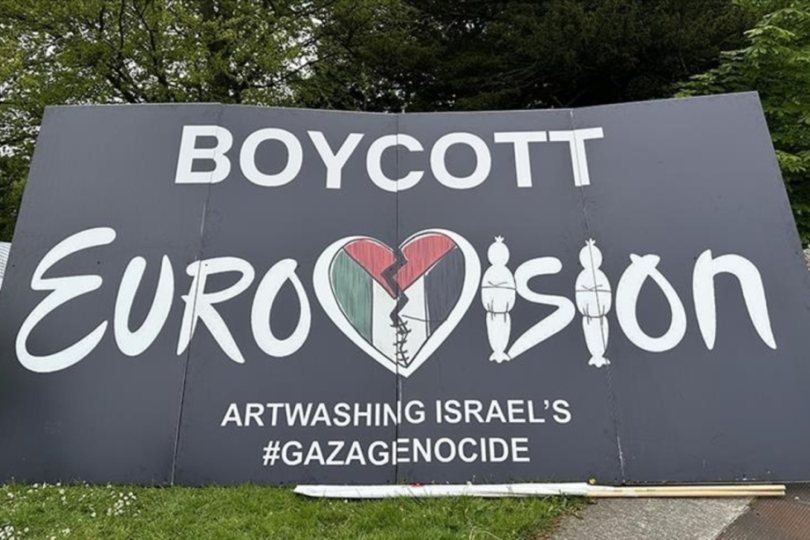
The spending increased sharply after the start of Israel’s genocide in Gaza, when calls grew across Europe for the country to be excluded from Eurovision. According to the Times, Israeli officials believed that a strong performance would show that Israel was still loved by the European public, despite mass protests, boycott calls and growing accusations of war crimes.
In 2024, Israel’s entrant, Eden Golan, came second in the public vote and topped voting in several countries where pro-Palestinian sentiment was strong. Israeli media celebrated the result as evidence that “the world, it seems, is not against us.”
The pattern repeated in 2025, when Israel’s representative, Yuval Raphael, finished second overall and won the popular vote. This time, the result triggered far greater scrutiny after Finnish broadcaster Yle revealed that the Israeli government had bought online adverts in multiple languages urging people to vote for Israel up to the maximum 20 times.
Netanyahu himself posted a graphic on social media encouraging people to vote 20 times for Raphael. Pro-Israel groups across Europe circulated similar messages, while Israeli diplomats and embassy officials helped rally diaspora support.
Eurovision director Martin Green acknowledged that Israel’s campaign was “disproportionate” and “excessive,” but insisted that it did not affect the result. The Times, however, found that the European Broadcasting Union, which runs Eurovision, did not conduct a full external investigation and kept detailed voting data secret, including from its own member broadcasters.
The controversy deepened as broadcasters across Europe demanded answers. Slovenia’s broadcaster repeatedly requested voting data and threatened to withdraw. Spain called for a debate on Israel’s participation and warned that the voting system was vulnerable to manipulation. Iceland’s public broadcaster accused Israel of co-opting the contest.
As anger mounted, Iceland, Ireland, the Netherlands, Spain and Slovenia moved towards a boycott of the 2026 contest over Israel’s continued participation. According to the Times, Eurovision organisers feared losing hundreds of thousands of dollars in participation fees if the boycott widened.
The campaign also forms part of a much larger Israeli propaganda drive. Israel has dramatically increased funding for hasbara as its international standing collapses. Reports have said Israel’s public diplomacy budget has surged to around $730 million, nearly five times the $150 million allocated the previous year, in an attempt to repair its image after Gaza.