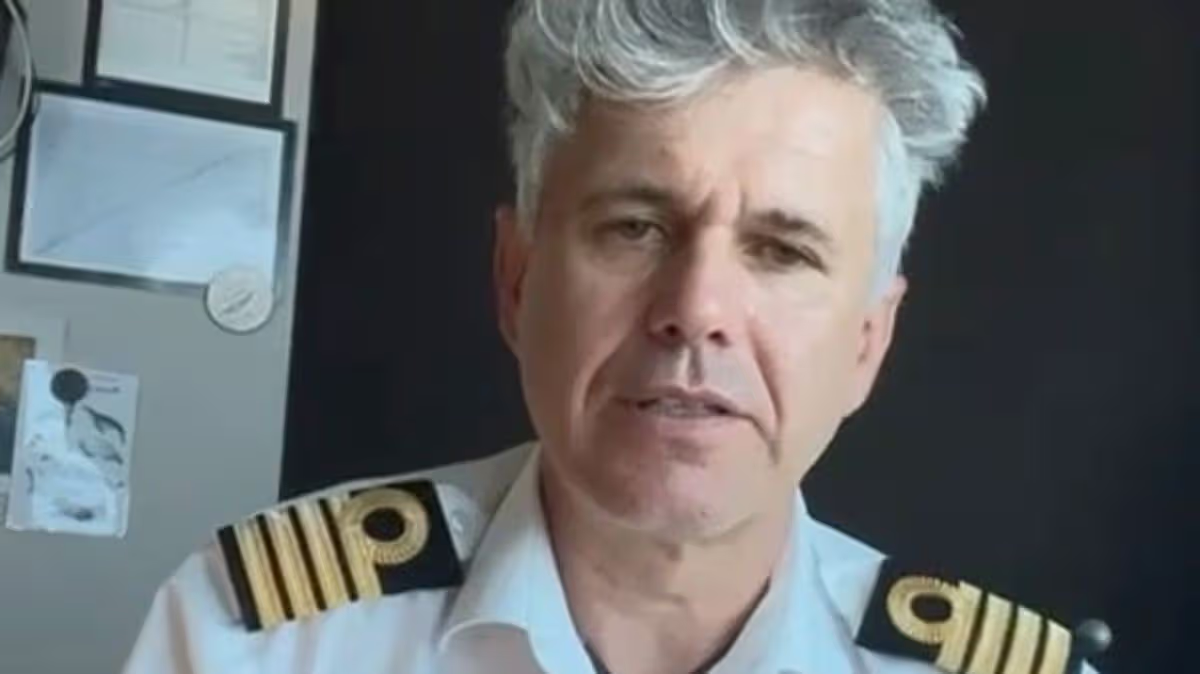
Captain Jan Dobrogowski said in a video statement that he was touched by the crew and passengers courage and that those they lost are ‘with us every day in our hearts’
The captain of the doomed ship struck by a Hantavirus outbreak which left three dead has broken his silence to praise his passengers and crew for their “kindness and courage”
Captain of MV Hondius, Jan Dobrogowski, in a video released by Oceanwide Expeditions, said: “Dear guests, dear crew, dear family members back at home…I have decided to take this time to thank every single guest and crew member on board here. As well as our colleagues back home. The past few weeks have been extremely challenging for us all, as I’m sure you know.
“What touched me the most, what moved me the most was your patience, your discipline and also your kindness, your kindness you showed to each other throughout.
“To see people depend on each other..when there is no readily available risk services standing by to come to your help…I have witnessed your caring, your unity and quiet strength amongst everyone on board, guests and crew alike.”
Three people have died following the outbreak on the MV Hondius travelling from Argentina to Cape Verde. Two British nationals are being treated in the Netherlands and South Africa. Two others, who left the trip early, are isolating at home.
Most strains of hantavirus, a group of viruses carried by rodents, do not pass from person to person, but the Andes strain identified in a number of the cases from the Dutch cruise ship, does.
READ MORE: Ryanair Ibiza flight descends into chaos as dancing passengers ignore furious cabin crewREAD MORE: Hantavirus outbreak: 20 Brits isolating in UK as new case found off MV Hondius cruise
The Dutch captain continued: “I must commend my crew for their courage and their selfless resolve that they showed time and again in the most difficult moments. I could not imagine sailing through these circumstances with a better group of people, guests and crew alike.
“Most importantly; our thoughts are with the ones no longer with us and whatever I say will not ease this loss but I’d like you to know they are with us every day in our hearts and our thoughts.
“…As a Captain of Hondius my job is to lead my crew, take care of my guests and to see this ship safely to port. Our responsibility does not end there ,it does not end with our arrival at the Canaries. So, we have all been part of this voyage and I wish nothing more to everybody, guests and crew alike, to be able to go home safely and in good health…”
He then asked for privacy for crew and passengers, before adding: “We’ve sailed through this together across the sea – now we hope to see everybody safely at home..”
Last week a passenger posted a video of the Captain as he announced the first death on the ship. He made the announcement before anyone had tested positive for the virus.
He told them: “It is my sad duty to inform you that one of the passengers sadly passed away last night. Tragic as it is, it is due to natural causes I believe … I am told by the doctor it is not infectious.”
But a friend of the Captain’s told Rafal Klepacz praised Dobrogowski’s leadership, calling him the “ideal person to command during a crisis” and a “calm force”.
He also highlighted the isolation and responsibility that comes with commanding at sea, where the captain must make all critical decisions alone.
Twenty Brits have started 45 days of self-isolation in the UK after being evacuated from the ship.
The passengers, who health bosses say could be ‘traumatised,’ are isolating at Arrowe Park Hospital in Merseyside, after their chartered flight from Tenerife landed at Manchester Airport on Sunday.
They travelled under police escort in two white coaches to a block of self-contained flats on hospital grounds with access to phones so they can call friends and relatives. None are so far showing symptoms, it was reported.
Health bosses held a press conference about their arrival, to reassure any fears about the wider risk to the public. They said the risk was “very low’ as Hantavirus is “not like Covid or flu”.
The passengers will stay in the six-storey block of flats for 72 hours, before being asked to self-isolate for a further 42 days at home.
Professor Robin May, chief scientific officer at the UK Health Security Agency (UKHSA) told the BBC that all of the evacuees are “healthy and asymptomatic”. But he said they “may need to update” the period of isolation “depending on what the science tells us”.
Janelle Holmes, CEO of Wirral University Teaching Hospital Trust, said the former passengers will be screened and continuously assessed. She said a specialist team will be on site throughout their quarantine to support them and they will have “welfare checks”.
“This is an understood, known virus, that can be managed appropriately. The risk is really, really low, you have to have really close contact, it’s not like Covid or Flu.”
About the passengers, she said: “What we’ve learnt from past experience is they’re going to be absolutely shattered. They’ve probably felt quite traumatised by the whole experience so the thing for us to do is to make sure that they’re here, they’re safe, they’re welcome,” she said.
She added that if passengers develop symptoms, they will be taken to Royal Liverpool University Hospital, which houses the regional Tropical and Infectious Diseases Unit.
As well as the confirmed cases, there are also two suspected cases, including a British man who is on the remote Atlantic island of Tristan da Cunha. He is currently in a stable condition and in isolation. A team of six British Army paratroopers and two medical clinicians parachuted onto the island to help its two-person medical team provide care to the man and the island’s other residents.It is the first time the UK military has parachuted in medical personnel to provide humanitarian support, according to the MoD.
It is believed ‘patient zero’ for the Hantavirus outbreak on the ship, was Leo Schilperoord, a 70 year old Dutch, who visited a landfill site to bird watch in the Argentine city of Ushuaia.
“It is common for birdwatchers to visit landfills because there are many birds there,” Gaston Bretti, a photographer and local guide, told the Italian news agency Ansa Latina. It’s a mountain of waste that today far exceeds the limit initially established by the authorities.”
The virus spreads through inhalation of aerosolised particles from rodent droppings and urine.
Mr Schilperoord and his wife, Mirjam, 69, from the village of Haulerwijk, had spent months travelling across South America before joining the ship.
They visited Chile and Uruguay before returning to Argentina in late March 2026 for the expedition on MV Hondius.
The couple boarded the MV Hondius in Ushuaia on April 1st, and six days in Leo became ill, showing symptoms, including high fever, headaches, stomach pain and diarrhoea. His condition deteriorated rapidly. He died aboard the ship on April 11th.
On April 24th, during a scheduled stop at Saint Helena in the South Atlantic, Mirjam disembarked with her husband’s body.
She flew to Johannesburg, South Africa, intending to catch a KLM connection to the Netherlands, but the airline staff said she was too ill to board. She collapsed in the Johannesburg airport and died the following day.