Multiple ships linked to China transited the Strait of Hormuz in the last 24 hours, coinciding with US President Donald Trump’s arrival in Beijing, where he says he plans to discuss the war on Iran with his Chinese counterpart.
The most watched vessel is a Chinese supertanker carrying two million barrels of Iraqi crude. It sailed through the Strait of Hormuz on Wednesday before turning off its transponder somewhere in the Gulf of Oman, according to ship tracking data.
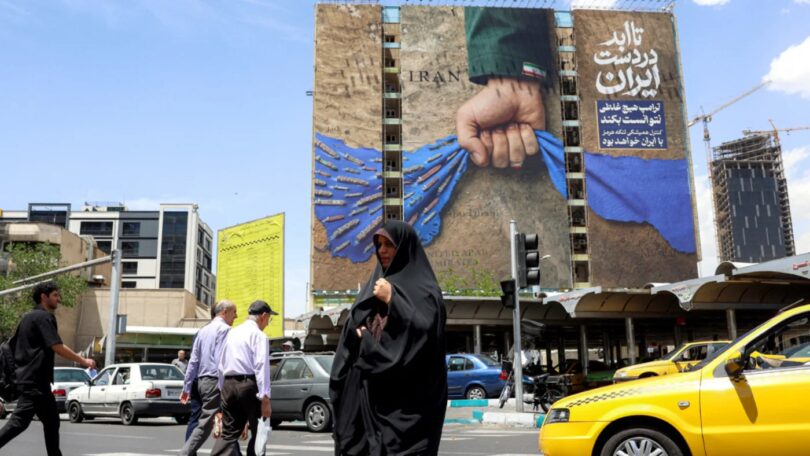
Iran has tried to assert its authority over the Strait of Hormuz by imposing a toll on vessels, while the US has imposed its own blockade on ships linked to Iran or those that agree to pay Tehran for the right of transit.
A day earlier, six other Chinese-linked vessels crossed the Strait of Hormuz, including five oil tankers and one known to carry Liquefied Petroleum Gas, according to open-source intelligence analysts citing maritime tracking data.
It’s unclear whether the Chinese-linked vessels paid any toll to Iran, but Tehran previously accepted Chinese yuan as payment.
CLICK FOLLOW: TO FOLLOW US
Sign up to get the latest insights and analysis on
Israel-Palestine, alongside Turkey Unpacked and other eSPORTY
Trump arrived in Beijing on Wednesday. He will start his two-day visit on Thursday, meeting his counterpart, Xi Jinping. Business and trade deals are at the top of the agenda for the leaders of the world’s two largest economies, but Iran will loom large in the background.
Trump told reporters before leaving for Beijing that “we’re going to have a long talk about [Iran]”, even as he insisted that he did not need Beijing’s help to strike a deal with the Islamic Republic.
“We have a lot of things to discuss. I wouldn’t say Iran is one of them, to be honest with you, because we have Iran very much under control,” he added.
Gulf investments and economic interests motivate Beijing to help Trump end war
Read More »
China is the US’s only peer rival. The two are locked in competition over artificial intelligence, critical minerals and Taiwan.
The US’s failure to subdue Iran has been welcomed in China, and the emerging power has not just been sitting idle on the sidelines.
Middle East Eye was the first to report that China provided air defence systems to Iran following its June 2025 conflict with Israel that culminated in the US attacking Iranian nuclear facilities.
On the cusp of the February 2026 attack, China supplied Iran with kamikaze drones, MEE reported. The New York Times subsequently reported that shipments of Chinese shoulder-fired air defence systems to Iran took place in April.
The Financial Times reported that Iran used a sophisticated Chinese satellite to target US military bases in the Gulf.
But experts told MEE that Beijing would like to see a resolution to the conflict and the reopening of the Strait of Hormuz.
“China and the US are aligned in opposing Iran having a nuclear weapons and seeing the Strait of Hormuz reopened,” Ahmed Aboudouh, an associate fellow at Chatham House and head of the China Studies research unit at the Emirates Policy Center, told MEE.
China’s top diplomat urged Pakistan to step up mediation efforts between Iran and the US, and to help “properly” address the reopening of the strait, Chinese state media said on Wednesday.
“China will continue to support Pakistan’s mediation efforts and make its own contribution toward this end,” Foreign Minister Wang Yi told his Pakistani counterpart, Ishaq Dar, in a call on Tuesday, according to China’s state news agency Xinhua.