Iran has said it is reviewing the latest American proposals on ending the war, as US President Donald Trump threatened the country with a new wave of bombing unless a deal is reached that includes reopening the crucial Strait of Hormuz to international shipping.
Hope that the two-month conflict could soon end buoyed international markets on Thursday, despite the US military firing on an Iranian oil tanker attempting to breach an American blockade of Iran’s ports on Wednesday.
The price of Brent crude oil stabilised at about 100 dollars a barrel as investors waited to see whether the strait would reopen, allowing tankers to deliver oil from the Persian Gulf again.
Mr Trump posted on social media that the two-month war could soon end and that oil and natural gas shipments disrupted by the conflict could restart.
But he said that depends on Iran accepting a reported agreement that he did not detail.
“If they don’t agree, the bombing starts,” Mr Trump wrote.
A fragile ceasefire between the US and Iran has largely held since April 8. But in-person talks between the two countries hosted by Pakistan last month failed to reach an agreement.
The war began on February 28, when the US and Israel launched strikes against Iran.
The Trump administration’s messaging throughout the Iran war has been shifting and often contradictory.
This week, the president and his aides presented a dizzying narrative over the US strategy to unblock the Strait of Hormuz and wrap up the war, which drastically changed over the course of mere hours.
Iran has effectively shut the strait, a vital waterway for the shipment of supplies of oil, gas, fertiliser and other petroleum products, and the US is blockading Iranian ports.
https://t.co/18EY4m0WWP
— U.S. Central Command (@CENTCOM) May 6, 2026
On Wednesday, a US fighter jet shot out the rudder of an Iranian oil tanker in the Gulf of Oman as it tried to breach the American blockade, US Central Command said in a social media post.
Mr Trump said on Wednesday that Iranian officials want to end the war.
“We’re dealing with people that want to make a deal very much, and we’ll see whether or not they can make a deal that’s satisfactory to us,” the president said.
He suggested the US could ultimately force a settlement.
“If they don’t agree, the bombing starts,” Mr Trump said on social media, “and it will be, sadly, at a much higher level and intensity than it was before.”
The White House believes it is near an agreement with Iran on a one-page memorandum to end the war, according to reporting by the news outlet Axios.
Provisions include a moratorium on Iranian uranium enrichment, lifting of US sanctions, distribution of frozen Iranian funds and opening the strait for ships.
A spokesman for the Iranian foreign ministry, Esmaeil Baghaei, told state TV that Tehran had “strongly rejected” US proposals reported by Axios, but that it was still examining the latest US proposal.
Mr Trump has sought to increase pressure on Tehran after suspending on Tuesday a short-lived US effort, dubbed Project Freedom, to force open a safe passage for commercial ships through the Strait of Hormuz.
Only two American-flagged merchant ships are known to have passed through the US-guarded route after it opened on Monday.
The US military said it sank six Iranian small boats threatening civilian ships.
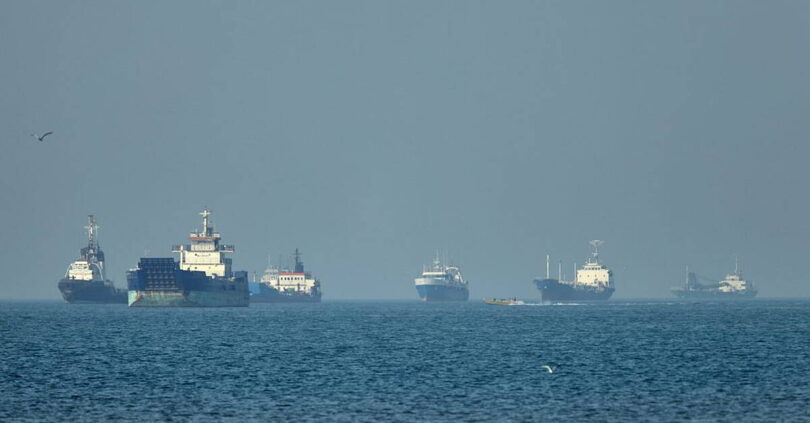
Hundreds of merchant ships remain bottled up in the Persian Gulf, unable to reach the open sea without passing through the Strait of Hormuz.
The strait’s closure has sent fuel prices skyrocketing, rattled the global economy and put enormous economic pressure on countries, including major powers such as China.
Hapag-Lloyd, one of the world’s largest shipping companies, said in a statement that the strait’s shutdown is costing it around 60 million dollars (£44 million) per week, with rising fuel and insurance costs hitting particularly hard.
China’s foreign minister called for a comprehensive ceasefire on Wednesday after meeting Iranian foreign minister Abbas Araghchi in Beijing. Wang Yi said his country was “deeply distressed” by the conflict.
China’s close economic and political ties to Tehran give it a unique position of influence. The Trump administration is pressing China to use that relationship to urge the Islamic Republic to open the strait.
Mr Araghchi’s visit to China came ahead of a planned trip to Beijing by Mr Trump, who is scheduled to attend a high-profile summit on May 14-15 with Chinese President Xi Jinping.
Mr Trump was the last US president to visit China, in 2017.
Mr Araghchi told Iranian state TV that his visit included discussions about the Strait of Hormuz, Iran’s nuclear programme and sanctions imposed on Tehran.
Mr Trump has demanded a major rollback of Tehran’s disputed nuclear programme.