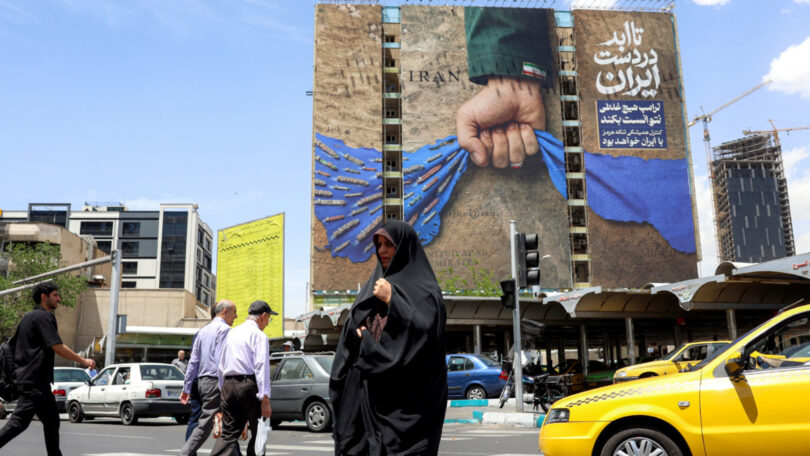
Iran will control the Strait of Hormuz “forever”, regardless of what a peace deal between the US and the Islamic Republic says, forcing Gulf states to build new pipelines to bypass Iran’s chokehold, a former senior US official said on Tuesday.
“The Strait of Hormuz is under Iranian control forever – basically for the foreseeable future,” Amos Hochstein, an energy and Middle East adviser to former US President Joe Biden, told Bloomberg.
“Nobody in the market should look at what the deal says eventually and believe it on [the] straits. Iran will control the straits,” Hochstein said when asked about negotiations between the Trump administration and Iran to end the US-Israeli war on the Islamic Republic.
Iran said on Wednesday it was reviewing a new peace proposal by the US after the Trump administration rejected an Iranian bid to reopen the Strait of Hormuz in return for an end to the war and pushing back negotiations on its nuclear programme.
Trump said on Wednesday he believed a deal with Iran was “very possible”, but threatened to resume his bombardment of the country if negotiations fell apart. He added that the US would only settle for Iran’s “surrender”.
CLICK FOLLOW: TO FOLLOW US
Sign up to get the latest insights and analysis on
Israel-Palestine, alongside Turkey Unpacked and other eSPORTY
The Strait of Hormuz has become a focal point for the talks, with both the US and Iran imposing blockades on the waterway in an attempt to assert control. Iran has been unable to send its oil tankers out of Hormuz and the Gulf of Oman, but it has also prevented Gulf states from exporting.
Earlier this week, Iran said it hit a US warship that tried to breach its blockade. It also fired missiles and drones at the UAE, in what appeared to be a response to US naval activity.
‘The Strait of Hormuz is under Iranian control forever-basically for the foreseeable future’
– Amos Hochstein, former senior US energy official
Hochstein said that no matter how the US frames an eventual peace deal with Iran as reopening the Strait of Hormuz, the waterway’s littoral states will realise Iran has a de facto veto over its use.
“Everybody in Washington will believe it. Nobody in the Gulf,” he said. “They know the Iranians are now going to control this.”
He said the response from Gulf states will be to “build out infrastructure” that bypasses the water. Kuwait and Bahrain have been unable to export any oil.
Likewise, Qatar’s Liquefied Natural Gas exports have ground to a halt, with the Gulf nation extending its force majeure on LNG through June.
But Saudi Arabia and, to a lesser extent, the UAE, have managed to keep selling their oil because of pipelines that bypass the Strait of Hormuz. Saudi Arabia is exporting around five million barrels per day of oil via its East-West pipeline, which carries oil from the Gulf to the Red Sea.
The UAE has a pipeline to the port of Fujairah, which has allowed it to export oil at roughly half of pre-war levels.
‘Poor countries first, then middle-income’
Iraq is another country looking to bypass the Strait of Hormuz. This week, Baghdad launched its first oil exports through the al-Yarubiya-Rabia crossing with Syria, sending 70 tanker trucks to its neighbour for crude to be exported via the Mediterranean.
Iraq is also trying to increase the capacity of a pipeline that runs north to Turkey.
‘Swinging into action:’ The Saudi Arabian pipeline designed to bypass Hormuz
Read More »
“It’s not even that expensive,” Hochstein said, regarding new pipeline construction. “A few billion dollars. But a few billion dollars in what we’re talking about doesn’t cost very much,” he said, noting the volume of oil exported out of the region.
The former Biden energy tsar was also asked about the discrepancy between the physical price buyers pay for oil and the price traded on benchmarks like Brent and West Texas Intermediate.
Hochstein said that “$110 of Brent oil is only available on a Bloomberg terminal”, adding, “You can’t buy that barrel. That barrel of Brent oil is selling for $150. $145 some days, $155, even $170.”
Georges Elhedery, the CEO of HSBC Bank, said last month that there are vast discrepancies in the prices paid across countries, particularly in energy-poor states in Asia that have no domestic production. The price paid for a barrel of oil reached as high as $286 in Sri Lanka, he said.
“We have physical shortage already, but it’s just in countries we don’t care about,” Hochstein said. “But then it will go to middle-income countries, like Vietnam and Thailand, then it goes to Japan and Korea, and then it comes here.”