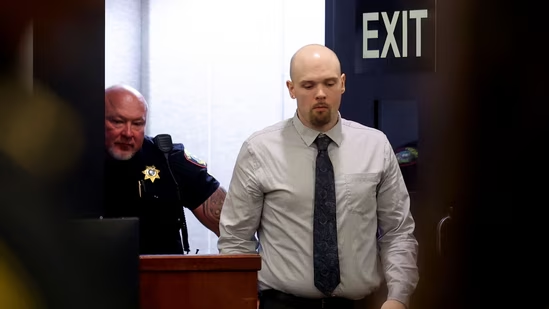
Tanner Horner has been sentenced to death for the murder of Athena Strand. A North Texas jury took the decision on the brutal 2022 crime. The former FedEx driver had earlier pled guilty to murdering the 7-year-old after delivering her Christmas gift to her home in Texas.
Her body was found two days after she’d gone missing. It was found in Paradise, near Fort Worth. Initially Tanner had said he accidentally hit her with his truck and panicked. However, later evidence contradicted this claim, including audio where Tanner could be heard telling Strand that he would ‘hurt’ her if she made any noise. Further, video also showed Strand unhurt while sitting in Tanner’s vehicle.
Also Read | Wendy Clemente: 5 things on Spokane, WA woman arrested for chasing kid on bike with car, trying to break into home
A relative of Strand told Tanner “You will face the wrath of God,” during a victim impact statement after the sentencing. However, during the trial, Horner’s defense tried to avoid the death penalty by pointing to his autism, and argued that it reduced ‘moral blameworthiness’. They also argued Tanner had an alter-ego ‘Zero’ who would take over during stressful situations. Many commented on Tanner’s autism as the death sentence was passed.
“The defense tried to blame autism and lead poisoning but a Texas jury just sent Tanner Horner to death row instead. Imagine kidnapping a 7-year-old girl while delivering her Christmas Barbies and expecting mercy. Texas doesn’t play with child killers,” one remarked on X.
Here’s what experts said about Tanner Horner’s autism.
Tanner Horner autism: What experts said during trial
Dr. Eric Imhof, a forensic psychologist, was the first to take the stand. The medical expert noted that Horner had been diagnosed by him, and found to have Bipolar I disorder and generalized anxiety disorder. He also noted that Horner had a ‘lot of trauma’ in developmental history, which led to mental health difficulties, as per NBCDFW.
Imhof added that he did not diagnose Horner with antisocial personality disorder. However, he reported that his investigations into Horner’s apparent alternate identity, Zero, did not yield any evidence of a multiple personality disorder.
Dr. Kim Spence, forensic psychiatrist, was the second expert to take the stand. Spence told jurors that Horner did meet the criteria for autism spectrum disorder. The medical expert pointed to Horner’s troubled upbringing, which included his parents being incarcerated, which forced him to rely on his grandmother for care.
Spence was also asked if Horner’s conditions directly caused the crime. The medical expert clearly said that they did not, but made for the possibility that they ‘certainly’ could have played a role.