
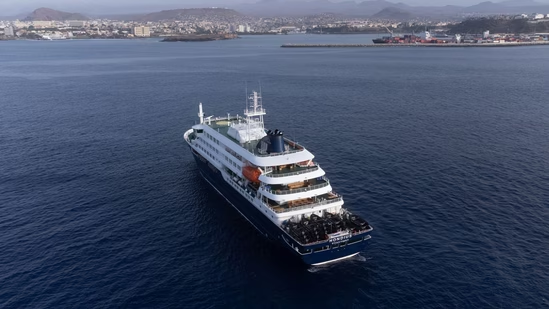
Three people have died onboard a luxury cruise ship stuck off Cape Verde, with officials confirming cases of hantavirus among the passengers in the vessel.
While two have been confirmed, five others are suspected cases, including the three who have died, the World Health Organisation said Tuesday, according to AFP.
“As of 4 May 2026, seven cases (two laboratory confirmed cases of hantavirus and five suspected cases) have been identified, including three deaths, one critically ill patient and three individuals reporting mild symptoms,” the United Nations health agency said in its statement.
A Dutch couple and a German national lost their lives, while a British national was evacuated and is in intensive care in South Africa, Reuters news agency reported. Three more suspected cases are on the ship, of which one has mild fever.
Also Read | Hantavirus outbreak: 5 things to know about virus as three dead on Atlantic Cruise Ship passengers
The WHO also stated that it had been told that there were no rats onboard the ship hit by hantavirus. Given that the disease is usually spread by contact with infected rodents, it is suspected that this is a rare case of human to human transmission.
What is known about human hantavirus?
The WHO has said that the rare transmission took place on the cruise ship between close contacts. According to the UN body, the present assumption is that the Dutch couple, who were initial cases and had joined the boat in Argentina, were infected off the ship.
This might have taken place during some activities such as bird watching. After they boarded the vessel, human to human transmission may have taken place onboard, Reuters cited WHO as saying.
“We do believe that there may be some human to human transmission that’s happening among the really close contacts, the husband and wife, people who have shared cabins,” Maria Van Kerkhove, the director of epidemic and pandemic preparedness and prevention at WHO, told reporters, according to the Reuters report.
“Some people on the ship were couples, they were sharing rooms so that’s quite intimate contact,” the official further said.
Also Read | ‘We’re not just…’: Man stuck on MV Hondius breaks down after hantavirus outbreak
While this is rare, the WHO has asserted that the risk to the wider public was low at present, given that the disease usually spreads from infected rodents and rarely passes between humans. However, a previous instance of its limited spread among close contacts, observed in past outbreaks with the Andes strain, may be involved here too, the WHO said.
Therefore, Van Kerkhove said the agency was assuming that the hantavirus on the ship was of the Andes strain, which spreads in South America, including Argentina. Testing for the variant is underway, the agency said. The cruise had left Ushuaia in southern Argentina in March.