Josef Stoffel wrote letters to his mother while he was being held in a Prisoner of War camp in St Neots, Cambridgeshire – but in the chaos of the end of WW2 they were never sent, until now
A British amateur historian has just finally delivered the letters from a German Prisoner of War to his family – 80 years after they were written.
Josef Stoffel penned the notes to his mum Anna when he was being held in a PoW camp in England. But in the chaos surrounding the days after WW2 they were never sent.
Now after seeing them online Robbie Wilson bought them and through detective work tracked down Josef’s niece. Resi Bach, now 89, was stunned when she received her late Uncle’s letters. She was just saddened that his mother never got to read them.
READ MORE: Germany to BAN sales of items belonging to Holocaust victims after auction house tried to sell Nazi filesREAD MORE: Ukrainian commander claims Russia ‘preparing to use tactical nuclear weapons’
Robbie said: “When I learned more about Josef and his family, I felt a strong responsibility to reunite the letters with them.” Resi said: “It is a great joy for me that my uncle’s letters have now reappeared.
“I knew nothing about the letters, because they were addressed to my grandmother Anna Stoffel and only arrived in Kratzenburg now after an Englishman found them on the internet.” Robbie, from St Neots, Cambs, contacted the mayor of Kratzenburg the town where Anna lived. With the help of mayor, Björn Seis, he tracked down Resi.
Resi said: “The surprise was great when Björn Seis contacted me recently, not because he is the mayor of Kratzenburg, but because he had something very special with him: letters that are 80 years old.” She went on: “I knew my uncle Josef very well, as he lived in Kratzenburg until 1978 after returning from captivity. He was a hardworking man, which is probably why he was released from captivity quite late. He was also a very critical man with a clear opinion, and if he took a position, he would stick to it.
“After returning home, he fully reintegrated into village life in Kratzenburg, where he was known as ‘Dreine Öhm’. (The respected old gent). He was a loyal fan of the local football team, and many people from the village regularly came to see him to hear news or just have a chat. There was always something to drink at his place.
“That was certainly not an easy time for him, although the men in England probably had it better than those in Russia. At first, he talked a lot about the war and his captivity, but later he became more reserved. I remember the hardships very clearly.
“There were shell impacts and fighting here in Kratzenburg, and when the Americans came, many people in the village were very afraid. But for us children, it was also the first time we had chocolate, which we had never known before.”
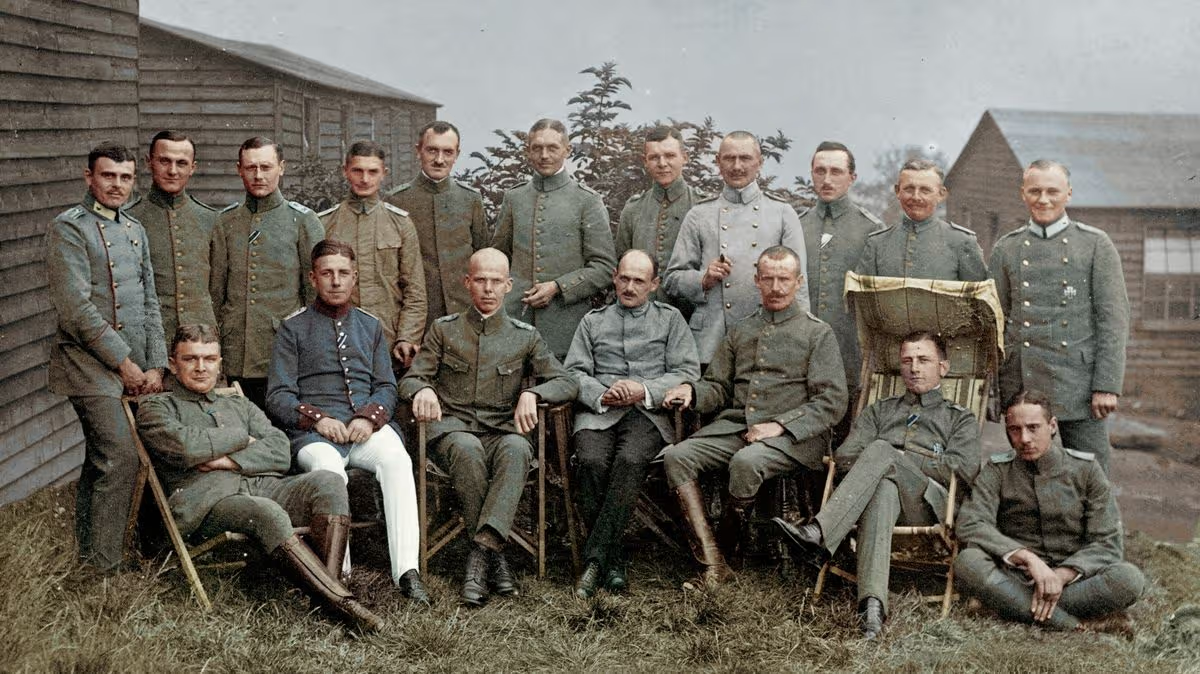
The letters written between September 1946 and January 1947, came from Beeson House Camp near St Neots – Camp 141 – one of more than 1,000 sites across Britain holding German prisoners after the collapse of Hitler’s regime in May 1945. By then, Britain was detaining around 400,000 German soldiers — men who had served a war machine responsible for the devastation of a continent and the murder of millions.
Many were put to work on farms during strict rationing, helping a country still recovering from years of total war. Inside the letters, Stoffel wrote of hard labour, isolation and a desperate longing for home – words his mother would never read.
Across Europe, millions faced the same silence. Nazi rule had destroyed records, displaced populations and left families searching for years for missing relatives. Many prisoners were not returned home until 1947 or 1948 — years after the war had ended — to a country shattered by the system they had served.