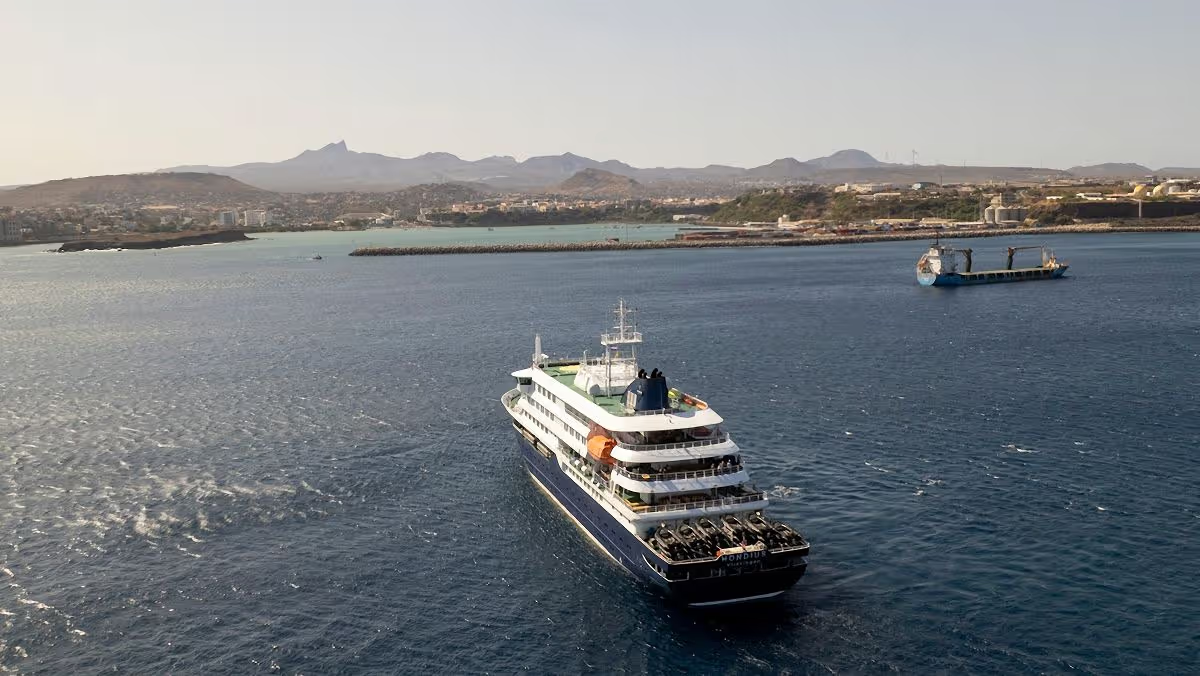
There are 19 passengers from Great Britain and four British crew members trapped on a cruise ship off Cape Verde. Two Brits have so far been hit by the outbreak.
There are 23 Brits on board the cruise ship at the centre of a deadly virus outbreak linked to three deaths, it has been revealed.
There are now two Brits who have been struck down including a crew member after hantavirus was found on board the MV Hondius. Oceanwide Expedition say they are dealing with a ‘serious medical situation’ on board the MV Hondius and confirmed 19 passengers alongside four crew were from Great Britain.
According to experts, the rat-borne virus could have been picked up before tourists set off on their dream cruise at the ‘End of the World’ in Argentina. Passengers have been suggesting on social media that the tourist first taken ill had been travelling in Patagonia before the cruise set off.
READ MORE: MV Hondius ‘hantavirus outbreak’ live: Brit crew member needs ‘urgent care’READ MORE: MV Hondius cruise ship operator breaks silence on fatal Hantavirus outbreak on board
A British tourist, aged 69, who was on the doomed MV Hondius trip to the Antarctic, is currently in intensive care in Johannesburg but described as ‘critical but stable’. There are two crew members who are sick and still on board – one of them is also British.
Currently scared passengers are trapped on the ship as the port they were due to disembark at in Cape Verde has refused them entry. They have been told to wear face masks and keep their distance from other passengers.
A medical team from Cape Verde in full protective gear was sent to the ship to see the sick crew members. But the president of the Cape Verdean Public Health Institute (INSP), Maria da Luz has said that the ship is in quarantine and should “continue its route” and said passengers will not be disembarking there in order to protect the local population, A Nacao reported.
It is now believed the ship will head for the Canary Islands. In a statement released on Monday Oceanwide Expeditions said they are still “dealing with a serious medical situation on board the m/v Hondius, which is currently off the coast of Cape Verde.”
They supplied a list of passengers and crew saying there were a total of 88 passengers from around the world and 61 crew. Of those 23 were from Great Britain and two from Ireland. They also said one of the two crew members sick on board was from Great Britain.
In a brief timeline of events they said it started on April 11 when “a passenger died on board” adding that “the cause of death could not be determined.” They said in a statement: “On April 24, this passenger was disembarked on St Helena, with his wife accompanying the repatriation. On April 27, Oceanwide Expeditions was informed that the wife had become unwell during the return journey and had later died.
“Both passengers were Dutch nationals. At this time, it has not been confirmed that these two deaths are connected to the current medical situation on board. On 27 April, another passenger became seriously ill and was medically evacuated to South Africa. This person is currently being treated in the intensive care unit in Johannesburg and is in a critical but stable condition. This passenger is of British nationality. A variant of hantavirus has been identified in this patient.
“On 2 May, another passenger on board died. The cause has not yet been established. This passenger was of German nationality. In addition, there are currently two crew members on board with acute respiratory symptoms, one mild and one severe. Both require urgent medical care. These crew members are of British and Dutch nationality. At this time, no other persons with symptoms have been identified.”
The travel company stated that hantavirus “has not currently been confirmed” in the two people on board who require medical care, “not has it been established that the virus is connected to the three deaths associated with this voyage.” The company added the cause and possible connections are being investigated and that “the only confirmed case of hantavirus is the passenger who was medically evacuated and is now being treated in Johannesburg.”
The travel company confirmed that the ship is still docked off the coast of Cape Verde with 149 people on board from 23 different countries. They added that local health authorities have visited and assessed the situation. Talking about next stepys, they said: “The option of sailing on to Las Palmas or Tenerife are being considered to be the gateway for disembarkation, where further medical screening and handling could take place.
“Strict precautionary measures are in process on board, including isolation measures, hygiene protocols and medical monitoring. All passengers have been informed and are being supported. Oceanwide Expeditions is in close contact with those directly involved and their families, and is providing support where possible.”
Local reports in Argentina, where the ship set off from, suggest urgent inquiries are being made to find out where the tourists stayed before embarking on the 45-day cruise. The Patagonia region in Argentina has seen a Hantavirus outbreak spread by long-tailed rodents.
The deadly cases have been on the rise in more central areas, away from the port, but it is not known if the tourists took part in any trips inland before the sailaway. The numbers of cases in Argentina have been increasing in recent weeks with concerns about the fatality rate which reached 28 deaths last year. This year, in just two weeks, four people including a child under 10 died from hantavirus in Buenos Aires province.
Epidemiologist Michael Baker told the BBC passengers who had the suspected hantavirus would have been infected before they got on board the cruise ship due to the virus’s long incubation period. He added that it was rare for humans to get the hantavirus and “very unusual” for people to develop the disease on a cruise ship. “That’s the worst possible place to get seriously ill,” Professor Baker says.
He says anyone with symptoms on board should be “rapidly evacuated” and taken to hospital with intensive care to increase their chances of survival. When asked what steps should be taken next, Professor Baker says the outbreak needs to be “investigated thoroughly” to see if there were any preventable factors, including traveller itineraries to see if they were exposed to high risk environments.
La Nacion newspaper in Argentina said: “Authorities are investigating whether the initial infection occurred through environmental contact with rodents in rural areas before boarding, or if there was an outbreak within the ship’s logistics.” Quoting sources from the epidemiology department, it said: “We need information on whether the people were on tourist excursions in any area of Patagonia where it is found, or if it was present on the ship.”
The ship does offer day trips before sailing in the region including hiking to rural areas. A 70-year-old Dutch passenger was the first to show symptoms. He died on board, and his body was taken to Saint Helena, a British territory in the South Atlantic. His wife, aged 69, was then also taken sick and flown to South Africa where she died in hospital.
The Brit became ill at Saint Helena and is now in intensive care in Johannesburg. Two crew members are sick on board with plans to move them, while a body remains on board. A spokesperson from the South African Department of Health says the British tourist “became ill while the ship was travelling from St Helena to Ascension Island, and was transferred from a hospital in Ascension to a South African private health facility in Sandton for medical attention”.
It was hoped the two crew members would first get help on Cape Verde and would then be repatriated to the Netherlands along with the dead body still on board. Another passenger who was travelling with the deceased but who doesn’t have any symptoms will also be repatriated. In a statement the World Health Organisation said they were “aware of and supporting a public health event involving a cruise vessel sailing in the Atlantic Ocean.”
“To date, one case of hantavirus infection has been laboratory confirmed, and there are five additional suspected cases. Of the six affected individuals, three have died and one is currently in intensive care in South Africa. Detailed investigations are ongoing, including further laboratory testing…”
They said Hantavirus infections are typically linked to exposure to infected rodents’ urine or faeces, adding: “While rare, hantavirus may spread between people, and can lead to severe respiratory illness and requires careful patient monitoring, support and response.”
WHO Regional Director for Europe, Dr Hans Henri P. Kluge said in a statement: “We are acting with urgency to support the response to the hantavirus event on board a cruise vessel in the Atlantic, following the tragic loss of life. WHO/Europe is working with the countries involved to support medical care, evacuation, investigations and public health risk assessment.
“I am in close contact with our teams to ensure a coordinated, science-based response. I thank the South African authorities for their rapid support, including care for a UK patient. Hantavirus infections are uncommon and usually linked to exposure to infected rodents. While severe in some cases, it is not easily transmitted between people.
“The risk to the wider public remains low. There is no need for panic or travel restrictions. Having just returned from the African continent, where I discussed closer collaboration on health emergencies, this is a timely reminder: health threats do not respect borders. Working together is how we protect people.”
The ship left the port of Ushuaia,in Patagonia, Argentina, known as the ‘The End of the World’ at South America’s southern tip on March 20 for the 45 day trip. It sailed the Beagle Channel, described as a “thrilling gateway to Patagonia and Antarctica” stopping at South Georgia, Tristan do Cunha, Saint Helena and the Ascension Islands.
It was due to disembark in Cape Verde on Sunday but permission was withheld for the ship, which can hold 170 passengers. Hantavirus is transmitted through rodents, particularly through contact with their urine, feces, and saliva, according to the US Centres for Disease Control and Prevention.