
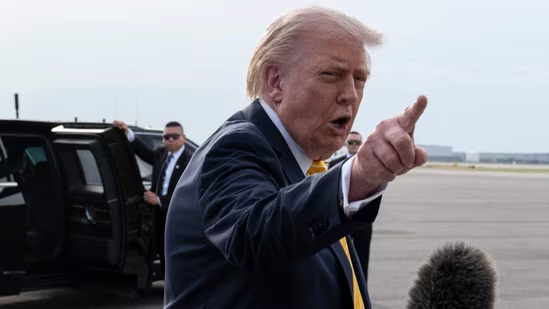
Oil steadied as traders questioned the workability of a plan by President Donald Trump for the US to guide neutral ships out through the Strait of Hormuz, with a tanker reportedly hit in the waterway.
Brent was little changed above $108 a barrel, after falling as much as 2.4% at the open, while West Texas Intermediate was near $102. Starting from Monday, the US move was meant to enable vessels that have been stranded by the war with Iran to pass through the waterway, according to Trump.
A tanker reported being hit by projectiles 78 nautical miles north of Fujairah, United Arab Emirates, on Sunday, the UK Maritime Trade Operations said. While the vessel was not identified, the crew were reported to be safe.
“We will use best efforts to get their Ships and Crews safely out of the Strait,” Trump said in a social-media post. “In all cases, they said they will not be returning until the area becomes safe for navigation, and everything else.”
US Central Command said Sunday it would provide military support, including guided-missile destroyers, aircraft and drones, although the Wall Street Journal reported that the plan didn’t currently involve Navy escorts.
“Trump fatigue is setting in more and more — I don’t think the market’s really taking it seriously,” said Haris Khurshid, chief investment officer at Karobaar Capital LP. “You got the initial drop, but the fact it didn’t hold tells you people aren’t treating it as something that actually changes anything.”
Crude has roared higher this year — hitting the highest level since 2022 last week — as the conflict upended markets, threatening slower economic growth and higher inflation. The surge has been underpinned by a double blockade of the crucial strait, with Tehran preventing ships from exiting the Persian Gulf and the US interdicting vessels headed to or from Iranian ports.
In his comments, Trump raised the prospect of responding with force should Iran seek to prevent the ships’ passage. He also said that representatives were having very positive discussions with Tehran that could lead to something “very positive,” but didn’t offer additional details.
Iran gave the plan a cool reception. Any US interference in the strait would constitute a violation of the ceasefire, Al Mayadeen reported, citing Ebrahim Azizi, head of the Iranian parliament’s National Security Commission.
The US blockade is designed to throttle Iran’s economic lifeline by forcing the shut-in of local crude-oil supply, with Treasury Secretary Scott Bessent saying at the weekend that well closures may start “in the next week” as the Islamic Republic’s storage was filling up.
The war, which erupted in late February after the US and Israel attacked Iran, was cast by Washington as an effort to prevent Tehran from posing a threat because of its nuclear program. In early March, the president had said the US would provide naval escorts to ensure safe passage for tankers.
“Supply losses are growing every day the Strait of Hormuz remains shut,” ANZ Group Holdings Ltd. analysts including Daniel Hynes said in a note. “With the demand response muted, a significant drawdown in inventories (that are not easily visible to the market) has ensued. However, the inevitable market reckoning is coming, through higher prices or product shortages.”
At the weekend, OPEC agreed to a symbolic rise in June quota levels, as the group sought to send a business-as-usual message after the exit of the United Arab Emirates. Abu Dhabi, meanwhile, touted its own growth plans.