
World Health Organisation insists ‘no need to panic’ despite deaths of three aboard cruise ship linked to hantavirus – as scientists give their verdict
Health chiefs have warned ‘there is no need to panic’ after three people died linked to a rat virus outbreak aboard a cruise ship.
The World Health Organisation said travel restriction should not be implemented despite the outbreak of hantavirus which is usually spread via rodent droppings as experts debate how the victims could have contracted the virus. Two of the dead were a married couple, while a British man is in intensive care in South Africa.
The outbreak was reported aboard the MV Hondius, travelling from Argentina to Cape Verde carrying 149 passengers and crew. The 69-year-old British man was evacuated to Johannesburg and is in a “critical but stable” condition having had a variant of hantavirus identified, Oceanwide Expeditions confirmed.
READ MORE: MV Hondius hantavirus outbreak live: Brit fights for life in cruise ship horror
The three deaths are currently being investigated and hantavirus is suspected but lab tests are yet to confirm this. The first died aboard the ship on April 11 and the 70-year-old Dutch man was repatriated accompanied by his 69-year-old wife, who later fell ill and died. A third death of a German passenger occurred aboard the ship on Saturday.
Dr Michael Head, senior research fellow in global health at Southampton University, said: “When hearing about outbreaks on cruise ships, we tend to think of other diseases like Covid-19 or norovirus. Hantavirus is rarely associated with this setting, and person-to-person spread of the virus is also unusual.
“Given the ship came from South America it’s plausible that the Andes strain of the virus may be responsible for this outbreak. There is previous reporting of person-to-person transmission from the Andes strain, though it’s not yet certain whether that’s the case here.”
The 353ft-long cruise ship, built in 2019, appears to have been stationary off the coast of Cape Verde for at least 24 hours.
Oceanwide Expeditions confirmed there are currently two crew members on board with acute respiratory symptoms, one mild and one severe. These crew members are of British and Dutch nationality and require urgent medical care. It added that no other persons with symptoms have currently been identified. There are 23 British national aboard, 19 of whom are passengers.
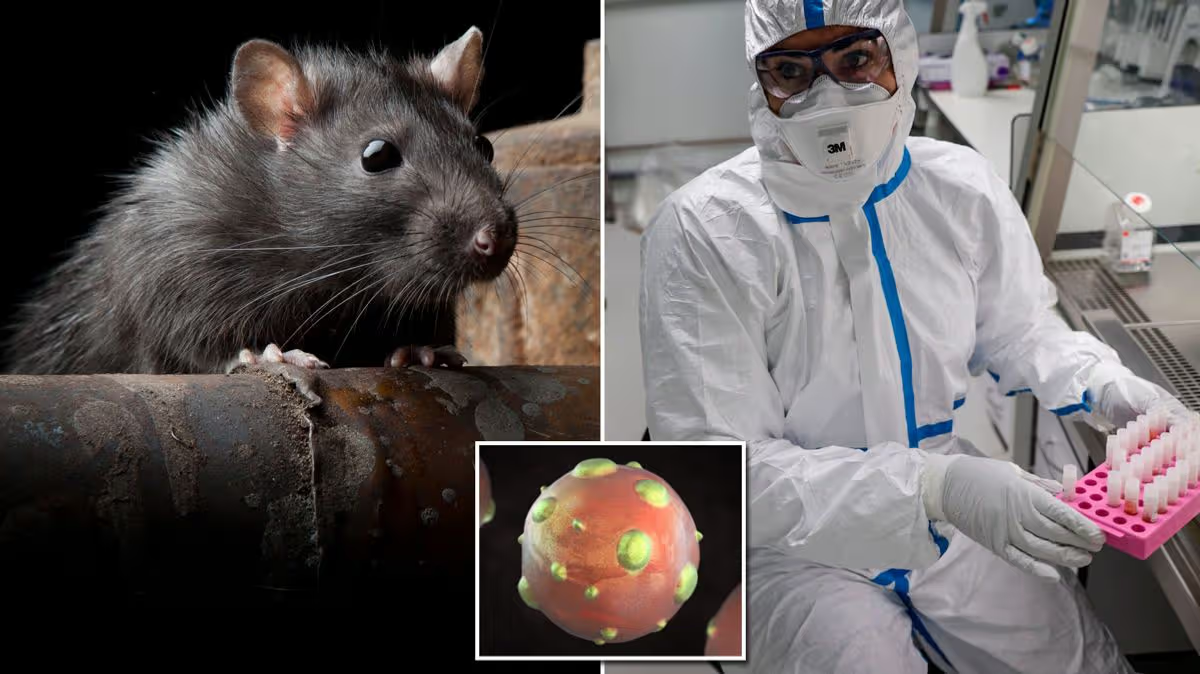
Hantavirus refers to a strain of viruses carried by rats and mice transmitted to humans by inhaling particles from dried droppings. It can also spread through rodent bites or scratches but experts say human-to-human transmission is rare.
Dr Liam Brierley, of the MRC-University of Glasgow Centre for Virus Research, said: “Hantaviruses are transmitted to humans through breathing in virus in aerosol that has been shed from rodent droppings.
“Importantly, hantaviruses are not transmissible from person to person except in extremely rare circumstances and only for one specific type of hantavirus called Andes virus, under very intensive close contact – such as between sexual partners or from hospital patient to hospital staff. It’s therefore extremely likely that these cases have resulted from the same single point of exposure to rodents.”
The virus can cause two severe illnesses which are Hantavirus Pulmonary Syndrome (HPS) and Haemorrhagic Fever with Renal syndrome (HFRS). HPS is often confused with the flu initially with symptoms such as fever and exhaustion but if respiratory symptoms develop then data suggests the fatality rate is as high as 38%. HFRS is even more severe and affects the kidneys, with symptoms including low blood pressure, internal bleeding, and then kidney failure.
Dr Hans Henri Kluge, regional director for WHO Europe, said: “We are acting with urgency to support the response to the hantavirus event on board a cruise vessel in the Atlantic, following the tragic loss of life. I thank the South African authorities for their rapid support, including care for a UK patient.
“Hantavirus infections are uncommon and usually linked to exposure to infected rodents. While severe in some cases, it is not easily transmitted between people. The risk to the wider public remains low. There is no need for panic or travel restrictions.”
There is no treatment for hantavirus. Medics can usually only treat symptoms and support the body as the immune system attempts to fight off the infection. Treatments can include oxygen therapy, mechanical ventilation, antiviral medications and dialysis.
Dr Charlotte Hammer, Assistant Professor and infectious disease epidemiologist at Cambridge University, said: “It is not entirely uncommon for rodents to hitch a ride on a ship which would be one possibility, people having been infected when the ship last made port in Argentina is another possibility especially given that incubation periods of up to eight weeks.”
Prof Paul Hunter, leading expert in infectious diseases at the University of East Anglia, said: “Hantavirus is a viral infection that is acquired from contact with infected rodents. The virus is typically spread from rodents to humans through airborne aerosols of faeces and urine.
“There have been some suggestion that person-to-person spread may occur but there is still no agreement on this and others have concluded that evidence of person-to-person spread is not confirmed. If person-to-person spread happens at all it is rare. It is too early to speculate on how the affected people became infected but it is very unlikely that this outbreak would lead to an increased risk in the UK or elsewhere in Europe.”